
Haemul pajeon is a Korean savory pancake made with green onions and seafood such as squid, shrimp, mussels, or other available ingredients. The mixture is cooked in a pan until the exterior develops golden, crisp areas while the inside remains softer and filled with green onion and seafood.
For international visitors, “Korean seafood and green onion pancake” is a useful description. However, haemul pajeon belongs to the much broader Korean jeon tradition, which includes many pan-cooked foods made with different vegetables, seafood, meat, kimchi, and other ingredients.
Haemul pajeon is also connected with a familiar Korean food-cultural association: eating pajeon on a rainy day, often discussed together with makgeolli, a traditional Korean rice-based alcoholic beverage.
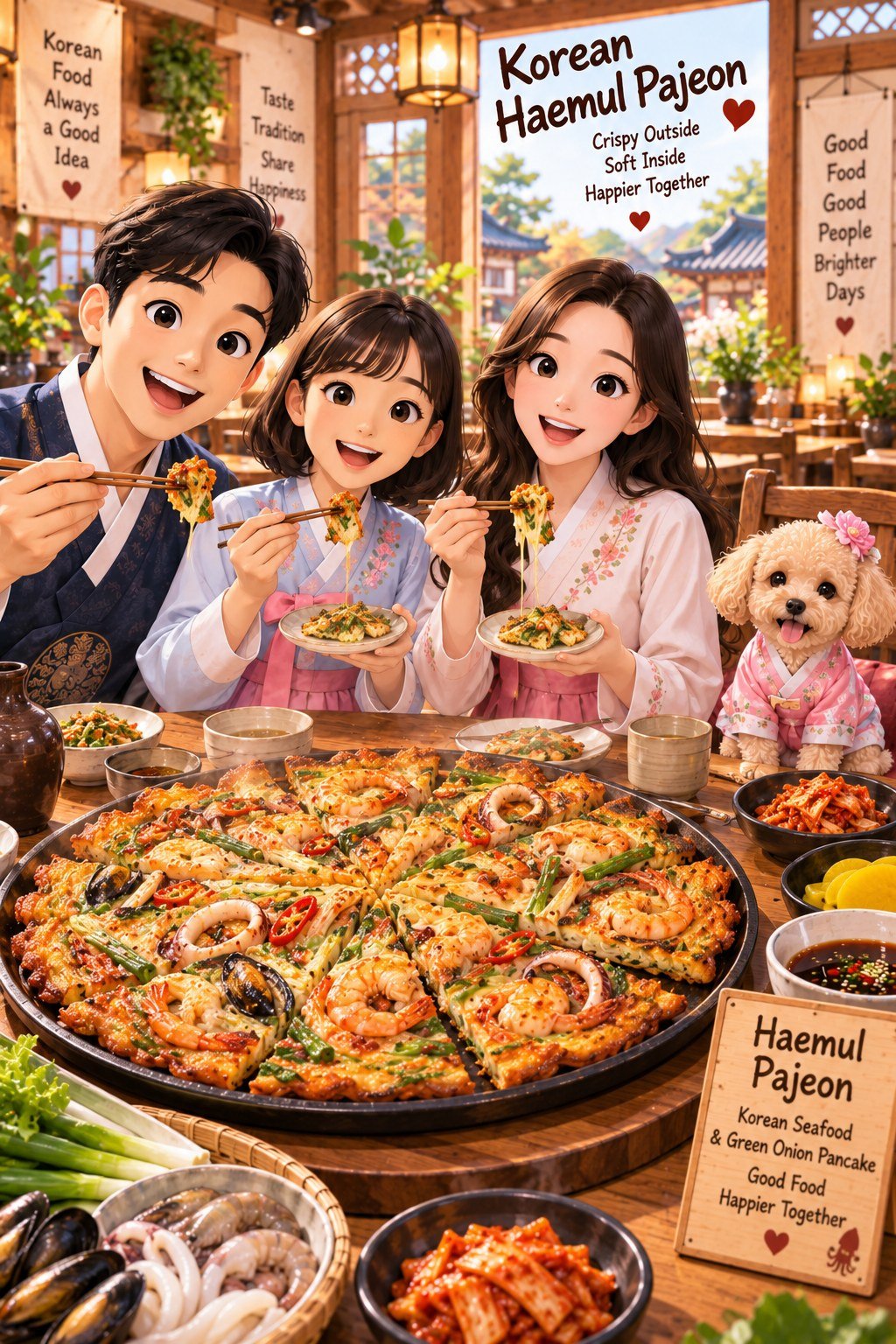
Green onions, seafood, a golden pan-cooked surface, and dipping sauce create the recognizable Korean haemul pajeon experience.
Quick Guide
| Korean name | 해물파전 |
| Romanization | Haemul Pajeon |
| Common English description | Korean seafood and green onion pancake |
| Food category | Jeon |
| Key vegetable | Green onion |
| Common seafood | Squid, shrimp, mussels and other recipe-dependent seafood |
| Cooking method | Pan-cooked with oil |
| Typical texture | Crisp golden areas with a softer interior |
| Common accompaniment | Soy-based dipping sauce |
| Cultural association | Rainy-day pajeon culture |
What Is Haemul Pajeon?
Haemul pajeon is a type of Korean savory pancake that combines pajeon with seafood.
Green onions provide the characteristic vegetable structure, while seafood adds savory flavor and additional texture.
The ingredients are held together with batter and cooked in a pan with oil until the pancake can be cut into shareable pieces.
What Does Haemul Pajeon Mean?
The name becomes easier to understand when divided into its main components.
Haemul means seafood. Pa means green onion. Jeon refers to a broad Korean category of ingredients that are pan-cooked, often with batter or an egg coating depending on the variety.
Haemul pajeon can therefore be understood as seafood pajeon, with green onion remaining central to the dish.
What Is Jeon?
Jeon is much broader than one type of Korean pancake.
Different jeon can feature vegetables, seafood, fish, meat, kimchi, tofu, mushrooms, or other ingredients that are prepared and pan-cooked in different ways.
Some forms resemble a large pancake that is sliced for sharing, while others consist of individual pieces coated with flour and egg before pan-cooking.
What Is Pajeon?
Pajeon is a type of jeon built around green onions.
The green onions can be arranged across the pan and combined with batter and other ingredients to create a broad savory pancake.
Seafood is not required for every pajeon. Once seafood becomes a prominent addition, the dish can be described as haemul pajeon.
Jeon vs. Pajeon vs. Haemul Pajeon
The relationship can be understood as a simple hierarchy.
Jeon is the broad category. Pajeon is green-onion-centered jeon. Haemul pajeon is a seafood variation of pajeon.
This distinction helps international diners avoid using “pajeon” as a name for every Korean pan-cooked pancake or jeon dish.
Why Is It Called a Korean Pancake?
“Korean pancake” is a convenient English description because large pajeon is flat, round, pan-cooked, and often sliced into pieces.
However, diners should not expect the sweet breakfast flavor of many Western pancakes.
Haemul pajeon is savory, contains vegetables and seafood, and is commonly eaten with a seasoned dipping sauce.
Green Onions in Haemul Pajeon
Green onions are one of the defining ingredients of pajeon.
Long pieces can be arranged across the pan rather than being chopped so finely that they disappear into the batter.
As they cook, the green onions soften while retaining enough structure to remain visually and texturally important.
What Seafood Is Used?
Seafood combinations vary according to the restaurant, region, season, and recipe.
Squid, shrimp, mussels, clams, oysters, or other seafood can appear, but no single combination defines every haemul pajeon.
International diners with seafood or shellfish allergies should therefore confirm the actual ingredients rather than relying on the general dish name.
Squid in Haemul Pajeon
Squid contributes a mild seafood flavor and a pleasantly firm, slightly chewy texture.
It is generally cut into manageable pieces so it can cook within the pancake and be eaten easily after slicing.
Overly large or undercooked pieces can make the pancake more difficult to eat, so appropriate preparation and cooking are important.
Shrimp & Shellfish
Shrimp can provide a firmer, slightly sweet seafood component that contrasts with soft green onion and batter.
Mussels, clams, or other shellfish can add additional ocean flavor depending on the recipe.
Because shellfish is a significant allergen, the presence of mixed seafood should always be checked when allergies matter.
Preparing Haemul Pajeon Ingredients
Green onions are cleaned and prepared, while seafood is appropriately cleaned and cut according to the recipe.
Flour or a pancake mixture, water, egg, and other recipe-dependent ingredients can be prepared separately to create the batter.
Raw seafood should remain appropriately separated from finished food and clean serving utensils during preparation.
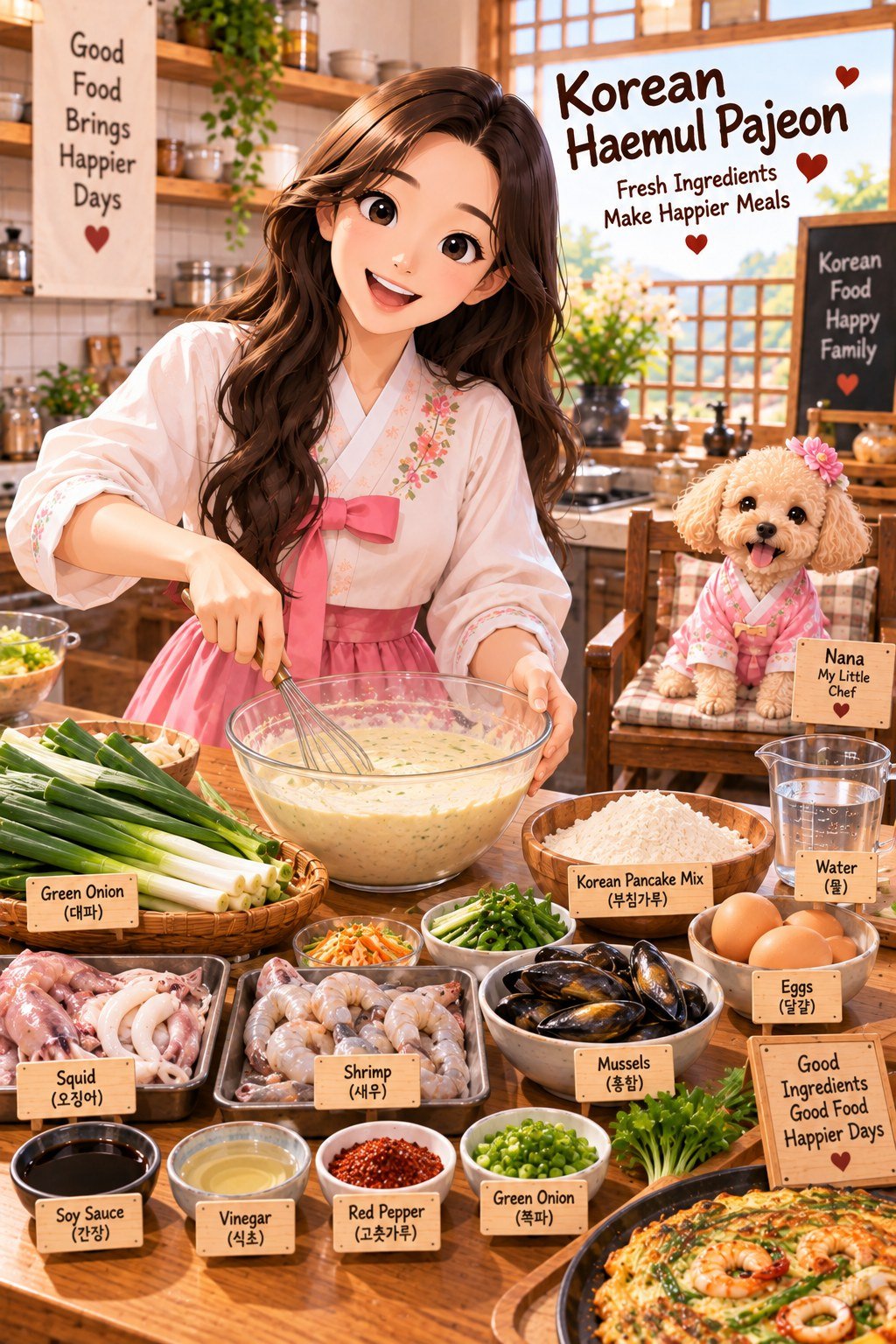
Fresh green onions, mixed seafood, batter, and egg form the basic foundation for many haemul pajeon recipes.
The Haemul Pajeon Batter
The batter helps hold the green onions and seafood together as the pancake cooks.
Recipes vary in flour, starch, water, egg, seasoning, and commercially prepared pancake mixes.
The batter should therefore be understood as recipe-dependent rather than as one standardized formula used throughout Korea.
Is Egg Always Used?
Egg can appear in haemul pajeon recipes, but it should not be assumed that every restaurant uses exactly the same amount or preparation method.
Some preparations incorporate egg into the batter or cooking process, while commercial mixes can have their own formulations.
People with egg allergies should confirm the actual recipe before eating.
How Haemul Pajeon Is Cooked
A pan or griddle is heated with an appropriate amount of oil before the green onions, seafood, batter, and other ingredients are arranged for cooking.
The pancake cooks until the bottom develops enough structure and browning to be turned.
The opposite side is then cooked so the batter and seafood are appropriately done while the surface develops golden areas.
Why Oil Matters
Oil helps transfer heat across the cooking surface and contributes to the characteristic browned exterior.
Too little oil can change the texture and browning, while excessive oil can make the finished pancake feel unnecessarily greasy.
The amount depends on the pan, recipe, heat level, and desired texture.
How Haemul Pajeon Gets Crispy
Crispness depends on more than simply cooking the pancake for a long time.
Pan temperature, batter thickness, moisture from the vegetables and seafood, oil, and cooking time all affect the final surface.
A well-cooked pajeon can develop crisp golden edges while retaining a softer interior around the green onions and seafood.
Crispy Edge vs. Soft Center
The contrast between exterior and interior is one of the dish’s most appealing characteristics.
Thin areas and edges can become especially crisp where they contact hot oil and the pan.
Thicker sections containing green onion and seafood can remain softer and more substantial.
Flipping Haemul Pajeon
Turning a large pajeon requires enough structure on the first side to prevent the pancake from breaking apart.
A wide spatula or other appropriate cooking technique can be used to support the pancake during the turn.
At home, control and safety are more important than attempting a dramatic airborne flip.
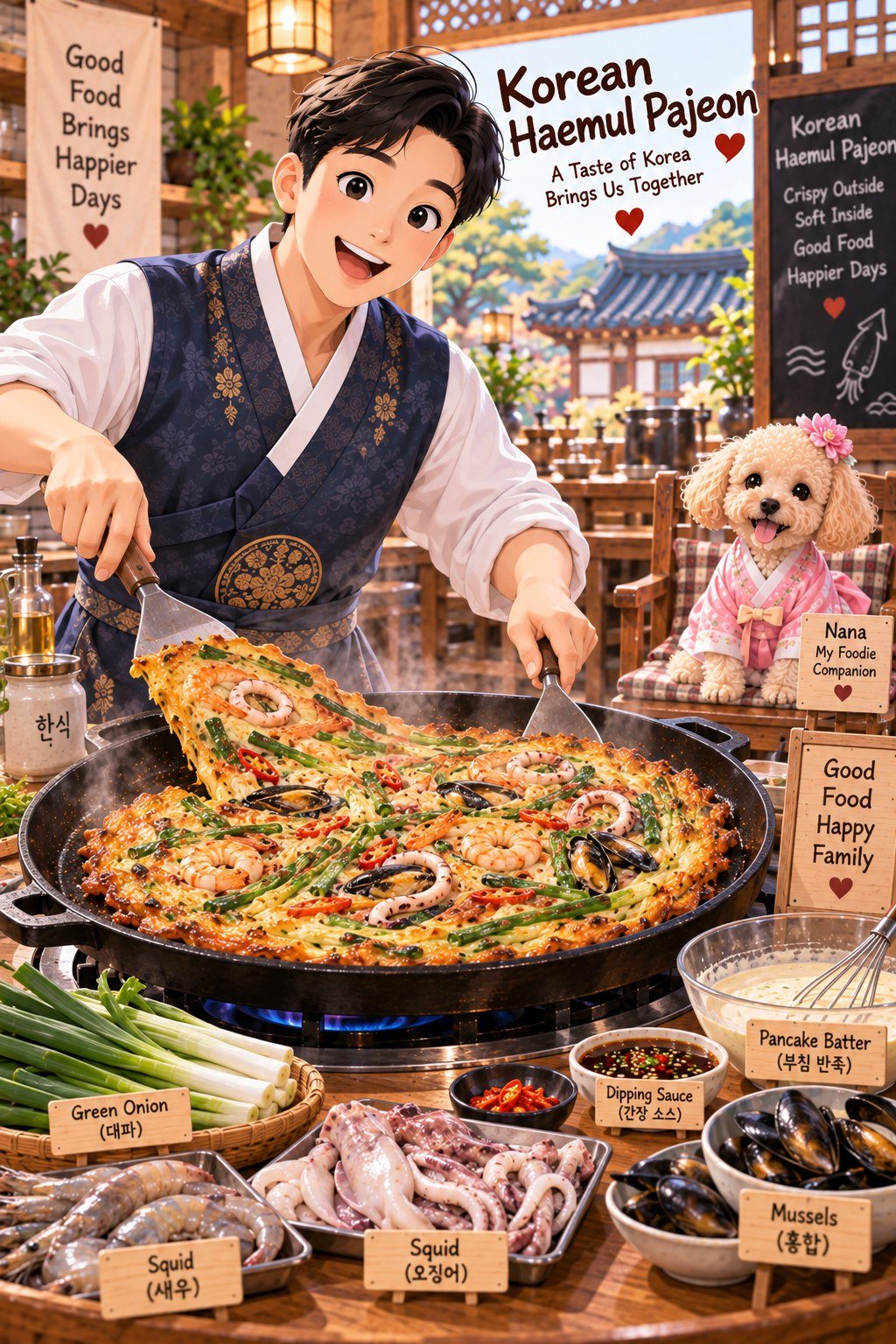
Careful pan cooking creates the contrast between crisp golden edges and the softer seafood-and-green-onion center of haemul pajeon.
How Do You Know the Seafood Is Cooked?
Seafood should be appropriately cooked before the pajeon is served.
Because a thick pancake can contain ingredients beneath batter and green onions, surface browning alone does not guarantee that every interior seafood piece is ready.
Cooking time, ingredient size, pan temperature, and seafood type all matter.
Haemul Pajeon Dipping Sauce
Haemul pajeon is commonly enjoyed with a savory dipping sauce served in a small dish.
A sauce can combine soy sauce with vinegar and recipe-dependent additions such as chili flakes, green onion, sesame, or other seasonings.
The salty and tangy sauce provides contrast with the richer pan-cooked pancake.
How to Eat Haemul Pajeon
A large haemul pajeon is commonly cut into smaller pieces before eating.
Take a manageable piece, allow it to cool if necessary, and use a small amount of dipping sauce according to preference.
Trying both an edge piece and a thicker center piece can make the difference between crisp and soft textures especially noticeable.
Should You Dip Every Bite?
No. The dipping sauce is an accompaniment rather than a requirement for every bite.
Some diners use only a small amount so the flavor of green onion and seafood remains prominent.
Because soy-based sauces can also be salty, the amount can be adjusted to individual preference.
Haemul Pajeon vs. Regular Pajeon
Pajeon refers broadly to green-onion-centered jeon, while haemul pajeon specifically adds seafood as a major component.
A simpler pajeon can emphasize green onions and batter without the same quantity or variety of seafood.
The addition of squid, shrimp, mussels, or other seafood changes the flavor, texture, allergen profile, and usually the visual appearance.
What Is Kimchi Jeon?
Kimchi jeon is another well-known member of the broader jeon family.
Instead of centering on long green onions and seafood, it uses Kimchi as a defining ingredient.
Its red-orange appearance, fermented flavor, acidity, and chili seasoning create a different experience from haemul pajeon.
Haemul Pajeon vs. Kimchi Jeon
Haemul pajeon emphasizes green onion and seafood, while kimchi jeon emphasizes fermented kimchi.
Both can be cooked as broad savory pancakes and sliced for sharing, but their dominant ingredients and flavor profiles are different.
Trying both is a useful way for international diners to understand how diverse Korean jeon can be.
Other Types of Korean Jeon
The jeon category extends well beyond pajeon and kimchi jeon.
Vegetables, fish, meat, tofu, mushrooms, and other ingredients can be flour-coated, egg-coated, battered, or otherwise prepared for pan cooking depending on the specific dish.
This diversity is why “Korean pancake” is useful for some large jeon but cannot fully describe every food within the category.
Haemul Pajeon & Rainy Days
Pajeon has a well-known cultural association with rainy weather in Korea.
On a wet day, the idea of eating a hot, freshly cooked pajeon is commonly referenced in Korean food and everyday culture.
The association is cultural rather than a rule: haemul pajeon can of course be eaten regardless of the weather.
Why Pajeon Is Associated with Rain
Several popular explanations are used to describe the rainy-day association, including the similarity people perceive between the sound of rain and food sizzling in a pan.
More broadly, a hot savory pancake also provides an appealing contrast with cool, damp weather.
The important point for visitors is that “pajeon on a rainy day” is a familiar Korean cultural idea rather than a requirement or formal tradition.
Pajeon & Makgeolli Culture
Pajeon is also commonly discussed together with makgeolli, a traditional Korean rice-based alcoholic beverage.
The pairing is part of Korean food culture, particularly in conversations about rainy days and casual shared meals.
Haemul pajeon itself does not contain or require makgeolli, and the pancake can be enjoyed independently of alcohol.
How to Experience Haemul Pajeon for the First Time
Start with a freshly cooked piece that has cooled enough to eat comfortably.
Notice the green onion and seafood before adding dipping sauce, then try a second bite with a small amount of sauce.
Compare a crisp edge with a thicker center piece to understand why texture is such an important part of the dish.
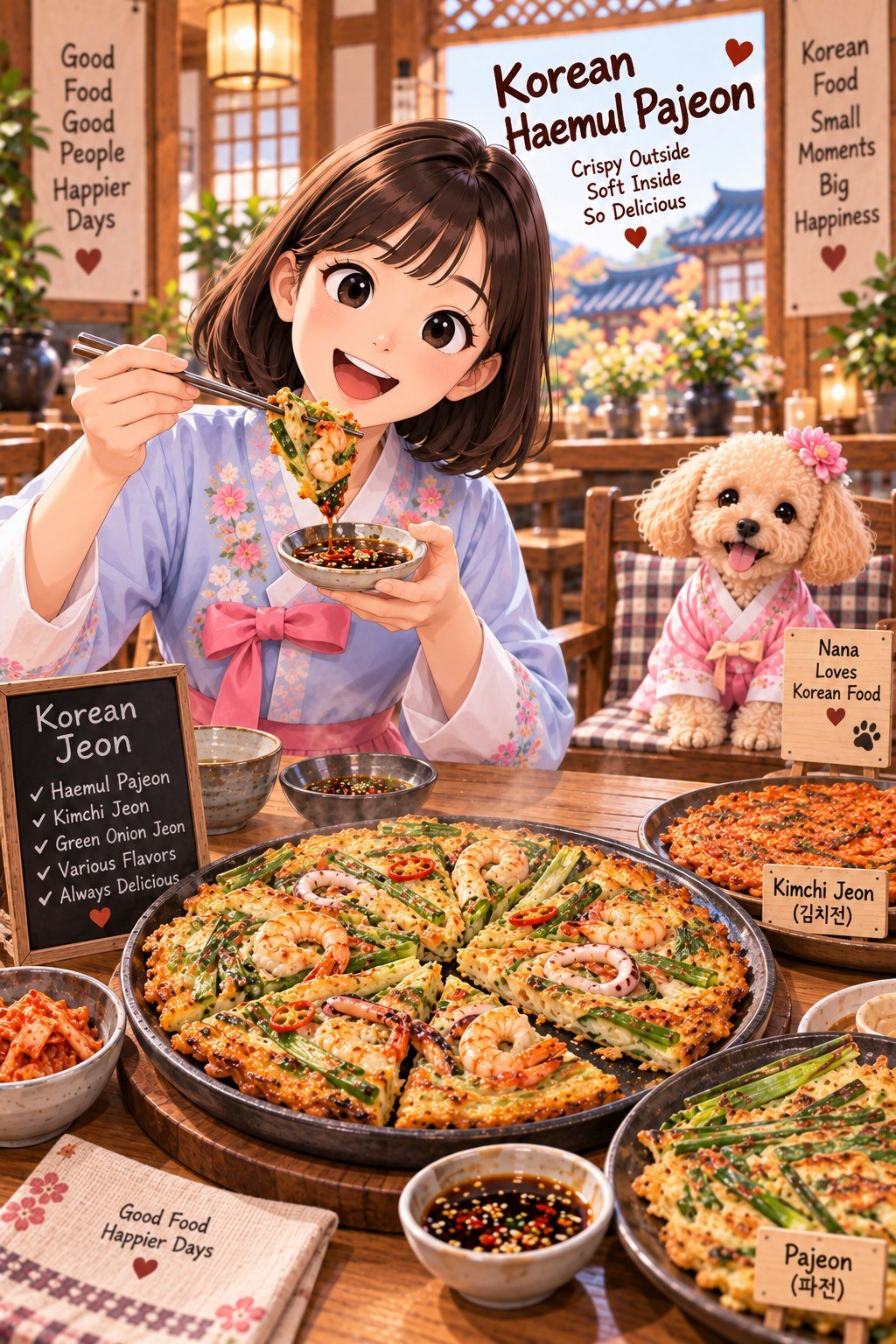
Trying a crisp edge, a softer seafood-filled center, and a small amount of dipping sauce reveals the different textures and flavors of haemul pajeon.
Haemul Pajeon as a Shared Korean Dish
A large pajeon is naturally suited to sharing because it can be cut into many smaller pieces and placed at the center of the table.
Diners can choose pieces with different amounts of green onion, seafood, and crisp edge while using the dipping sauce according to preference.
This shared serving style makes haemul pajeon suitable as an appetizer, side dish, drinking accompaniment, or part of a larger Korean meal depending on the restaurant and occasion.
Haemul Pajeon in Korean Restaurant Culture
Haemul pajeon can appear at Korean restaurants, traditional-style dining businesses, markets, and establishments specializing in jeon or makgeolli.
It can be ordered as a dish to share rather than as an individual main course, although serving size and menu structure vary by restaurant.
Some businesses specialize in large, generously filled pajeon, while others serve smaller versions as part of a broader Korean meal.
Haemul Pajeon at Korean Markets
Traditional markets provide another setting where visitors can encounter jeon culture.
Seeing pancakes cooked on large griddles makes it easier to understand the role of oil, heat, batter, vegetables, and fillings in creating different textures.
Individual vendors, recipes, seafood combinations, prices, and operating hours change, so market availability should always be checked locally.
Haemul Pajeon & Korean Home Cooking
Pajeon can also be prepared at home using a frying pan or griddle.
Home recipes can be adjusted according to available green onions, seafood, batter ingredients, and preferred thickness.
The basic idea is flexible, but seafood handling, cooking temperature, and thorough cooking remain important regardless of where the dish is prepared.
Haemul Pajeon & Global K-Food
Haemul pajeon expands international understanding of Korean food beyond barbecue, fried chicken, noodles, rice dishes, and spicy street foods.
Its familiar pancake-like shape gives first-time diners an easy visual reference, while green onions, seafood, dipping sauce, and Korean jeon culture make the experience distinctively Korean.
This combination can make haemul pajeon an approachable introduction to the broader jeon category.
Why Haemul Pajeon Works in Food Videos
The cooking process provides several visually distinctive stages.
Long green onions and seafood are arranged in the pan, batter binds the ingredients together, the surface gradually turns golden, and the finished pancake reveals seafood and vegetables when sliced.
The contrast between crisp edges and a softer center also translates clearly into close-up food photography and short-form video.
Haemul Pajeon & Korean Food Content
International audiences can encounter pajeon through Korean cooking videos, restaurant content, travel programs, social media, and other K-Food media.
Rainy-day references and the familiar pajeon-and-makgeolli pairing can also introduce cultural context beyond the recipe itself.
These references should be understood as part of Korean food culture rather than as rules about when or how pajeon must be eaten.
Haemul Pajeon vs. Tteokbokki
Tteokbokki and haemul pajeon represent very different branches of Korean casual food.
Tteokbokki centers on chewy rice cakes cooked in sauce, while haemul pajeon combines green onions, seafood, and batter on a pan or griddle.
Both can be shared, but their main ingredients, textures, cooking methods, and flavor profiles are substantially different.
Haemul Pajeon vs. Korean Fried Chicken
Korean Fried Chicken uses deep-frying to create a crisp chicken exterior, while haemul pajeon is pan-cooked as a broad savory pancake.
The crispness of pajeon comes primarily from the batter, oil, pan contact, and thin browned areas rather than from deep-frying individual pieces.
The two foods therefore provide different examples of how Korean cooking creates crisp textures.
Haemul Pajeon vs. Mandu
Mandu consists of Korean dumplings with fillings enclosed inside wrappers.
Haemul pajeon leaves its green onions and seafood visible throughout a broad pan-cooked pancake.
Both can function as shareable dishes, but their construction and eating experience are fundamentally different.
Haemul Pajeon vs. Japchae
Japchae centers on glass noodles combined with vegetables and other ingredients.
Haemul pajeon contains no defining noodle component and instead depends on green onions, seafood, batter, and pan cooking.
Serving both within a Korean meal can demonstrate how differently vegetables and savory ingredients are used across Korean dishes.
Haemul Pajeon vs. Korean BBQ
Korean BBQ centers on grilling meat at or near the table and eating it with various accompaniments.
Haemul pajeon is prepared as one broad pancake that is divided into smaller pieces for sharing.
Both can be communal foods, but the cooking equipment, central ingredients, and dining process are different.
Haemul Pajeon & Kimchi
Kimchi also connects directly with the wider jeon category through kimchi jeon.
Kimchi jeon uses fermented kimchi to create a savory pancake with acidity, chili flavor, and a reddish appearance.
Comparing it with haemul pajeon is one of the easiest ways to understand that Korean jeon can be built around very different defining ingredients.
Haemul Pajeon & a Korean Shared Meal
Haemul pajeon can sit at the center of the table and be divided among several diners.
It can accompany other Korean dishes rather than needing to function as the entire meal.
This makes it particularly useful for a group that wants to experience several foods and compare different textures and flavors.
Choosing Haemul Pajeon for the First Time
First check which seafood the restaurant uses because “haemul” does not specify one universal seafood combination.
Then consider portion size, particularly when ordering several Korean dishes for the same table.
If seafood, shellfish, wheat, egg, soy, or other allergens matter, confirm the ingredients and preparation before ordering.
What Makes a Good Haemul Pajeon Experience?
Texture is as important as flavor.
A freshly cooked pajeon can provide browned and crisp areas while maintaining enough moisture inside for the green onions and seafood to remain substantial.
A small amount of dipping sauce can add acidity and saltiness without completely covering the flavor of the pancake.
Individual Pieces Can Taste Different
A large pajeon is not perfectly uniform from edge to center.
One piece can contain more seafood, another more green onion, while thin edge pieces can be noticeably crisper than thicker central sections.
This variation is part of the appeal of sharing one large pancake.
The Complete Haemul Pajeon Experience
Haemul pajeon combines long green onions, seafood, savory batter, hot oil, crisp browned areas, a softer interior, and dipping sauce in one shareable dish.
Its connection with rainy days, jeon culture, Korean markets, and casual group dining gives the food a cultural identity beyond the ingredients alone.
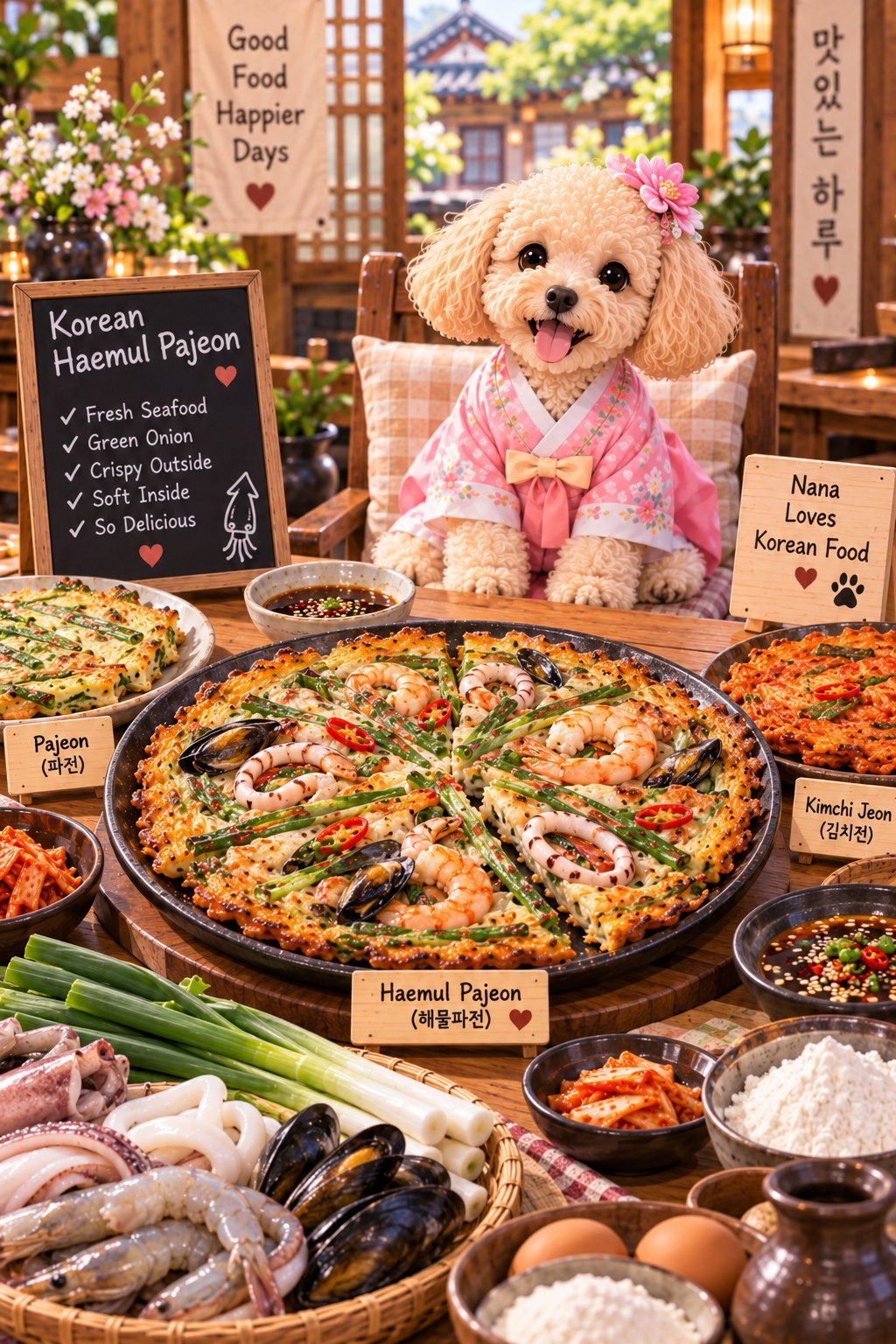
Haemul pajeon brings together green onions, mixed seafood, crisp pan-cooked edges, a softer center, and Korea’s broader jeon culture.
How Haemul Pajeon Connects with Other K-Food
Kimchi provides the foundation for kimchi jeon, one of the clearest comparisons with seafood-and-green-onion pajeon.
Tteokbokki, Korean Corn Dog, and Gimbap expand the collection into other Korean street and casual foods.
Mandu provides another shareable Korean food, while Japchae introduces glass-noodle culture.
Tteok explains the Korean rice-cake category, while Bingsu, Hotteok, and Bungeoppang extend the Wiki into Korean dessert and snack culture.
Dakgalbi, Korean BBQ, Galbi, Bulgogi, and Samgyeopsal provide contrasting examples of Korean shared-table meat culture.
Korean Fried Chicken, Korean Ramyeon, and Buldak Bokkeummyeon represent other globally recognizable modern K-Food categories.
Bibimbap and Kimchi Fried Rice expand the collection into Korean rice dishes.
Jjajangmyeon and Naengmyeon provide additional noodle traditions, while Kimchi-jjigae, Sundubu-jjigae, and Samgyetang extend the collection into stews and soup.
Haemul Pajeon & Gwangjang Market
Gwangjang Market provides useful context for understanding Korean market-food and jeon culture.
Visitors can experience the sounds, aromas, griddles, shared tables, and variety of prepared foods that make Korean market dining different from a conventional restaurant meal.
Specific vendors, menus, seafood combinations, prices, and opening hours can change, so current information should be checked before visiting a particular business.
Haemul Pajeon & Insadong
Insadong provides another natural connection with traditional Korean food, tea, crafts, cultural streets, and restaurants.
A shared Korean meal including jeon can fit naturally into a visit focused on traditional and contemporary Korean culture.
Haemul Pajeon & a Seoul Food Day
A Seoul itinerary can combine cultural destinations such as Gyeongbokgung Palace and Bukchon Hanok Village with a market or restaurant meal.
Haemul pajeon provides a shareable savory option that differs significantly from Korean barbecue, noodles, soups, and rice dishes already familiar to many international travelers.
Restaurant menus, prices, seafood availability, operating hours, and seasonal conditions should be checked when planning a specific visit.
FAQ
What is haemul pajeon?
Haemul pajeon is a Korean savory pancake made with green onions and seafood such as squid, shrimp, mussels, or other recipe-dependent seafood. It is pan-cooked with batter until golden and commonly served in pieces with a dipping sauce.
What is the difference between jeon, pajeon, and haemul pajeon?
Jeon is the broad Korean category. Pajeon is a type of jeon centered on green onions, while haemul pajeon is a seafood variation of pajeon. Not every jeon is pajeon, and not every pajeon contains seafood.
What seafood is in haemul pajeon?
The seafood varies by restaurant and recipe. Squid, shrimp, mussels, clams, oysters, or other seafood can appear, so people with seafood or shellfish allergies should confirm the actual ingredients before ordering.
Is haemul pajeon spicy?
Haemul pajeon itself does not need to be strongly spicy. Green onions, seafood, batter, and pan-cooked flavors are central to the dish, although chili can appear in seasoning or dipping sauce depending on the recipe.
What is the difference between haemul pajeon and kimchi jeon?
Haemul pajeon centers on green onions and seafood, while kimchi jeon uses kimchi as a defining ingredient. Both can be broad pan-cooked savory pancakes, but their dominant ingredients, colors, flavors, and allergen profiles are different.
Why do Koreans eat pajeon on rainy days?
Pajeon has a familiar cultural association with rainy weather in Korea. One popular explanation compares the sound of rain with food sizzling in a pan, while a hot savory pancake also pairs naturally with cool, wet weather. It is a cultural association rather than a dining rule.
What sauce is served with haemul pajeon?
A soy-based dipping sauce is common and can include vinegar, chili flakes, green onion, sesame, or other recipe-dependent seasonings. The exact sauce varies by restaurant and household.
Where to Try Haemul Pajeon
Haemul pajeon can be found at Korean restaurants, jeon-focused businesses, traditional markets, casual dining establishments, and restaurants serving traditional-style Korean food.
The seafood combination, pancake size, crispness, dipping sauce, price, and serving style can differ considerably between businesses.
Travelers looking for a particular restaurant or market vendor should check current menus and operating information rather than relying only on older travel or social-media content.
What to Check Before Ordering
First check whether the menu offers basic pajeon, haemul pajeon, kimchi jeon, or several different jeon varieties.
If ordering haemul pajeon, confirm the seafood when allergies, dietary restrictions, or ingredient preferences matter.
Also consider the portion size because a large pancake can be intended for sharing alongside other dishes rather than for one diner.
First-Time Haemul Pajeon Tips
- Try a crisp edge — thin browned sections can provide the strongest crunch.
- Try the center too — thicker areas highlight green onion, seafood, and softer batter.
- Use sauce lightly at first — taste the pancake before adding a large amount of dipping sauce.
- Check the seafood — the combination varies between restaurants.
- Share the pancake — large haemul pajeon can be substantial.
- Eat it fresh — the crisp exterior changes as the pancake cools and sits.
- Allow it to cool — seafood, batter, and oil can remain very hot immediately after cooking.
Seafood & Allergy Notes
Haemul pajeon can contain several types of seafood in the same pancake.
Squid, shrimp, mussels, clams, oysters, or other ingredients can vary according to the restaurant, season, region, and recipe.
People with seafood allergies should confirm the complete seafood mixture rather than assuming that only the most visible ingredient is present.
Shellfish
Shrimp, mussels, clams, oysters, and other shellfish can appear in haemul pajeon.
Mixed seafood can make it difficult to identify every ingredient after the pancake has been cooked and sliced.
People with shellfish allergies should ask about ingredients and preparation before ordering.
Wheat & Gluten
Haemul pajeon batter commonly uses wheat flour or a prepared pancake mix that can contain wheat.
Additional starches, seasonings, sauces, and commercial mixes can also have recipe-dependent formulations.
People who must strictly avoid gluten should confirm both the batter and dipping sauce and ask about cross-contact during preparation.
Egg
Egg can be incorporated into the batter or cooking process depending on the haemul pajeon recipe.
Its presence may not be obvious in the finished pancake.
People with egg allergies should confirm the recipe rather than relying on appearance.
Soy
Soy sauce is a common component of dipping sauces and can also appear in other seasonings.
The pancake itself and the sauce should therefore be checked separately when soy allergy or avoidance matters.
Restaurant recipes vary, so one soy-free preparation does not establish that all haemul pajeon is soy-free.
Sesame
Sesame seeds or sesame oil can appear in dipping sauces, garnishes, or other components served with haemul pajeon.
Sesame can be incorporated into a sauce and may not always be immediately visible.
People with sesame allergies should confirm the complete dish and accompaniments.
Cooking Seafood Thoroughly
Seafood inside haemul pajeon should be appropriately cooked before the pancake is served.
A golden exterior does not by itself confirm that every thick or hidden piece of seafood in the center has cooked sufficiently.
Ingredient size, seafood type, pancake thickness, pan temperature, and cooking time all affect cooking.
Raw Seafood & Cross-Contamination
Raw seafood and its juices should remain appropriately separated from cooked food, clean utensils, and ready-to-eat ingredients during preparation.
Cutting boards, knives, containers, and other equipment that contact raw seafood require appropriate handling before reuse with finished food.
People with serious food allergies should also consider cross-contact from shared pans, utensils, work surfaces, and cooking areas.
Hot Oil & Pan Safety
Haemul pajeon is cooked on a hot pan or griddle with oil.
Moisture from seafood and vegetables can interact with hot oil, so appropriate cooking equipment and careful handling are important.
Children and pets should remain appropriately separated from hot pans, oil, cooking surfaces, and utensils.
Hot Food Safety
A freshly cooked pajeon can remain very hot even after it has been sliced.
Seafood and thicker sections of batter can retain heat longer than thin, crisp edges.
Allow pieces to cool to a comfortable temperature before taking a large bite.
Storage & Leftovers
Haemul pajeon contains cooked seafood and other perishable ingredients and requires appropriate food handling if it is kept for later.
Storage conditions and safe keeping time depend on preparation, temperature, ingredients, packaging, and applicable food-safety guidance.
Follow restaurant or manufacturer instructions where available and reheat stored seafood pancakes appropriately before eating.
Reheating Haemul Pajeon
Reheating can warm leftover pajeon, but the original crisp texture may change during storage.
A method that restores some surface crispness can provide a different result from reheating that introduces additional moisture.
Regardless of method, seafood-containing leftovers should be handled appropriately and heated according to relevant food-safety guidance.
Image Credits
Korean haemul pajeon family restaurant visual with Dad, Mom, K-Nana daughter, and Nana in hanbok enjoying a golden seafood and green onion pancake with dipping sauce — K-Nana Studio original visual.
Korean haemul pajeon preparation visual with Mom in hanbok preparing green onions, squid, shrimp, mussels, batter, and egg while Nana watches from a separate safe seat — K-Nana Studio original visual.
Korean haemul pajeon cooking visual with Dad in hanbok safely pan-cooking a golden seafood and green onion pancake while Nana remains separated from the hot pan, oil, and cooking area — K-Nana Studio original visual.
Korean haemul pajeon tasting visual with K-Nana daughter in hanbok enjoying a cooled piece of seafood pajeon with dipping sauce beside pajeon and kimchi jeon while Nana sits separately without touching the food — K-Nana Studio original visual.
Nana in pink floral hanbok seated separately as a K-Food mascot beside haemul pajeon, pajeon, kimchi jeon, green onions, squid, shrimp, mussels, batter, egg, and dipping sauce — K-Nana Studio original visual.
Disclaimer
This article is provided for general food, travel, and cultural information. Haemul pajeon ingredients, seafood combinations, batter, egg, seasonings, dipping sauces, allergens, cooking methods, serving sizes, and restaurant procedures can vary by business and recipe. Recipes may contain shellfish, other seafood, wheat, gluten, egg, soy, sesame, or other recipe-dependent ingredients, and shared pans, utensils, work surfaces, or cooking equipment can create cross-contact risks. Raw seafood requires appropriate handling and seafood should be appropriately cooked before consumption. Hot oil, pans, cooking equipment, freshly cooked batter, and seafood can cause burns. People with allergies, medical conditions, religious dietary restrictions, or other individual requirements should confirm ingredients and preparation directly with the restaurant or manufacturer and follow appropriate professional guidance when necessary.