
Hotteok is a popular Korean street food made from soft dough filled with a sweet mixture and cooked on a hot griddle until the outside becomes golden and lightly crisp.
The classic sweet filling is commonly associated with brown sugar, cinnamon, and nuts or seeds. As the hotteok cooks, the sugar melts inside the dough and creates the warm syrupy center that makes the food especially memorable.
Hotteok is strongly associated with Korean markets and cool-weather street-food culture. A freshly cooked hotteok can be comforting on a cold day, but the melted sugar inside can remain extremely hot even after the outside appears ready to eat.
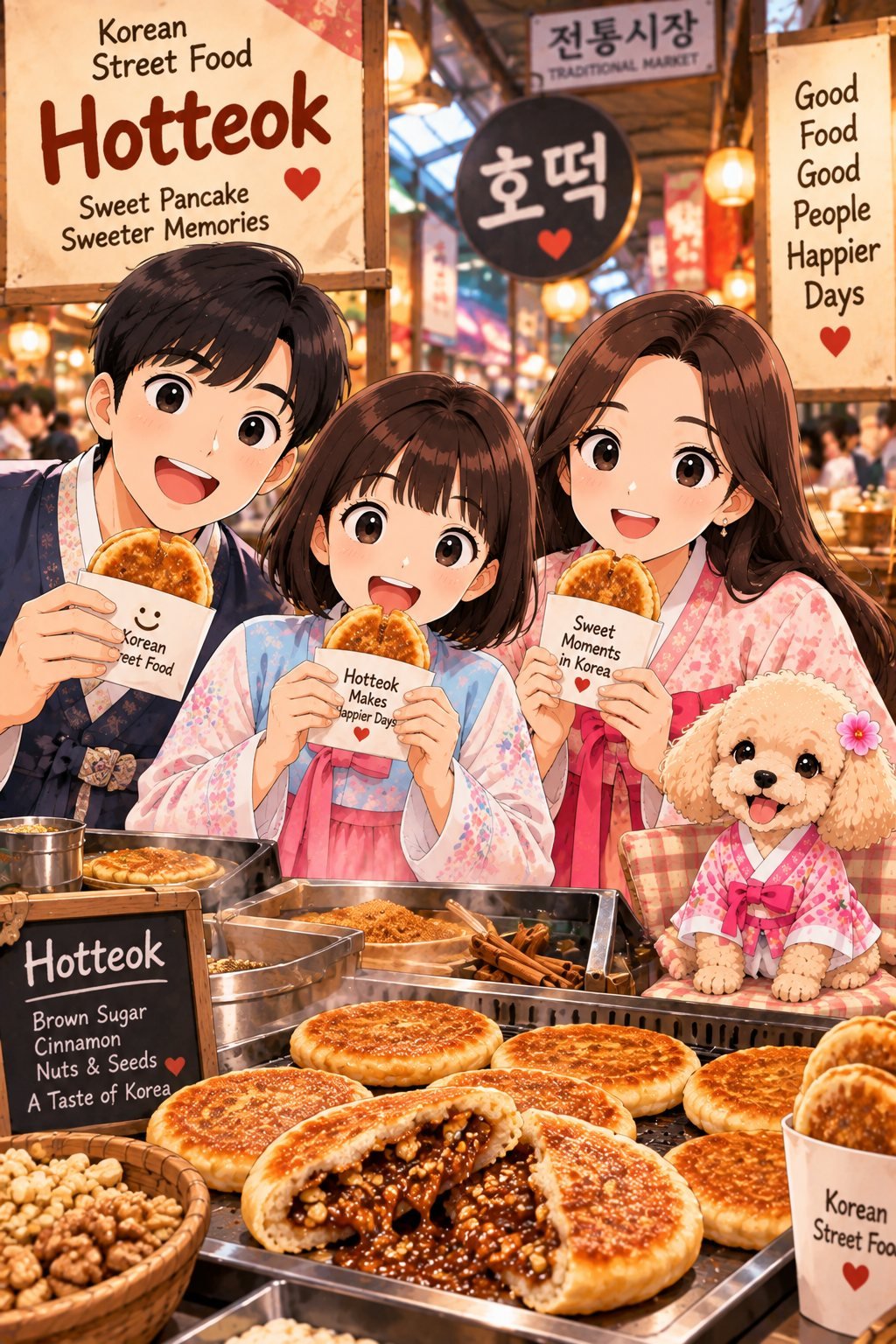
Golden hotteok filled with warm brown-sugar, cinnamon, nut, and seed flavors is one of Korea’s most recognizable sweet street foods.
Quick Guide
| Korean name | 호떡 |
| Romanization | Hotteok |
| Common English description | Korean sweet pancake |
| Food type | Korean street food and filled griddle cake |
| Basic structure | Soft dough surrounding a sweet or recipe-dependent filling |
| Classic sweet filling | Brown sugar, cinnamon, and recipe-dependent nuts or seeds |
| Cooking method | Cooked and pressed on a hot pan or griddle |
| Common texture | Golden exterior, chewy or soft dough, and warm syrupy center |
| Common setting | Traditional markets and Korean street-food stalls |
| Important first-time tip | The melted sugar filling can remain much hotter than expected |
What Is Hotteok?
Hotteok is a filled Korean griddle cake commonly sold as street food.
A portion of dough is flattened, filled, sealed, placed onto a heated cooking surface, and pressed into a round pancake-like shape while it cooks.
The sweet filling melts inside, creating a strong contrast between the cooked exterior and the warm, syrupy center.
Is Hotteok Really a Pancake?
“Korean sweet pancake” is a convenient English description, but hotteok is structurally different from many Western-style breakfast pancakes.
Instead of pouring a liquid batter directly onto a pan, hotteok commonly begins with a soft dough that can be handled, filled, sealed, and pressed.
The filling is enclosed inside the dough before cooking rather than simply being poured over the finished pancake.
What Does Hotteok Taste Like?
Classic sweet hotteok combines several contrasting sensations.
The cooked exterior develops toasted and lightly crisp areas, while the dough underneath can remain soft and pleasantly chewy. Inside, melted sugar creates sweetness and moisture, while cinnamon adds aroma and nuts or seeds can provide texture.
The exact balance varies because street vendors, restaurants, packaged mixes, and home recipes do not all use identical dough or fillings.
Hotteok Dough
Hotteok dough is designed to be soft enough to shape around a filling while remaining strong enough to keep most of that filling enclosed during cooking.
Recipes can vary in flour composition, yeast use, liquid, sweetness, and other ingredients.
This means one hotteok can be softer and more bread-like while another can have a noticeably chewier or crisper texture.
The Classic Sweet Filling
A familiar hotteok filling combines brown sugar with cinnamon and nuts or seeds.
During cooking, the sugar melts and combines with the other ingredients to form a hot syrup inside the pancake.
The ratio and ingredients vary by recipe. Some fillings emphasize cinnamon, while others contain a more noticeable amount of nuts or seeds.
Brown Sugar
Brown sugar contributes the concentrated sweetness associated with classic hotteok and melts as the pancake cooks.
Because the sugar is enclosed within the dough, it can become very hot without being immediately visible from the outside.
This hidden temperature is one of the most important things for first-time diners to understand before taking a large bite.
Cinnamon
Cinnamon provides the warm aromatic character commonly associated with sweet hotteok.
It works with melted sugar to create a flavor profile that feels especially suited to cool-weather street food.
The amount of cinnamon varies, and not every modern hotteok variation uses the same filling.
Nuts & Seeds
Chopped nuts or seeds can add crunch and nutty flavor to the melted sugar filling.
Specific ingredients vary considerably. Peanuts, other nuts, sunflower seeds, or different seed mixtures can appear depending on the recipe or vendor.
People with nut or seed allergies should therefore confirm ingredients rather than relying on appearance alone.
Preparing the Filling
The dry filling ingredients are prepared before the dough is sealed so an appropriate amount can be placed in the center of each portion.
Too much filling can make sealing difficult, while an uneven seal can allow melted sugar to escape onto the hot cooking surface.
Recipes and vendors use their own proportions, so there is no single universal filling quantity.
Filling & Sealing the Dough
A portion of soft dough is flattened enough to hold the filling.
The sweet mixture is placed in the center, and the dough edges are gathered around it and sealed so the filling remains enclosed.
The filled dough can then be handled carefully before it reaches the hot pan or griddle.
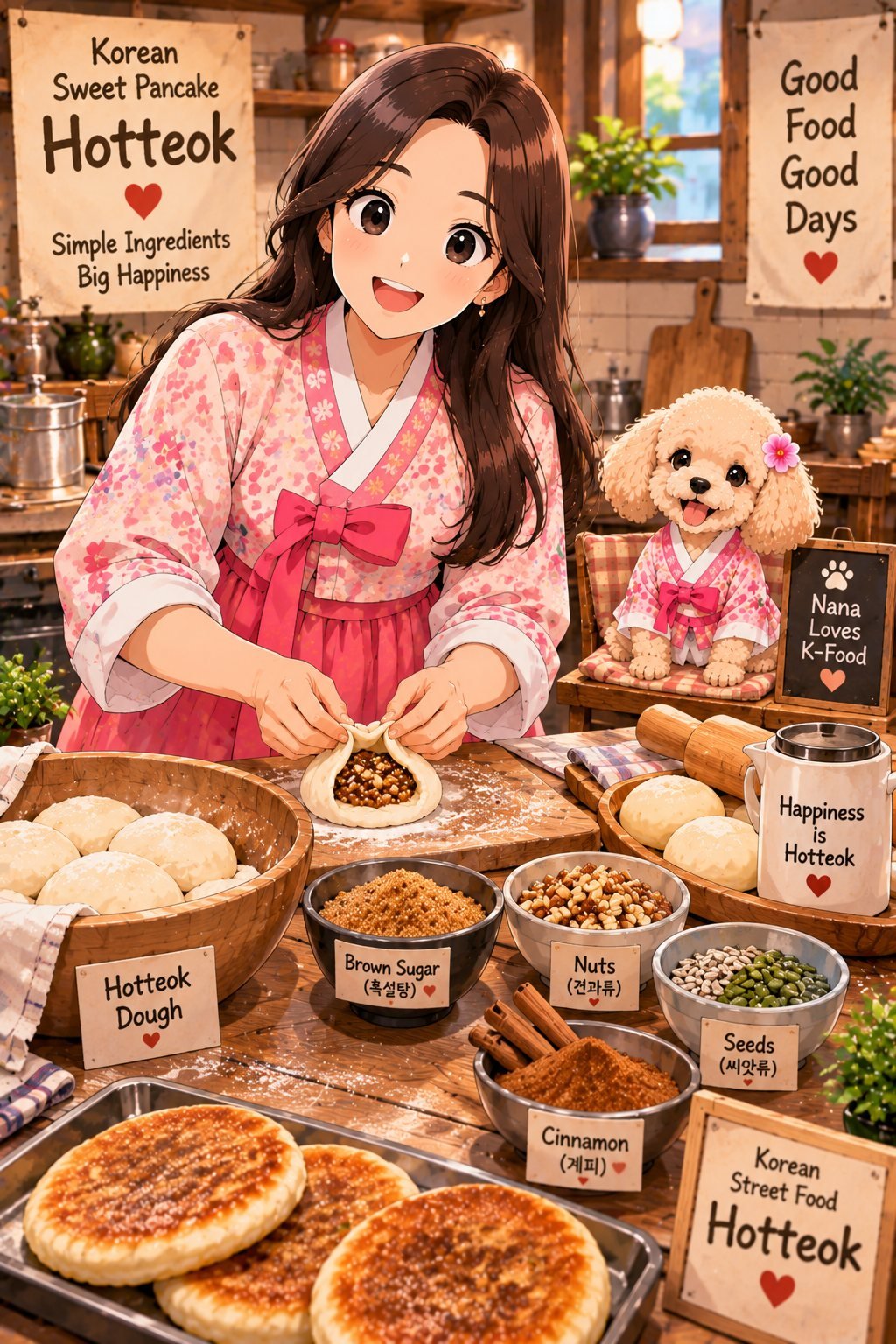
Soft dough is wrapped around a sweet filling before the edges are sealed, preparing each hotteok for the hot griddle.
How Hotteok Is Cooked
The filled dough is placed onto a heated pan or flat griddle with an appropriate amount of cooking oil.
As the first surface begins to cook, the dough is pressed so it spreads into the familiar round, relatively flat shape.
The hotteok is turned as needed so both sides cook and develop golden-brown areas.
Why Is Hotteok Pressed Flat?
Pressing changes the filled ball of dough into a flatter shape that can cook more evenly against the hot surface.
It also spreads the filling through a larger area inside the pancake.
Street-food vendors may use a dedicated hotteok press or another suitable cooking tool to achieve the shape.
Why the Outside Becomes Golden
Direct contact with the heated pan or griddle creates the browned surface associated with freshly cooked hotteok.
Oil, temperature, dough composition, cooking time, and the amount of pressure all influence how crisp or browned the exterior becomes.
Very high heat can darken the outside before the dough and filling are properly heated, so controlled cooking is important.
What Happens to the Filling During Cooking?
As the hotteok heats, the sugar inside melts and forms a syrup around the cinnamon, nuts, seeds, or other filling ingredients.
The sealed dough traps much of this mixture inside the pancake.
If the dough tears or the seal opens, hot sugar syrup can leak onto the cooking surface.
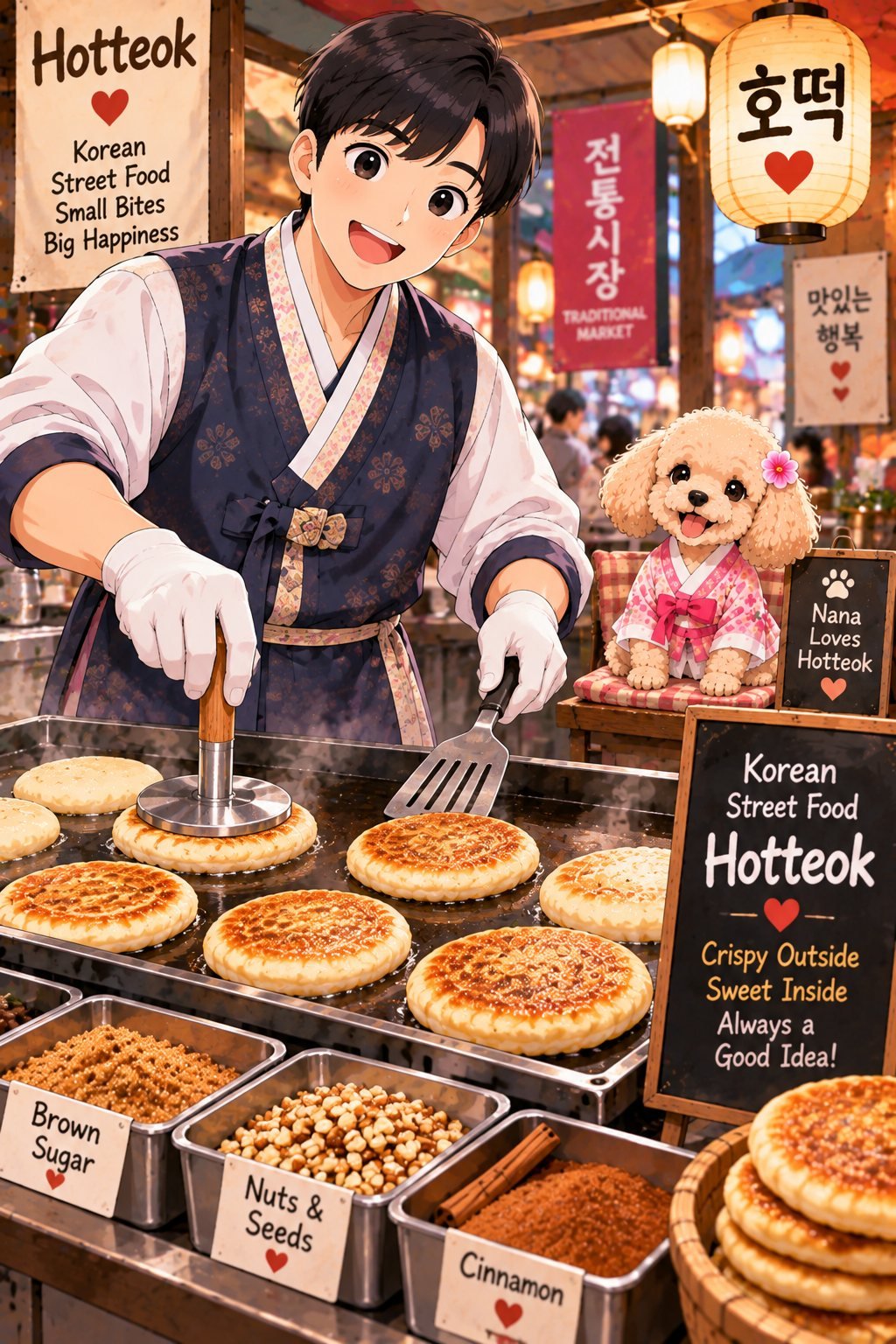
Hotteok is pressed on a hot griddle until the dough becomes golden while the sugar filling melts into a warm syrup inside.
Crispy Outside, Chewy Inside
One of hotteok’s attractions is the contrast between textures.
The surface touching the pan can become lightly crisp and browned, while the dough remains softer or chewier beneath it.
The melted filling then adds another texture, especially when nuts or seeds are mixed into the syrup.
Why Fresh Hotteok Can Be Extremely Hot
The outside of a freshly cooked hotteok may cool faster than the sugar syrup sealed inside.
A diner can therefore touch the exterior comfortably while the center is still hot enough to cause a burn.
Breaking or biting into hotteok can also release hot syrup unexpectedly, so allowing it to cool is more important than simply checking the surface temperature.
How to Eat Hotteok for the First Time
Hold the hotteok using the paper cup, sleeve, or serving material provided by the vendor rather than squeezing the freshly cooked pancake directly.
Wait long enough for the filling to cool, then begin with a small bite from the edge.
Be especially careful once the filling becomes visible because melted sugar can flow toward the opening.

Let freshly cooked hotteok cool before eating—the sweet syrup hidden inside can remain much hotter than the golden exterior.
Hotteok as Korean Winter Street Food
Hotteok is strongly associated with cool-weather street-food experiences in Korea.
The combination of a hot griddle, freshly cooked dough, cinnamon aroma, and warm melted filling makes it particularly appealing during colder months.
However, availability varies by market, neighborhood, vendor, and season, so travelers should not assume every street-food area sells hotteok throughout the entire year.
Hotteok at Traditional Markets
Traditional markets are one of the most recognizable settings for experiencing hotteok alongside other Korean street foods.
Customers can often see the pancakes being filled, pressed, turned, and served directly from the cooking surface.
This visible cooking process is part of the experience: hotteok is not only a finished snack but also a street food defined by the sounds, aromas, and movement around the griddle.
Why Hotteok Works as Street Food
Hotteok is compact, individually portioned, and can be served in simple paper packaging for eating while standing or walking.
Its warm temperature makes it especially appealing outdoors in cool weather, while the sweet filling provides a strong flavor without requiring additional sauces at the table.
At the same time, the hot syrup means it should be eaten slowly rather than treated as a snack that must be finished immediately.
Seed Hotteok
Hotteok does not have only one filling. One especially recognizable variation emphasizes seeds, creating a stronger contrast between the chewy dough, melted sweetness, and crunchy filling.
Seed mixtures can include sunflower seeds and other recipe-dependent nuts or seeds. The exact combination varies between vendors, so “seed hotteok” should be understood as a style rather than one universal recipe.
This variation is particularly associated with Busan street-food culture and has become one of the city’s familiar food experiences.
Busan-Style Hotteok
Busan is strongly associated with seed-filled hotteok, often encountered in busy market and street-food areas.
The experience can differ from a simple brown-sugar-and-cinnamon hotteok because seeds contribute additional crunch, aroma, and visual texture.
Recipes, preparation methods, fillings, and serving styles vary by vendor, so travelers should expect differences even among stalls selling similar-looking hotteok.
Sweet Hotteok Variations
Classic brown-sugar hotteok provides the basic reference point, but sweet versions can vary considerably.
Some emphasize cinnamon, while others contain more nuts or seeds. Modern versions can also introduce different sweet fillings or toppings according to the vendor or recipe.
The important distinction is that the filling is generally enclosed inside the dough before cooking rather than simply added as a sauce after the pancake leaves the griddle.
Savory Hotteok
Not every hotteok needs to be dessert-like.
Savory variations can replace the familiar sweet filling with vegetables, noodles, cheese, or other recipe-dependent ingredients.
These versions demonstrate how the basic hotteok technique—filled dough pressed and cooked on a griddle—can be adapted beyond brown sugar and cinnamon.
Hotteok vs. Western-Style Pancakes
Hotteok and Western-style pancakes can both be round and cooked on a flat heated surface, but their structures are substantially different.
Many familiar breakfast pancakes begin as a pourable batter. Hotteok generally uses a soft dough that is portioned, filled, sealed, and then pressed during cooking.
The syrup is also commonly inside sweet hotteok rather than poured over the finished food.
Hotteok vs. Bungeoppang
Hotteok and bungeoppang are both strongly associated with Korean street food and cool-weather snacking, but they are different foods.
Hotteok is a round filled dough cooked and pressed on a griddle. Bungeoppang is generally made in a fish-shaped mold and commonly contains a filling such as sweet red bean paste or another variation.
Their shape, dough or batter structure, cooking equipment, and traditional fillings therefore create clearly different eating experiences.
Hotteok & Korean Market Culture
Part of the appeal of hotteok comes from watching it being prepared.
At a market stall, customers may see portions of dough being filled, sealed, placed onto a hot surface, pressed, turned, and served only moments after cooking.
The aroma of toasted dough and cinnamon, the sound of the griddle, and the sight of fresh batches cooking make the preparation itself part of the street-food experience.
How to Order Hotteok
At a street stall, ordering can be straightforward when only one type of hotteok is available.
When several versions are offered, check the displayed filling or ask which type contains brown sugar, seeds, nuts, vegetables, cheese, or another ingredient.
People with allergies or dietary restrictions should confirm ingredients before ordering because the filling may not be visible from the outside.
How Hotteok Is Served
Fresh hotteok is often served in simple packaging designed to make a hot, oily pancake easier to hold.
A paper cup, sleeve, folded paper, or other vendor-specific serving material can help keep hands away from the hot surface and melted filling.
The serving material does not make the center immediately safe to bite, so the hotteok should still be allowed to cool.
How Much Does Hotteok Cost?
There is no single fixed price for hotteok.
Prices can vary according to location, market, vendor, size, filling, ingredients, and time. Specialty or larger versions can also be priced differently from a basic street-stall hotteok.
Travelers should check the current displayed price rather than relying on an older online price as a universal standard.
Is Hotteok Available All Year?
Hotteok has a particularly strong association with autumn and winter because freshly cooked sweet pancakes are well suited to cold weather.
That does not mean hotteok disappears everywhere during warmer months. Permanent market stalls, restaurants, cafés, or other businesses may sell it at different times of year.
Availability depends on the individual vendor and location.
The Complete Hotteok Experience
A classic hotteok experience combines freshly cooked dough, a golden griddle-toasted exterior, warm melted sugar, cinnamon aroma, and the crunch of nuts or seeds.
The market setting adds another layer through warm lights, visible cooking, simple paper packaging, and the movement of Korean street-food culture around the stall.
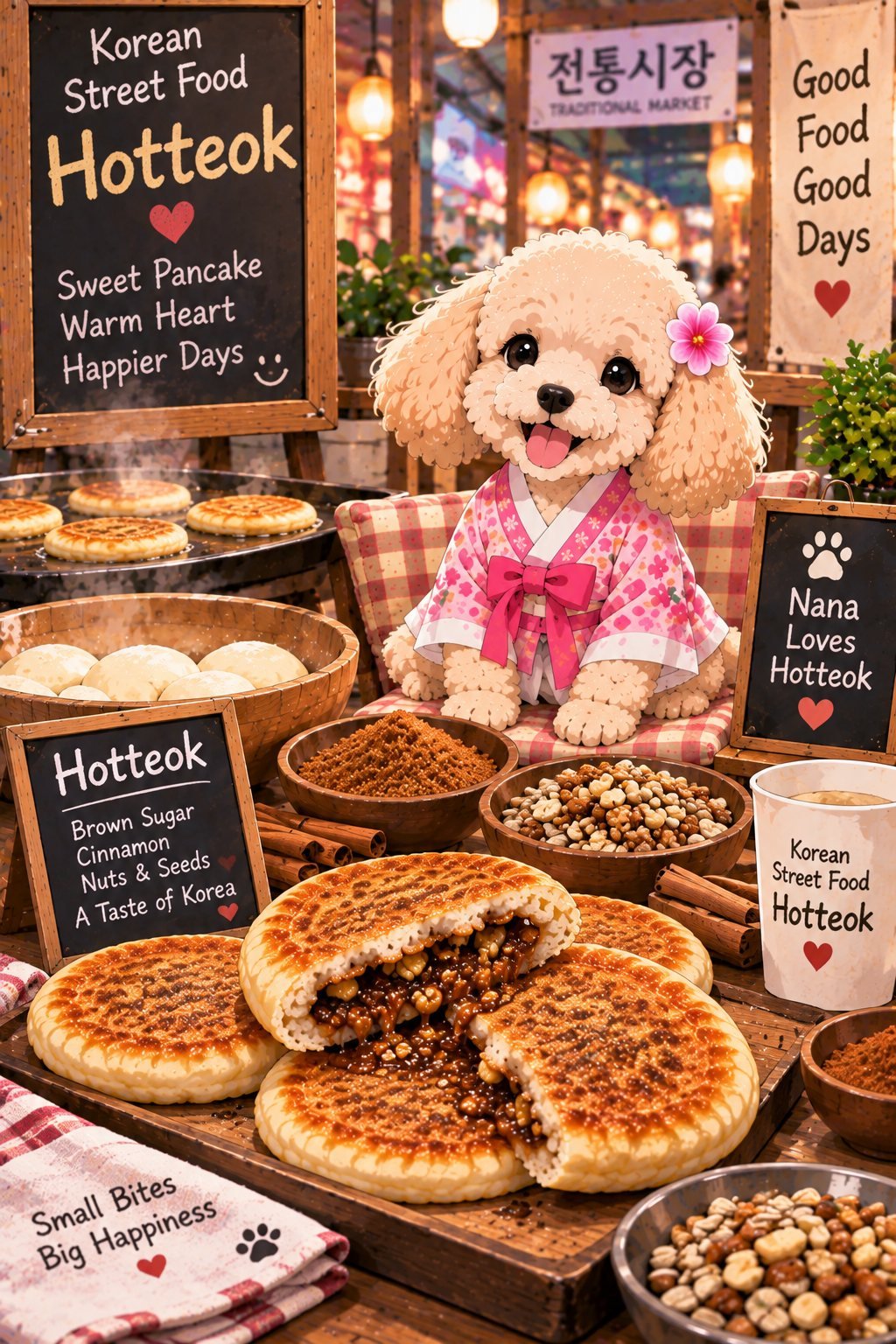
Golden hotteok, melted brown-sugar filling, cinnamon, nuts, seeds, and a warm traditional-market setting capture the comforting side of Korean street-food culture.
How Hotteok Connects with Other K-Food
Tteokbokki provides one of the clearest comparisons with Korea’s savory street-food culture, replacing hotteok’s sweet filled dough with chewy rice cakes and a strongly seasoned sauce.
Gimbap represents another convenient Korean food that can be eaten casually or on the go, while Mandu demonstrates a very different filled-dough tradition through Korean dumplings.
Korean Ramyeon introduces instant-noodle and convenience-store food culture, while Buldak Bokkeummyeon explores the much more intense K-Spicy side of modern Korean noodles.
Kimchi Fried Rice shows the practical side of Korean home cooking, while Bibimbap provides another major rice-centered Korean meal.
Korean BBQ, Galbi, Bulgogi, and Samgyeopsal contrast hotteok’s quick street-snack experience with Korea’s shared grilled-meat dining culture.
Kimchi introduces Korean fermentation, while Kimchi-jjigae and Sundubu-jjigae extend the collection into hot Korean stew culture.
Japchae, Jjajangmyeon, and Naengmyeon show three very different Korean noodle traditions, while Samgyetang provides a mild whole-chicken soup comparison.
Korean Fried Chicken adds another globally recognizable casual K-Food experience through fried texture and sauce variations.
Hotteok & Gwangjang Market
Gwangjang Market provides a useful starting point for understanding the atmosphere of Korean traditional-market food culture.
Markets bring many foods, vendors, aromas, cooking sounds, and customers into one environment, allowing travelers to compare sweet snacks with savory dishes during the same visit.
Individual vendors and menus change, so a market guide should be used to understand the destination rather than as a guarantee that one specific hotteok stall will always be operating.
Hotteok & a Seoul Travel Day
Hotteok can fit easily into a walking itinerary because it is generally treated as a snack rather than a large sit-down meal.
Travelers exploring Insadong can combine traditional streets, crafts, cafés, and Korean snacks, while Bukchon Hanok Village and Gyeongbokgung Palace provide nearby historical and architectural context for a traditional Seoul itinerary.
For a more contemporary atmosphere, Hongdae offers a different combination of youth culture, shopping, cafés, performances, and casual food.
FAQ
What is hotteok?
Hotteok is a Korean filled griddle cake commonly associated with street-food and traditional-market culture. A classic sweet version uses soft dough filled with brown sugar, cinnamon, and recipe-dependent nuts or seeds before being pressed and cooked until golden.
What is inside hotteok?
The familiar sweet filling commonly combines brown sugar, cinnamon, and nuts or seeds. However, fillings vary by vendor and recipe, and modern versions can include different sweet or savory ingredients.
Is hotteok the same as a pancake?
Not exactly. “Korean sweet pancake” is a useful English description, but hotteok generally uses a soft dough that is filled, sealed, and pressed during cooking rather than the pourable batter used for many Western-style pancakes.
Why is hotteok popular in winter?
Hotteok is served hot from a pan or griddle, and its warm dough, toasted surface, cinnamon aroma, and melted sweet filling make it particularly appealing in cold weather. Availability still varies by vendor, market, and season.
What is seed hotteok?
Seed hotteok is a variation that emphasizes seeds and other crunchy ingredients in or with the sweet filling. It is particularly associated with Busan street-food culture, although individual recipes and seed mixtures vary.
Is hotteok always sweet?
No. Sweet brown-sugar hotteok is the best-known style, but savory versions can contain vegetables, noodles, cheese, or other recipe-dependent fillings.
Why should freshly cooked hotteok cool before eating?
The sugar inside can melt into extremely hot syrup during cooking. The outside may become comfortable to touch before the center has cooled, so taking a large bite immediately can cause a burn.
Where to Try Hotteok
Hotteok can be found at Korean traditional markets, street-food stalls, specialty shops, and other businesses selling Korean snacks.
Availability is not identical throughout Korea. Some vendors operate seasonally, while permanent shops or market businesses may offer hotteok for longer periods of the year.
Different regions and vendors can also specialize in different fillings, textures, sizes, and cooking styles.
What to Check Before Ordering
Look at the menu or stall display to see whether the hotteok is sweet, seed-filled, savory, or another variation.
If more than one version is available, confirm the filling before ordering because ingredients enclosed inside the dough may not be visible.
Current prices and availability should be checked at the vendor rather than assumed from older travel posts or videos.
First-Time Hotteok Tips
- Wait before the first bite — the syrup inside can remain extremely hot.
- Start from the edge — a small bite makes it easier to judge the filling temperature.
- Hold the serving paper — freshly cooked hotteok can be hot and oily.
- Keep it upright — melted filling can move toward an opening once the pancake is bitten or torn.
- Check the filling — nuts, seeds, cheese, vegetables, or other ingredients vary by recipe.
- Ask about allergens — ingredients may be hidden inside the dough.
- Expect different textures — vendors can produce softer, chewier, thinner, thicker, or crispier hotteok.
Food & Allergy Notes
Hotteok recipes are not standardized, so dough, fillings, cooking oils, toppings, and preparation environments can differ between vendors.
Wheat is common in hotteok dough, while sweet fillings can contain nuts, seeds, cinnamon, and other ingredients. Some recipes or commercial mixes can contain additional allergens.
People with allergies, intolerances, religious dietary restrictions, vegetarian or vegan requirements, or other dietary needs should confirm ingredients directly with the vendor or product manufacturer.
Wheat & Gluten
Many hotteok recipes use wheat flour, which means conventional hotteok should not automatically be assumed to be gluten-free.
Even when an alternative flour is used, preparation on shared surfaces or with shared utensils can introduce cross-contact.
Anyone who must strictly avoid gluten should verify both ingredients and preparation conditions rather than relying on the appearance of the finished pancake.
Nuts & Seeds
Nuts and seeds are especially important considerations because they can be enclosed inside the filling and therefore invisible before the hotteok is opened.
Recipes may use peanuts, other nuts, sunflower seeds, or different mixtures depending on the vendor.
A person with a relevant allergy should not assume that a plain-looking sweet hotteok contains only sugar and cinnamon.
Cooking Oil & Shared Griddles
Hotteok is commonly cooked with oil on a pan or flat griddle.
The type and amount of cooking oil vary, and vendors can prepare several foods or hotteok variations on shared equipment.
People who need to avoid particular ingredients should consider possible cross-contact from shared griddles, presses, spatulas, containers, or cooking oil.
Hot Sugar Syrup Safety
The melted filling is one of hotteok’s defining features and one of its main safety considerations.
Sugar syrup can retain substantial heat inside the sealed dough. Biting, squeezing, or tearing a freshly cooked hotteok can cause hot filling to escape suddenly.
Allow the pancake to cool sufficiently and take a small first bite rather than assuming the center temperature matches the exterior.
Griddle, Oil & Burn Safety
Hotteok preparation involves a heated pan or griddle, cooking oil, steam, and melted sugar.
Oil or hot filling can splatter during cooking, particularly if filled dough tears or moisture reaches the hot surface.
Children and pets should remain away from the cooking area, and appropriate utensils should be used when pressing, turning, or removing hotteok.
Storage & Reheating
Fresh hotteok is generally valued for the contrast between its warm filling and freshly cooked exterior.
If hotteok is stored for later, follow appropriate food-storage practices based on its ingredients and filling.
Reheating can make the center unexpectedly hot again, so allow reheated hotteok to cool before eating even when the outside feels manageable.
Image Credits
Korean hotteok family street-food visual with Dad, Mom, K-Nana daughter, and Nana in hanbok enjoying freshly cooked golden hotteok with brown sugar, cinnamon, nuts, and seeds in a traditional Korean market setting — K-Nana Studio original visual.
Korean hotteok preparation visual with Mom in hanbok filling soft dough with brown sugar, cinnamon, nuts, and seeds while Nana watches from a separate safe seat without touching ingredients or cooking equipment — K-Nana Studio original visual.
Korean hotteok cooking visual with Dad in hanbok pressing and grilling filled hotteok dough on a hot market-style griddle while Nana remains safely separated from the hot surface, oil, and cooking tools — K-Nana Studio original visual.
Korean hotteok tasting visual with K-Nana daughter in hanbok carefully eating a cooled portion of freshly cooked hotteok with melted brown-sugar, cinnamon, and nut filling while Nana sits separately without touching the food — K-Nana Studio original visual.
Nana in pink floral hanbok seated separately as a K-Food mascot beside golden Korean hotteok, melted brown-sugar filling, cinnamon, nuts, seeds, and dough in a warm traditional-market setting — K-Nana Studio original visual.
Disclaimer
This article is provided for general food, travel, and cultural information. Hotteok dough, fillings, nuts, seeds, cooking oils, allergens, preparation methods, prices, serving styles, and availability can vary by vendor, product, region, and season. Conventional hotteok commonly contains wheat, and fillings may contain nuts, seeds, dairy, soy, or other recipe-dependent ingredients. Shared griddles, utensils, containers, and cooking oil can create cross-contact risks. Freshly cooked or reheated hotteok can contain extremely hot melted sugar or other fillings even when the exterior feels cooler. Hot pans, griddles, cooking oil, steam, and melted sugar can cause burns. People with allergies, medical conditions, religious dietary restrictions, or other individual requirements should confirm ingredients and preparation directly with the vendor or manufacturer and follow appropriate professional guidance when necessary.