
Galbi is one of the most recognizable dishes in Korean barbecue culture. The Korean word “galbi” means ribs, and the dish commonly refers to beef or pork ribs prepared for grilling, often with a savory-sweet marinade.
For many international diners, beef galbi is especially familiar: tender pieces of short rib are seasoned with a soy-based marinade, grilled over charcoal or a tabletop grill, and eaten with rice, kimchi, vegetables, sauces, and other banchan.
Galbi is not simply another name for Korean BBQ. Korean barbecue is the larger dining category, while galbi refers specifically to rib cuts and the dishes prepared from them.

Glazed grilled ribs, fresh ssam vegetables, garlic, ssamjang, kimchi, and banchan create one of the classic experiences of Korean barbecue dining.
Quick Guide
| Korean name | 갈비 |
| Romanization | Galbi |
| Common English descriptions | Korean short ribs, Korean BBQ ribs |
| Main meat | Commonly beef ribs; pork galbi also exists |
| Common styles | Marinated galbi and unseasoned or lightly seasoned ribs |
| Typical cooking method | Grilling over charcoal or on a tabletop grill |
| Common marinade base | Soy sauce, garlic, green onion, sesame oil, sugar or another sweet component, with recipe-dependent additions |
| Common accompaniments | Rice, lettuce, perilla leaves, garlic, ssamjang, kimchi, scallion salad and banchan |
| Important first-time tip | Galbi cuts, marinades, sweetness, portion sizes and grilling styles vary by restaurant |
What Is Galbi?
Galbi refers to ribs. In a restaurant context, the term can describe rib meat prepared in several ways rather than one universally standardized recipe.
Beef galbi is strongly associated with Korean barbecue and can be served marinated or in a simpler form that emphasizes the meat itself.
Pork ribs can also be prepared as galbi, so international visitors should not assume that every menu item containing the word “galbi” automatically means beef.
What Does Galbi Mean?
The Korean word 갈비 refers to ribs. This distinguishes the dish from names that primarily describe a sauce or cooking technique.
When the term appears on a Korean menu, additional words can identify the meat, preparation, cut, or seasoning style.
This is why understanding “galbi” as a rib category is more useful than memorizing only one image of marinated beef short ribs.
Beef Galbi
Beef galbi uses rib cuts and is one of the best-known premium choices within Korean barbecue dining.
The meat can be prepared in different cuts and thicknesses. Some versions remain attached to sections of bone, while others are cut to create thin pieces that cook quickly on a grill.
The cut influences texture, grilling time, presentation, and the way diners handle the meat at the table.
Pork Galbi
Pork galbi is another important part of the category.
It is commonly seasoned and grilled, but its flavor, fat distribution, texture, and required cooking differ from beef ribs.
Because both beef and pork versions exist, diners with dietary or religious restrictions should confirm the type of meat rather than relying only on the word “galbi.”
Saeng Galbi vs. Yangnyeom Galbi
Two useful concepts for understanding Korean rib dishes are saeng galbi and yangnyeom galbi.
Saeng galbi refers to fresh or unseasoned ribs where the natural character of the meat is emphasized.
Yangnyeom galbi refers to seasoned or marinated ribs. The marinade can contribute sweetness, saltiness, garlic, sesame aroma, and other flavors before the meat reaches the grill.
Restaurants can use their own recipes and terminology, so the exact preparation should still be confirmed from the menu.
What Is Galbi Marinade?
A familiar Korean galbi marinade is built around soy sauce and aromatic ingredients.
Garlic, green onion, sesame oil, sesame seeds, sugar or another sweet ingredient can appear, while some recipes use Korean pear, other fruit, or additional seasonings.
The purpose is not simply to make the meat sweet. A balanced marinade can combine savory, salty, sweet, aromatic, and roasted flavors once the ribs are grilled.
Why Is Korean Pear Used in Some Galbi Recipes?
Korean pear appears in some traditional and modern marinades because it contributes sweetness, moisture, and fruit character.
Not every galbi recipe contains pear, and other recipes may use different fruits or no fruit at all.
Travelers with dietary concerns should therefore treat marinade ingredients as recipe-dependent rather than assuming that all galbi restaurants use the same formula.
Preparing Galbi for the Marinade
The ribs are prepared according to the cut being used before seasoning begins.
Marinade needs to contact the meat effectively, and restaurants or households can use different methods depending on thickness and presentation.
Raw beef or pork should be handled separately from foods that will be eaten without further cooking.
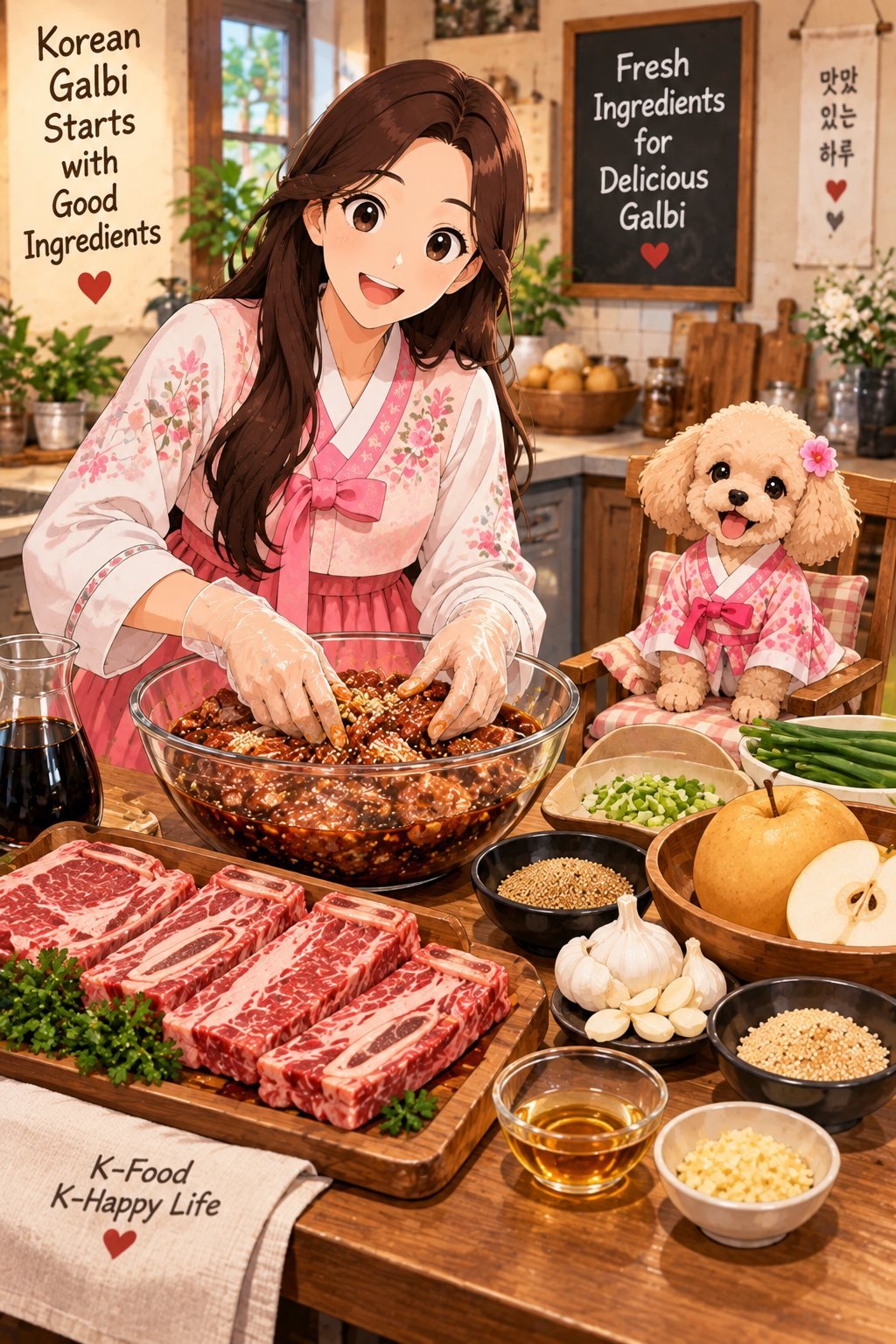
Soy sauce, garlic, green onion, sesame, sesame oil, and fruit such as Korean pear can form the foundation of a savory-sweet galbi marinade.
Marinating the Ribs
Marinating gives the seasoning time to contact the meat before grilling.
The appropriate time depends on the cut, thickness, recipe, and desired result. More time does not automatically mean better galbi because an overly strong marinade can dominate the meat or change its texture.
Raw marinated meat should remain appropriately refrigerated rather than being left at room temperature for an extended period.
Why Galbi Caramelizes on the Grill
Marinated galbi often develops a glossy brown surface and darker grilled areas as it cooks.
The sugars and other components in the marinade react strongly to heat, helping create the roasted appearance and flavor associated with grilled ribs.
This also means marinated galbi can scorch if left over intense heat for too long. Grilling requires attention rather than simply placing the meat over the hottest part of the fire and waiting.
Charcoal vs. Tabletop Grill
Korean barbecue restaurants use different grilling systems. Some emphasize charcoal, while others use gas or other tabletop grill equipment.
Charcoal can contribute a distinctive grilled aroma, but the overall result also depends on the meat, marinade, grill design, heat control, and cooking technique.
The presence of a tabletop grill is part of the interactive Korean BBQ experience, allowing meat to be cooked close to the diners.
How Galbi Is Grilled
Galbi is placed on a sufficiently heated grill and cooked according to the cut and thickness.
The meat is turned so different surfaces cook appropriately, while strongly marinated areas need attention because they can brown quickly.
Raw-meat utensils should be managed carefully. Restaurants may provide separate tongs or other tools for handling uncooked and cooked meat.
Why Korean BBQ Uses Kitchen Scissors
Kitchen scissors are a familiar tool at Korean barbecue tables.
Larger pieces of meat can be cut into bite-sized portions after or during cooking, making them easier to share and wrap in vegetables.
Scissors are practical for tabletop dining because the meat can remain on or near the grill while being divided without moving it to a separate cutting board.
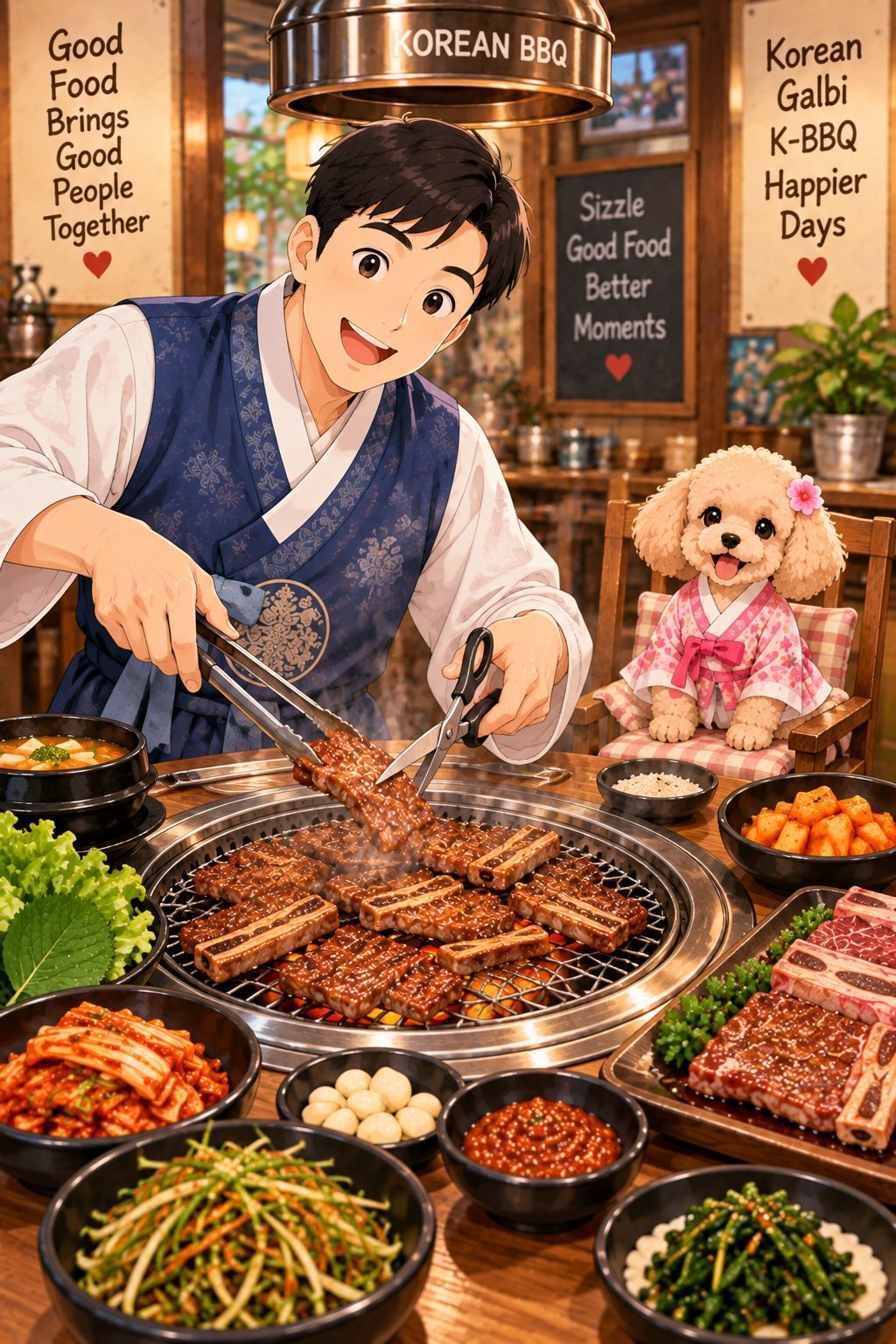
Tongs, kitchen scissors, controlled heat, and careful turning help transform marinated ribs into bite-sized Korean BBQ galbi.
How to Eat Galbi
Galbi can be eaten directly with rice and banchan or combined with fresh vegetables as a ssam.
A small piece of cooked meat can be placed on lettuce or a perilla leaf and combined with garlic, ssamjang, scallion salad, or another accompaniment according to preference.
There is no requirement to put every available condiment into a single wrap. Smaller combinations often make it easier to taste the galbi itself.
What Is Ssam?
Ssam means a wrap. In Korean barbecue dining, leafy vegetables can be used to wrap grilled meat and selected accompaniments into a bite-sized package.
Lettuce is familiar internationally, while perilla leaves provide a more distinctive herbal aroma.
Ssam is not exclusive to galbi, but it is one of the most recognizable ways to enjoy Korean grilled meat.
Ssamjang, Garlic & Scallion Salad
Ssamjang is a thick Korean condiment commonly served with grilled meat and vegetables. Its flavor is savory and concentrated, so only a small amount may be needed in a wrap.
Garlic can be eaten raw or grilled depending on preference and restaurant setup.
Seasoned scallion salad adds freshness, aroma, and a contrasting texture beside rich grilled ribs.
Kimchi & Banchan with Galbi
Kimchi provides acidity, fermentation, chili seasoning, and crisp or softened textures depending on the type.
Other banchan can include seasoned vegetables, pickles, salads, or restaurant-specific dishes.
The exact side-dish selection varies, but the contrast between rich grilled meat and smaller vegetable-based accompaniments is an important part of the Korean BBQ table.
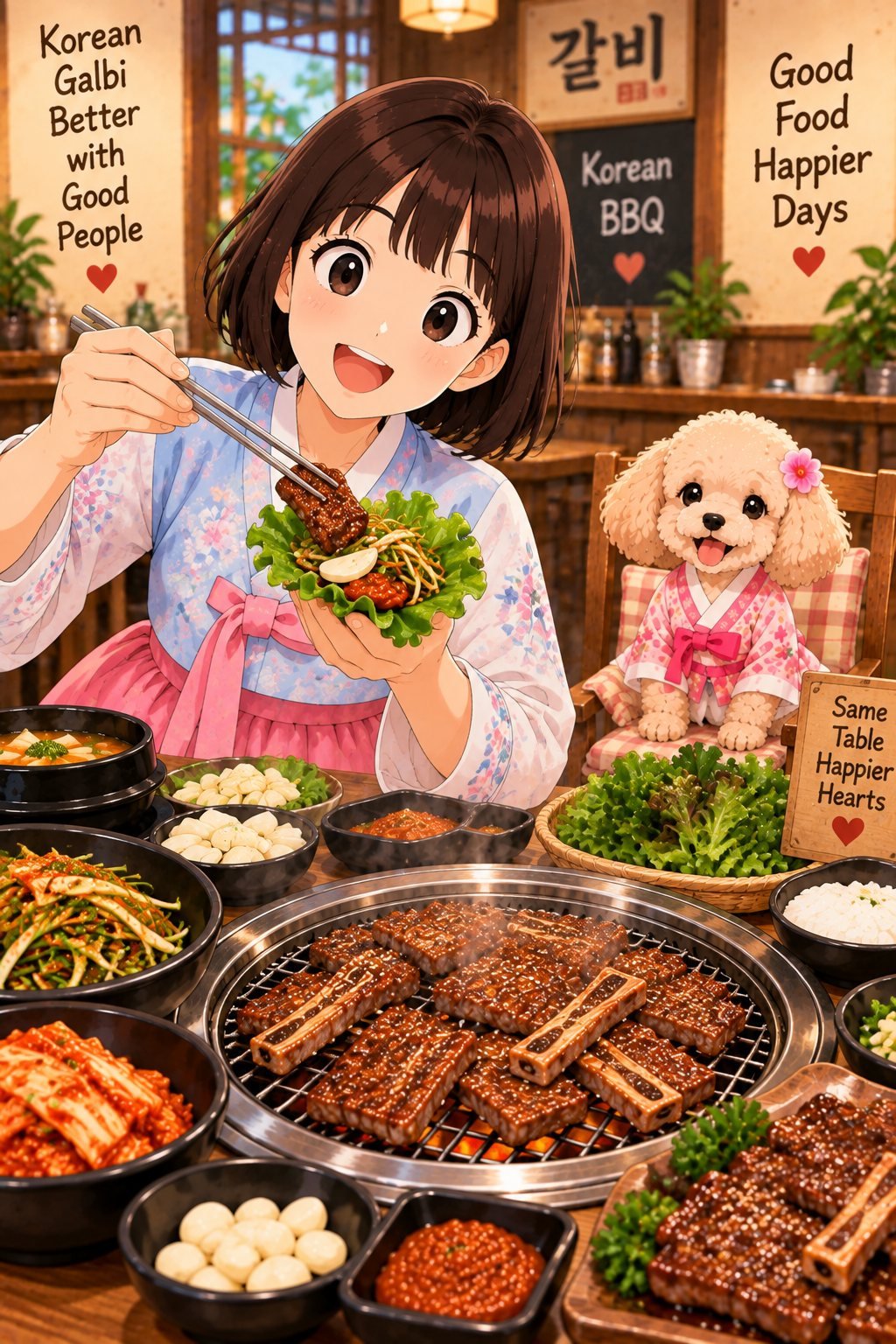
Galbi can be enjoyed in a ssam with lettuce or perilla leaf, garlic, ssamjang, and scallion salad, or simply eaten with rice and banchan.
Galbi & Rice
Plain rice provides a mild base beside strongly seasoned and caramelized ribs.
Diners can alternate bites of galbi and rice or place a small amount of rice inside a vegetable wrap.
Because marinated galbi can already be sweet and salty, rice can help create a more balanced mouthful without adding another strong seasoning.
Is Galbi Always Sweet?
No. Marinated galbi is often associated with a savory-sweet flavor, but sweetness varies substantially between recipes and restaurants.
Saeng galbi can place much more emphasis on the natural flavor of the meat, while different yangnyeom recipes use different amounts and types of sweet ingredients.
International diners should therefore avoid assuming that every Korean rib dish has the same sweet soy flavor.
Galbi vs. Bulgogi
Bulgogi and galbi can both use savory-sweet soy-based seasoning, but they are not the same dish.
Galbi centers on rib cuts, while bulgogi commonly uses thinly sliced meat prepared for quick cooking.
The cut changes the texture, presentation, grilling experience, and relationship with the bone, making the distinction much more significant than the similarity of their marinades.
Galbi vs. Samgyeopsal
Samgyeopsal is pork belly and is commonly grilled without the sweet soy-style marinade strongly associated with many galbi preparations.
Samgyeopsal emphasizes layers of pork fat and meat, while beef galbi emphasizes rib meat and can include bone and marinade.
Both can be grilled at the table and eaten as ssam, but their cuts, flavors, and textures are clearly different.
Galbi & Korean BBQ
Korean BBQ is the larger dining culture that includes many meats, cuts, marinades, grilling methods, sauces, wraps, and side dishes.
Galbi is one important part of that larger category rather than a synonym for Korean BBQ itself.
Understanding this relationship helps international diners read menus more accurately: Korean BBQ describes the dining world, while galbi identifies a rib-centered branch within it.
What Is LA Galbi?
LA galbi is a widely recognized style of Korean beef short ribs in which the ribs are cut thinly across the bones rather than separated into thick individual rib sections.
This cross-cut creates long, relatively thin pieces of meat containing several small sections of bone. The large surface area makes the cut well suited to marinating and relatively quick grilling.
LA galbi has become especially familiar in Korean restaurants, Korean-American food culture, home cooking, and international Korean BBQ.
Why Does LA Galbi Look Different?
The major visual difference comes from the direction in which the butcher cuts through the rib section.
Instead of following between individual rib bones, the cut passes across multiple bones. Each strip can therefore contain several oval or round bone sections surrounded by meat.
This is often described in English as a flanken-style or cross-cut short rib.
LA Galbi vs. Traditional Rib Cuts
LA galbi is relatively thin and broad, while other galbi preparations can use thicker rib sections or meat shaped differently around the bone.
The thinner cut provides more exposed surface for marinade and generally cooks faster than a thick rib section.
Neither format represents every Korean galbi preparation. They are different ways of preparing rib meat for particular cooking and dining experiences.
Why Is It Called LA Galbi?
The exact origin of the name “LA galbi” has been explained in more than one way, and the name should not be presented as having one universally proven origin without qualification.
It is strongly associated with Korean-American food culture and the popularity of cross-cut short ribs in Los Angeles and other Korean communities in the United States.
Some explanations connect “LA” directly with Los Angeles, while other popular explanations refer to the lateral direction of the cut. For travelers, the most useful point is practical: LA galbi usually identifies the recognizable thin cross-cut rib style.
Galbi & Korean-American Food Culture
Galbi demonstrates how Korean food traditions can adapt as communities move between countries and encounter different butchery systems, ingredients, restaurants, and dining environments.
LA galbi became highly recognizable within Korean-American cooking and later circulated widely through restaurants, supermarkets, recipes, and international Korean BBQ culture.
This makes it useful not only as a meat cut but also as an example of how Korean food develops through migration and cultural exchange.
Galbi vs. Galbi-jjim
Galbi is not always grilled. Korean rib dishes also include galbi-jjim, a braised preparation with a very different cooking method and final texture.
Grilled galbi is cooked over a grill or similar high-heat surface and develops browned, roasted flavors.
Galbi-jjim cooks ribs more slowly with liquid and seasonings until the meat becomes tender. Vegetables and other ingredients can also be included depending on the recipe.
Travelers should therefore check the full menu name rather than assuming that every dish containing the word “galbi” will arrive at the table as Korean BBQ.
Ordering Galbi at a Korean BBQ Restaurant
Before ordering, check whether the menu describes beef galbi, pork galbi, marinated galbi, fresh galbi, or LA galbi.
Also check whether the listed portion is intended for one diner or for sharing. Korean BBQ restaurants can use minimum-order requirements or portion systems that differ from what international visitors expect.
Some restaurants grill the meat for customers, while others allow diners to cook it themselves. Follow the restaurant’s service style rather than assuming every Korean BBQ table works the same way.
Does the Weight Include the Bone?
Galbi is a bone-in cut in many preparations, so part of the served weight can consist of bone rather than edible meat.
The exact cut and presentation vary, and some restaurants can serve meat prepared differently around or away from the bone.
When portion size or value matters, read the menu description carefully instead of comparing galbi directly with a boneless meat using only the listed weight.
Why Galbi Can Cost More Than Some Other BBQ Cuts
Galbi can be positioned as a premium Korean BBQ choice, particularly when higher-grade beef or particular rib cuts are used.
Price can depend on beef origin, grade, cut, restaurant location, portion size, marinade, service style, and whether the restaurant specializes in premium Korean beef.
There is therefore no universal price that defines authentic galbi.
First-Time Galbi Tips
- Check the meat — confirm whether the menu uses beef or pork.
- Check the style — saeng galbi and yangnyeom galbi provide different experiences.
- Look at the cut — LA galbi looks very different from thicker rib preparations.
- Remember the bone — listed weight and visible portion size can include bone.
- Do not overload the ssam — a small amount of garlic, ssamjang, or scallion salad can be enough.
- Watch marinated meat carefully — sweet marinades can brown and scorch quickly.
- Keep raw and cooked utensils separate — do not place fully cooked galbi back onto a plate that held raw meat.
- Follow the restaurant — staff may handle the grilling at some Korean BBQ restaurants.
Eating Galbi from the Bone
Depending on the cut, cooked meat can remain attached to sections of rib bone.
Kitchen scissors, tongs, chopsticks, or other utensils can be used to separate manageable portions according to the restaurant setup.
Bone fragments can occasionally be present around cut ribs, so diners should eat carefully rather than biting aggressively into unfamiliar bone-in pieces.
Galbi for a Shared Korean BBQ Meal
Korean BBQ is often a shared dining experience. Several portions of meat can be grilled while diners share vegetables, sauces, rice, soup, and banchan around the same table.
Galbi works naturally in this format because cooked pieces can be divided into smaller portions and eaten in different combinations.
One diner might prefer galbi with rice, another might make a lettuce ssam, and another might eat the meat with only a small amount of sauce.
The Complete Galbi Experience
A Korean galbi meal combines more than marinated ribs alone. The experience can include the sound and aroma of grilling, shared side dishes, fresh lettuce and perilla leaves, garlic, ssamjang, scallion salad, kimchi, rice, and conversation around the table.
Saeng galbi emphasizes the meat differently from yangnyeom galbi, while LA galbi introduces another recognizable cut and Korean-American dimension.
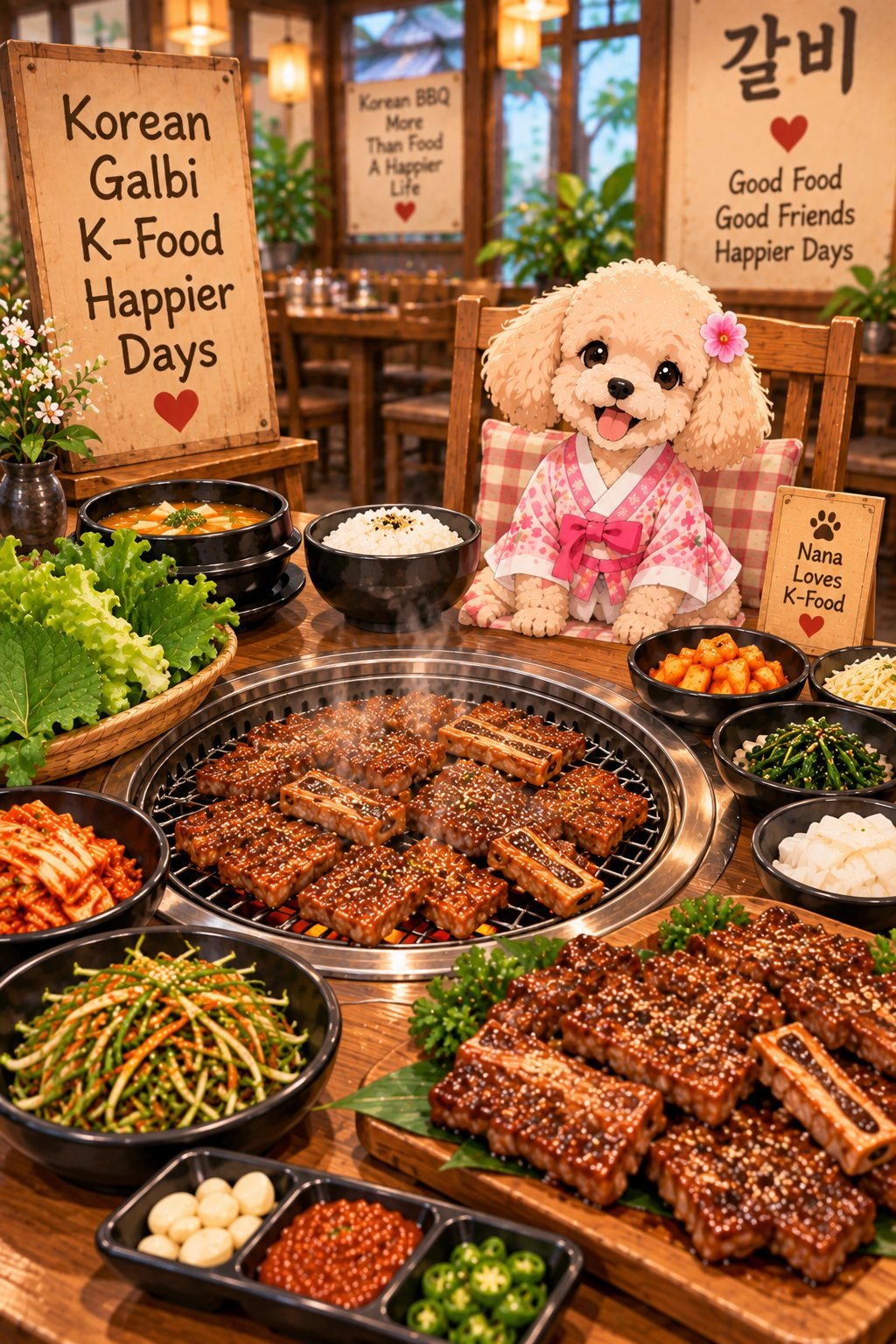
Grilled ribs, ssam vegetables, garlic, ssamjang, kimchi, rice, and banchan bring together the meat, cooking, and shared-table traditions of Korean galbi.
How Galbi Connects with Other K-Food
Korean BBQ provides the larger framework for understanding tabletop grilling, shared meat, banchan, sauces, vegetables, and Korean barbecue restaurant culture.
Bulgogi provides an important comparison because both dishes can use savory-sweet soy-based seasoning, but bulgogi generally centers on thinly sliced meat while galbi centers on ribs.
Samgyeopsal demonstrates another major Korean BBQ experience through thick slices of pork belly commonly grilled without the sweet soy marinade associated with many galbi dishes.
Kimchi introduces the fermented side dish that commonly accompanies grilled meat, while Gimbap and Bibimbap expand the collection into portable and mixed-rice dishes.
Korean Fried Chicken provides another internationally recognizable Korean meat experience, but uses fried chicken and sauce rather than tabletop-grilled ribs.
Mandu introduces Korean dumplings, while Japchae provides a glass-noodle dish that can also appear as part of a larger Korean meal.
Kimchi-jjigae, Sundubu-jjigae, and Samgyetang show three very different directions within Korea’s hot soup and stew culture.
Tteokbokki, Korean Ramyeon, and Buldak Bokkeummyeon extend the collection into bunsik, instant noodles, and modern K-Spicy culture.
Jjajangmyeon, Naengmyeon, and Kimchi Fried Rice provide further comparisons across Korean noodle and rice meals.
Galbi & a Korea Travel Day
A Korean BBQ meal can fit naturally into an evening after exploring Seoul because galbi is commonly associated with a slower, shared table experience rather than a meal that needs to be eaten quickly.
A day in Hongdae can combine contemporary youth culture, shopping, cafés, and an evening Korean BBQ meal.
Travelers interested in traditional Seoul can combine dining with Gyeongbokgung Palace, Bukchon Hanok Village, or Insadong.
Gwangjang Market offers another perspective on Korean food through traditional-market dining, allowing travelers to compare market foods with the shared grill culture of a Korean BBQ restaurant.
FAQ
What is galbi?
Galbi means ribs in Korean. In Korean food, the term commonly refers to beef or pork rib dishes prepared in several styles, including fresh ribs, marinated ribs, grilled ribs, and braised preparations.
Is galbi always beef?
No. Beef galbi is internationally well known, but pork galbi also exists. Diners with dietary, religious, or personal restrictions should confirm the meat rather than assuming every menu item containing the word “galbi” uses beef.
What is the difference between galbi and bulgogi?
Galbi centers on rib cuts, while bulgogi commonly uses thinly sliced meat. Both can use savory-sweet soy-based seasoning, but the meat cut, texture, presentation, and cooking experience are different.
What is LA galbi?
LA galbi commonly refers to relatively thin beef short ribs cut across the bones. This creates strips containing several small bone sections and a broad surface that works well with marinade and quick grilling.
What is the difference between saeng galbi and yangnyeom galbi?
Saeng galbi generally refers to fresh or unseasoned ribs that emphasize the meat itself. Yangnyeom galbi refers to seasoned or marinated ribs. Restaurant recipes and terminology can vary.
How do you eat Korean galbi?
Cooked galbi can be eaten with rice and banchan or wrapped in lettuce or perilla leaves as ssam. Garlic, ssamjang, scallion salad, kimchi, and other accompaniments can be added according to preference.
Is galbi the same as Korean BBQ?
No. Korean BBQ is the broader dining category covering many grilled meats, cuts, marinades, sauces, wraps, and side dishes. Galbi is a rib-centered category within that larger Korean barbecue culture.
Where to Try Galbi
Galbi is commonly associated with Korean barbecue restaurants, including restaurants specializing in beef, ribs, charcoal grilling, or premium Korean meat.
Restaurant styles differ significantly. Some focus on marinated galbi, others emphasize fresh ribs, and some offer both beef and pork versions.
LA galbi can also appear in Korean restaurants, supermarkets, butcher shops, and home cooking, particularly in Korean-American food culture.
What to Check Before Ordering
Start by confirming whether the menu item is beef or pork and whether it is fresh or marinated.
Check the portion size, listed weight, price, and whether the weight includes bone. Also look for minimum-order requirements because some Korean BBQ restaurants require multiple portions or a minimum quantity for the table.
If the menu offers several rib cuts, ask staff when necessary rather than assuming all galbi will have the same thickness or presentation.
Who Grills the Galbi?
Service varies between Korean BBQ restaurants.
At some restaurants, staff members place, turn, cut, and monitor the meat. At others, diners manage most of the grilling themselves.
If staff begin handling the grill, following their service is generally easier than simultaneously moving or turning the meat yourself.
Food & Allergy Notes
Galbi marinades vary between restaurants and recipes. Soy sauce or other soy-containing seasonings are common, while sesame oil and sesame seeds can also appear.
Garlic, green onion, sugar or another sweet ingredient, fruit, sauces, and other seasonings can be included depending on the preparation.
Ssamjang and banchan introduce additional ingredients and potential allergens that are separate from the ribs themselves.
People with allergies, intolerances, medical conditions, religious dietary restrictions, or other dietary requirements should confirm the meat, marinade, sauces, side dishes, and shared cooking environment directly with the restaurant.
Beef & Pork Identification
Because galbi can refer to both beef and pork rib dishes, identifying the meat is particularly important for diners who avoid one of them.
Appearance alone is not always a reliable method, especially after the meat has been marinated and grilled.
Confirm the menu description or ask the restaurant before ordering when the distinction matters.
Soy & Sesame
Soy and sesame are especially relevant to many Korean BBQ marinades and condiments.
Soy sauce can form the base of a galbi marinade, while sesame oil and sesame seeds can be used for aroma and finishing.
Ssamjang and other sauces can contain additional ingredients, so checking only the meat marinade may not be sufficient for someone managing an allergy.
Raw Meat & Cross-Contamination
Korean tabletop barbecue places raw and cooked food close to the same dining area, making utensil management important.
Tongs or other utensils used for raw meat should not automatically be used to transfer fully cooked galbi directly to a diner’s plate unless they have been appropriately changed or handled.
Raw meat should also not be returned to plates holding cooked meat, lettuce, perilla leaves, or other ready-to-eat foods.
Cooking Galbi Safely
Galbi cuts vary in thickness, bone structure, and meat type, so cooking time cannot be determined by one universal number.
Beef and pork should be cooked using appropriate food-safety practices for the specific cut and preparation.
Color and grill marks alone are not always reliable indicators of doneness, particularly with marinated meat whose surface can darken quickly.
Marinade Is Not a Doneness Indicator
Sugar and other ingredients in a galbi marinade can caramelize and darken rapidly over high heat.
A deeply browned exterior therefore does not automatically mean the center of a thick piece has reached an appropriate level of doneness.
Heat should be controlled so the exterior does not burn before the meat has cooked appropriately.
Tabletop Grill & Burn Safety
A Korean BBQ grill can remain extremely hot throughout the meal and for some time afterward.
Do not touch the grill surface, charcoal area, burner, exhaust equipment, or hot metal surrounding the cooking zone.
Keep loose clothing, bags, children, and pets away from the grill. Use the provided tongs, scissors, and other appropriate utensils rather than reaching across the hot cooking surface.
Charcoal, Smoke & Ventilation
Charcoal and high-heat grilling can generate smoke, heat, and cooking fumes.
Korean BBQ restaurants commonly use ventilation or extraction systems around the table, but equipment and restaurant layouts differ.
Do not obstruct ventilation equipment, and follow restaurant instructions concerning charcoal, burners, grill plates, or exhaust systems.
Bone Safety
Galbi can contain substantial sections of bone, particularly in short-rib preparations.
Cross-cut ribs can also contain smaller bone sections, and cutting or grilling can occasionally leave small fragments.
Eat bone-in galbi carefully and avoid biting forcefully into hard or unfamiliar pieces.
Scissors & Tongs
Kitchen scissors and metal tongs are useful Korean BBQ tools but should be handled carefully around a crowded table.
Keep scissors pointed away from other diners and avoid placing hot tongs where someone can accidentally touch them.
When restaurants provide separate tools for raw and cooked meat, preserve that separation throughout the meal.
Leftovers & Takeaway
Cooked galbi and other perishable foods should not remain at room temperature for an extended period.
If a restaurant permits takeaway, store leftovers appropriately and follow suitable food-safety practices for transport, refrigeration, and reheating.
Raw marinated meat purchased for home cooking also requires appropriate refrigeration and separation from ready-to-eat foods.
Image Credits
Korean galbi family dining visual with Dad, Mom, K-Nana daughter, and Nana in hanbok enjoying grilled Korean short ribs with lettuce, perilla leaves, garlic, ssamjang, scallion salad, kimchi, and Korean banchan — K-Nana Studio original visual.
Korean galbi preparation visual with Mom in hanbok preparing beef short ribs and a soy-based marinade with garlic, green onion, sesame, sesame oil, and Korean pear while Nana watches from a separate safe seat — K-Nana Studio original visual.
Korean galbi grilling visual with Dad in hanbok using tongs and kitchen scissors to cook marinated short ribs on a Korean BBQ tabletop grill while Nana remains safely separated from the hot cooking area — K-Nana Studio original visual.
Korean galbi ssam visual with K-Nana daughter in hanbok combining grilled short rib with lettuce, perilla leaf, garlic, ssamjang, and scallion salad while Nana sits separately without touching food or the grill — K-Nana Studio original visual.
Nana in pink floral hanbok seated separately as a K-Food mascot beside grilled Korean galbi, lettuce, perilla leaves, garlic, ssamjang, scallion salad, kimchi, rice, and Korean banchan — K-Nana Studio original visual.
Disclaimer
This article is provided for general food, travel, and cultural information. Galbi cuts, meat types, marinades, ingredients, allergens, portion sizes, prices, grilling methods, and restaurant service can vary. Beef and pork require appropriate handling and cooking, and raw meat should be kept separate from cooked and ready-to-eat foods. Marinades and condiments can contain soy, sesame, fruit, garlic, sweeteners, and other recipe-dependent ingredients. Tabletop grills, charcoal, burners, hot metal, steam, cooking fumes, scissors, and tongs can cause injury if handled improperly. Bone-in and cross-cut ribs can contain hard bone or small fragments. People with allergies, medical conditions, religious dietary restrictions, or other individual requirements should confirm ingredients and preparation directly with the restaurant or food provider and follow appropriate professional guidance when necessary.