
Tteok is the broad Korean category of rice cakes made in many different shapes, textures, colors, and flavors. Some tteok is soft and chewy, some is steamed into thick cakes, and other varieties are shaped, coated, sliced, filled, or cooked again as part of another Korean dish.
For international visitors, “Korean rice cake” is a useful English description, but tteok is much more diverse than a single food. Garaetteok, injeolmi, songpyeon, sirutteok, chapssaltteok, and baekseolgi can look and taste remarkably different from one another.
Tteok also has an important cultural role in Korea. Different varieties are connected with holidays, family celebrations, traditional ceremonies, desserts, street food, soups, and everyday snacks.
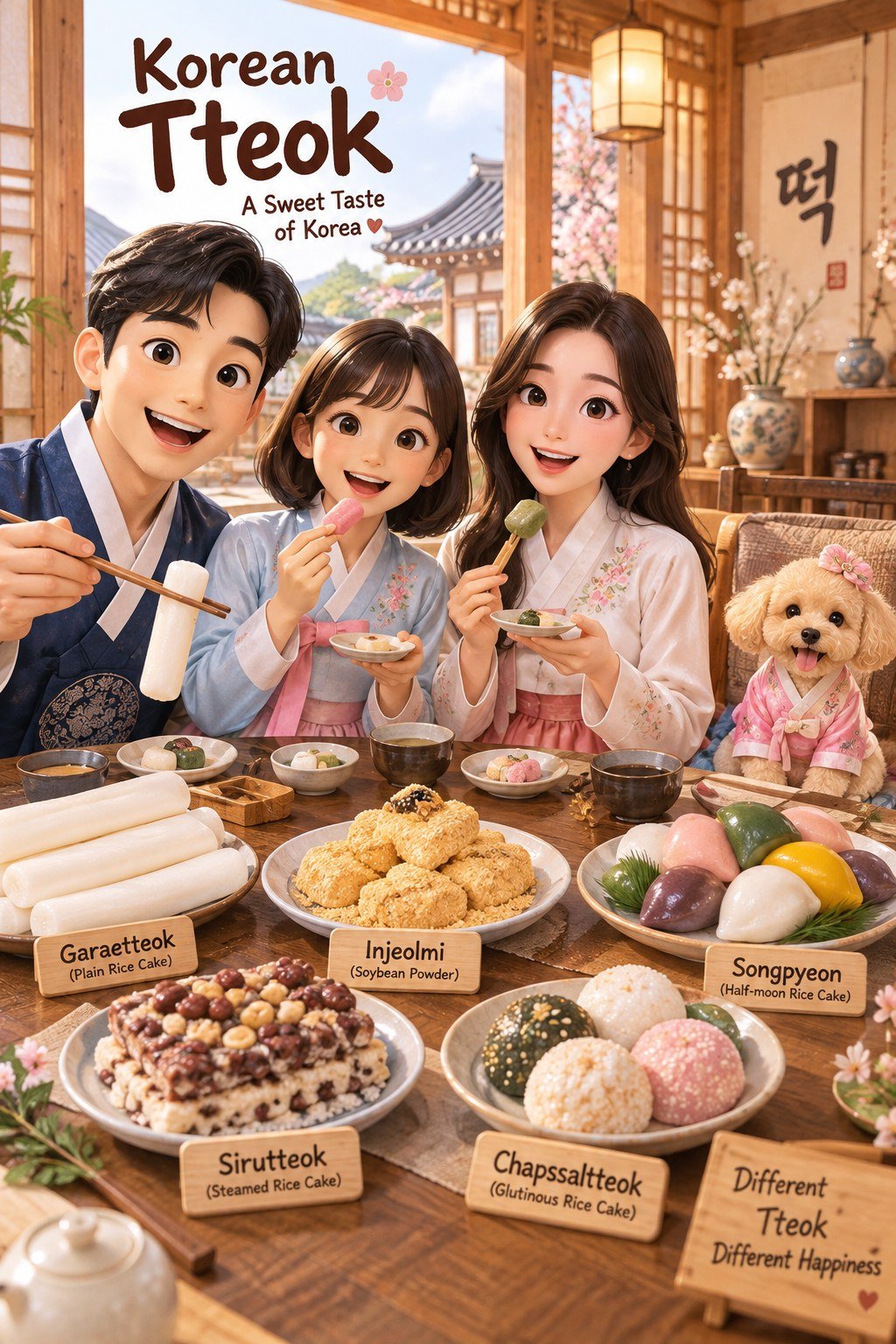
Garaetteok, injeolmi, songpyeon, sirutteok, and chapssaltteok show how diverse Korea’s rice-cake tradition can be.
Quick Guide
| Korean name | 떡 |
| Romanization | Tteok |
| Common English description | Korean rice cake |
| Main ingredients | Rice flour, glutinous rice flour, or other recipe-dependent grain preparations |
| Common textures | Chewy, soft, dense, sticky, tender, or layered depending on the variety |
| Major examples | Garaetteok, injeolmi, songpyeon, sirutteok, chapssaltteok and baekseolgi |
| Common uses | Desserts, snacks, holidays, ceremonies, soups and dishes such as tteokbokki |
| Important holidays | Seollal and Chuseok |
| Important first-time tip | Tteok can be very chewy and should be eaten in manageable pieces and chewed thoroughly |
What Is Tteok?
Tteok is a large family of Korean rice cakes rather than one standardized recipe.
Different varieties can be made from non-glutinous rice, glutinous rice, or other grain-based preparations and can include red bean, soybean powder, sesame, nuts, sweet fillings, or other ingredients.
The rice mixture can also be steamed, pounded, shaped, sliced, coated, filled, or prepared using other methods depending on the type of tteok.
Why Is Tteok Called Korean Rice Cake?
“Korean rice cake” is the most convenient broad English description for tteok.
However, the word “cake” can create the wrong expectation for someone imagining a soft Western-style baked cake. Many types of tteok are steamed or otherwise prepared rather than baked, and some have a dense or highly chewy texture.
It is therefore useful to understand Korean rice cake as a category name rather than a description of one cake-like texture.
Rice vs. Glutinous Rice
Different types of rice produce different tteok characteristics.
Non-glutinous rice can be used for varieties with firmer or more structured textures, while glutinous rice is strongly associated with particularly sticky and chewy rice cakes.
Despite the English name “glutinous rice,” glutinous rice refers to its sticky texture rather than the presence of gluten.
Is Tteok Gluten-Free?
Rice itself does not contain gluten, but not every product called tteok should automatically be assumed to be gluten-free.
Recipes can include additional grains, flavorings, sauces, fillings, coatings, or processed ingredients, and commercial preparation can involve shared equipment.
Anyone who must strictly avoid gluten should check the specific ingredients and preparation conditions rather than relying only on the word “rice cake.”
Why Is Tteok So Chewy?
The distinctive texture comes from the properties of cooked rice starch and the way the rice or rice flour is processed.
Steaming, pounding, kneading, shaping, and moisture levels can influence whether a particular tteok becomes soft, elastic, dense, sticky, or highly chewy.
This texture is one reason tteok has become especially recognizable in international food videos and other content focused on chewy foods.
How Tteok Is Made
There is no single manufacturing method that applies to every Korean rice cake.
Rice can be soaked, ground into flour, mixed with water or other ingredients, steamed, pounded, kneaded, shaped, coated, or cut depending on the desired variety.
The preparation technique is therefore one of the main reasons different tteok can have dramatically different textures even when rice remains the central ingredient.
Preparing Rice Flour for Tteok
Some tteok begins with rice that has been soaked and ground, while other preparations can use rice flour prepared for a specific recipe.
Moisture is important because overly dry or overly wet flour can change how the rice cake steams and holds together.
The flour can also be sifted to create a more even texture before steaming or shaping.
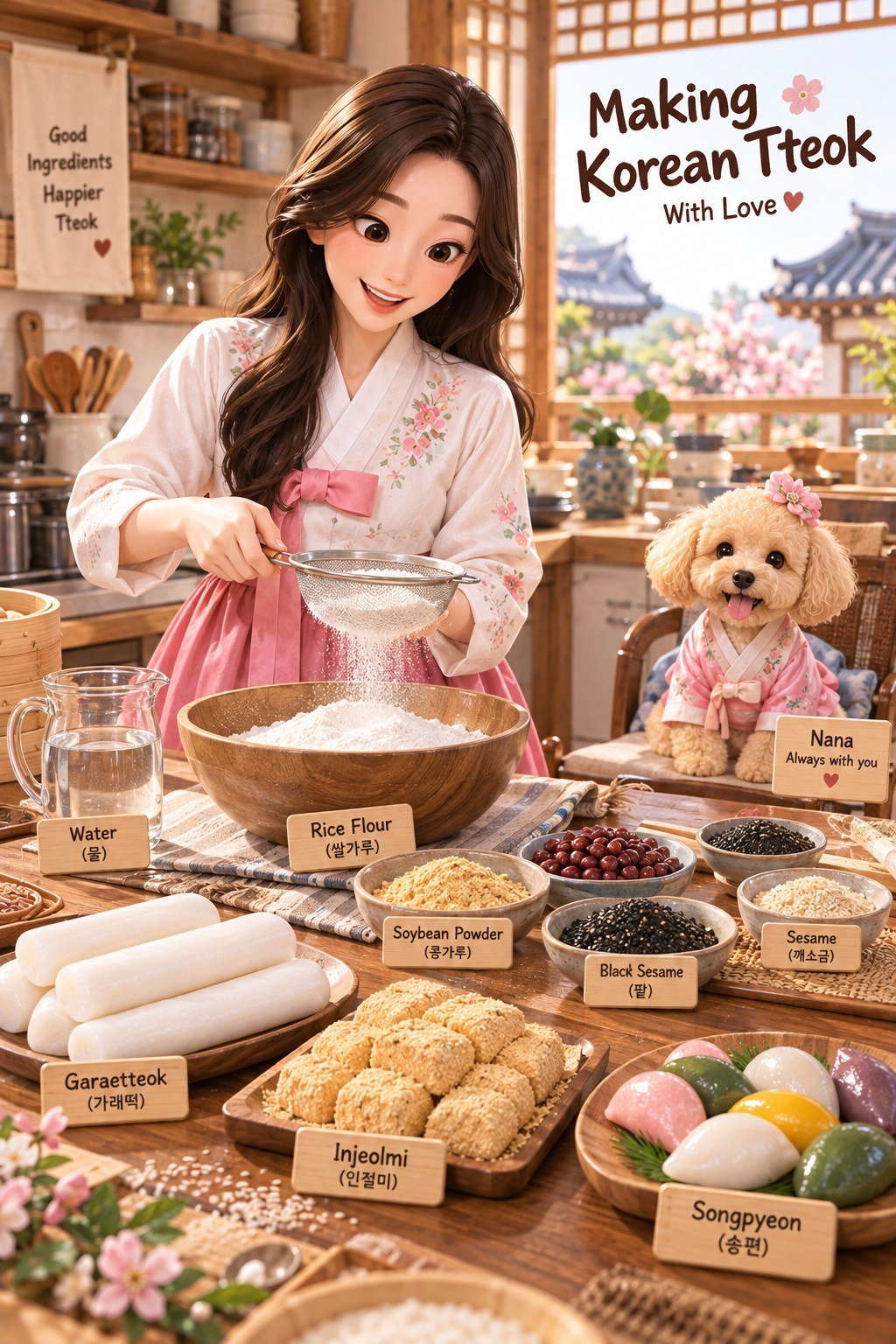
Rice flour, glutinous rice flour, soybean powder, red bean, and sesame can become the foundation for very different Korean tteok traditions.
Steaming Tteok
Steaming is an important technique in Korean rice-cake making.
Moistened rice flour or prepared rice mixtures can be placed into a steamer so heat and steam cook the starch without requiring an oven.
The exact steaming process varies according to the rice, thickness, ingredients, and type of tteok being prepared.
Pounding Tteok
Pounding is another technique strongly associated with traditional rice-cake making.
Cooked rice or a prepared rice mass can be repeatedly pounded and worked until its texture becomes more cohesive, smooth, and elastic.
Traditional demonstrations using a large wooden mallet are visually memorable, although modern production can use specialized machinery to perform similar processing more efficiently.
Why Tteok Is Kneaded & Shaped
After cooking or pounding, some rice-cake dough is worked further to create the desired consistency.
It can then be rolled into long cylinders, divided into pieces, flattened, filled, molded, or coated depending on the final tteok.
This shaping stage helps explain why one rice-based preparation can become a long white garaetteok while another becomes small pieces of injeolmi or colorful songpyeon.
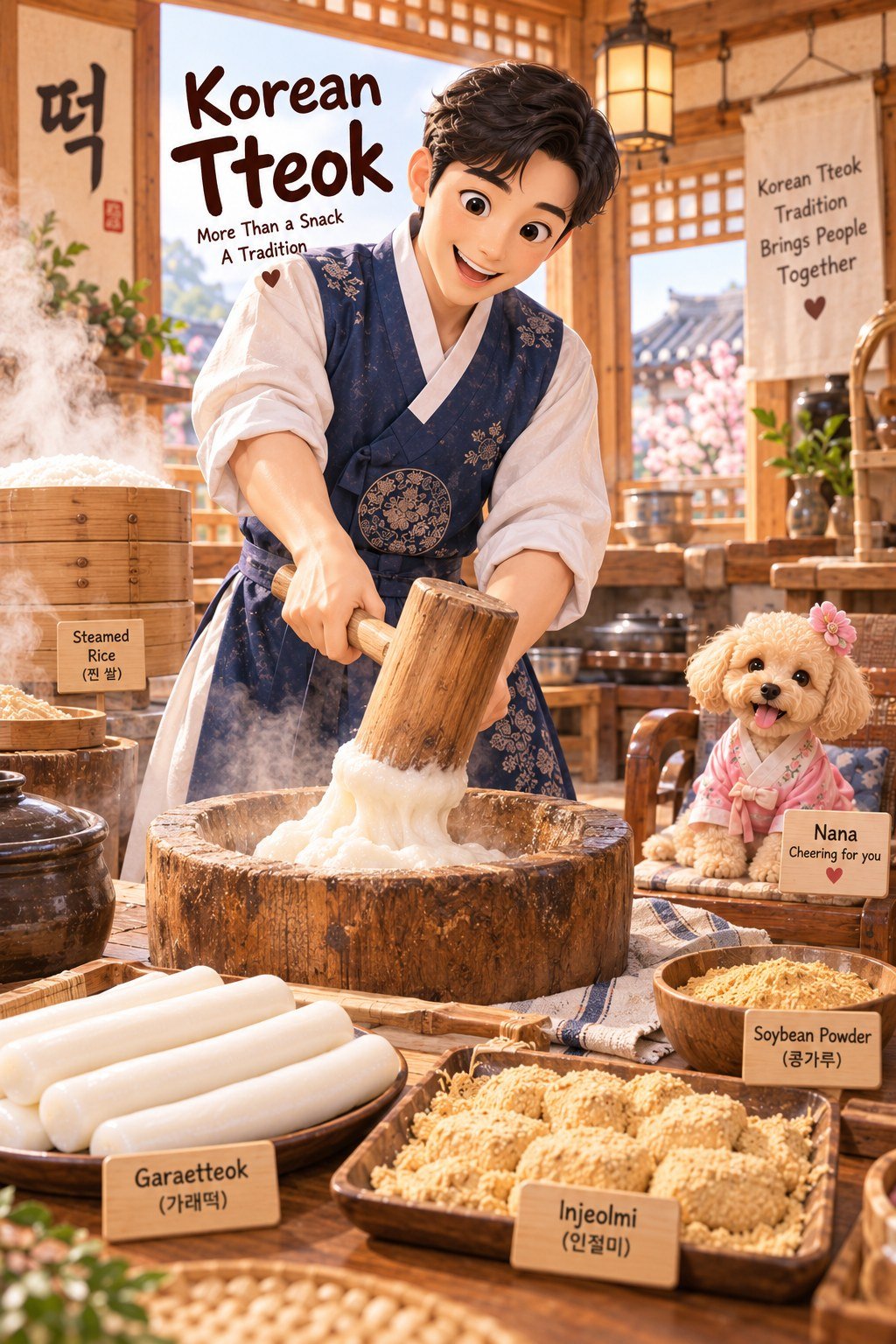
Steaming, pounding, kneading, and shaping transform cooked rice into the elastic and chewy textures associated with many Korean rice cakes.
What Is Garaetteok?
Garaetteok is a long, smooth, cylindrical white rice cake.
Its simple appearance makes it an important base for several familiar Korean dishes. Fresh garaetteok can be eaten in pieces, while different cuts are used for other preparations.
The long cylinder can be cut into shorter pieces for dishes such as tteokbokki or sliced diagonally into thin oval pieces for tteokguk.
Garaetteok & Tteokbokki
Tteokbokki is not another word for tteok. It is a specific Korean dish that uses rice cakes as a central ingredient.
The familiar cylindrical rice cakes absorb sauce while retaining their chewy texture, creating the contrast that defines much of the tteokbokki experience.
This relationship is useful for international visitors: tteok is the broad rice-cake category, while tteokbokki is one famous dish made with particular rice cakes.
Garaetteok & Tteokguk
Tteokguk is a Korean soup made with thinly sliced rice cakes and is strongly associated with Seollal, the Korean Lunar New Year.
Garaetteok can be sliced diagonally into oval pieces that soften as they cook in the soup.
This demonstrates how the same basic rice-cake tradition can move from long cylindrical tteok into a completely different dish through slicing and cooking.
What Is Injeolmi?
Injeolmi is a chewy Korean rice cake commonly associated with glutinous rice and a coating of roasted soybean powder.
The powder gives the exterior a beige color and a roasted, nutty aroma that contrasts with the mild chewy rice cake underneath.
Injeolmi can be eaten as a traditional rice cake and has also inspired modern desserts such as injeolmi toast, ice cream, and bingsu.
Injeolmi & Bingsu
Bingsu provides one of the clearest modern examples of tteok moving into Korean café culture.
Injeolmi bingsu can combine fine milk ice with pieces of rice cake and roasted soybean powder, adding chewy and nutty textures to the cold dessert.
This connection shows how traditional tteok flavors can be adapted into contemporary Korean desserts without replacing the original rice cake tradition.
What Is Songpyeon?
Songpyeon is one of Korea’s most culturally recognizable rice cakes and is strongly associated with Chuseok, the Korean harvest holiday.
It is commonly shaped into small half-moon forms and can contain fillings made with ingredients such as sesame, beans, or other recipe-dependent mixtures.
Different colors can be created using various ingredients, giving a plate of songpyeon a distinctive festive appearance.
Songpyeon & Chuseok
Songpyeon is closely connected with family gatherings and holiday food traditions during Chuseok.
Preparing and sharing rice cakes can be part of the cultural experience surrounding the holiday rather than simply a dessert course.
Recipes and family traditions vary, so no single filling or color represents every songpyeon served in Korea.
What Is Sirutteok?
Sirutteok refers to rice cakes associated with steaming in a traditional earthenware steamer called a siru.
Different versions can use rice flour, red bean, beans, or other ingredients to create layered or topped steamed rice cakes.
Its structure and texture differ noticeably from long garaetteok or individually shaped songpyeon.
What Is Chapssaltteok?
Chapssaltteok is made with glutinous rice and is known for its particularly soft, sticky, and chewy texture.
Some versions contain sweet red bean or another filling inside, creating a contrast between the elastic outer rice cake and the softer center.
Because the texture can be dense and sticky, small bites and thorough chewing are especially important.
What Is Baekseolgi?
Baekseolgi is a white steamed rice cake with a soft, crumbly or tender structure that differs from highly elastic varieties such as injeolmi.
Its clean white appearance has long made it suitable for Korean celebrations and family occasions.
Baekseolgi demonstrates why “chewy” alone cannot describe every type of tteok.
What Is Jeolpyeon?
Jeolpyeon is a Korean rice cake commonly shaped from prepared rice dough and can feature decorative pressed patterns on its surface.
Its texture is smooth and pleasantly chewy, while the molded designs provide a visual element that distinguishes it from plain cylindrical rice cakes.
Like many traditional tteok varieties, exact shapes and preparation can differ according to occasion, maker, and region.
How to Taste Different Tteok
When several varieties are available, begin with small pieces rather than treating every rice cake as having the same texture.
Compare a simple garaetteok with soybean-coated injeolmi, filled songpyeon, soft chapssaltteok, or steamed baekseolgi.
Differences in rice, preparation, filling, coating, moisture, and freshness become much easier to understand when the varieties are tasted side by side.
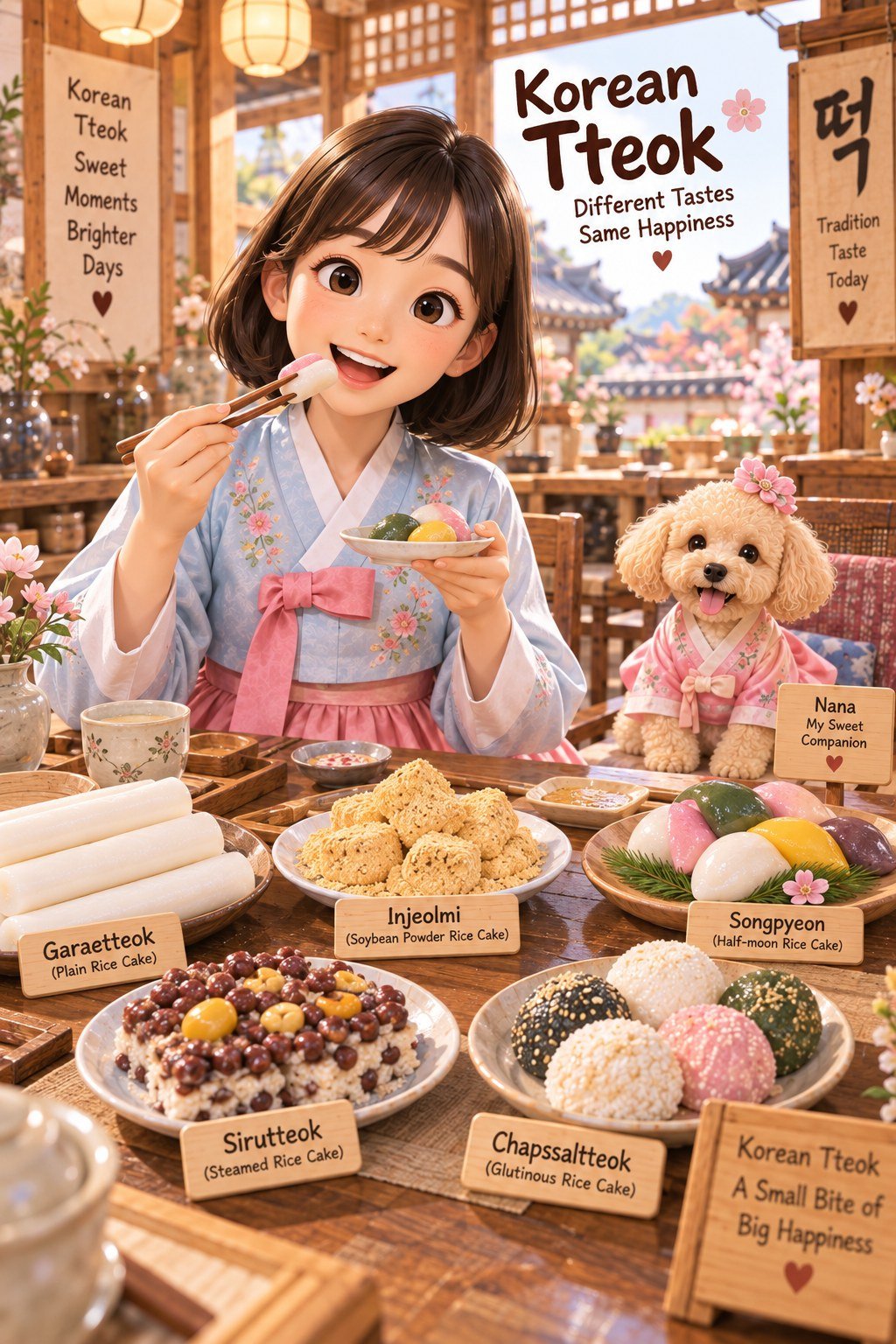
Injeolmi, songpyeon, chapssaltteok, and garaetteok reveal how Korean rice cakes can differ dramatically in shape, coating, filling, softness, and chewiness.
Freshness & Tteok Texture
Freshness has a major effect on rice-cake texture.
Many tteok varieties are softest soon after preparation and gradually become firmer as they cool and age.
Storage and reheating methods therefore matter if the goal is to preserve or restore an enjoyable texture.
Why Does Tteok Become Hard?
Cooked rice starch changes as it cools and sits, causing many rice cakes to lose softness over time.
The rate depends on the type of tteok, moisture, ingredients, temperature, and storage conditions.
A rice cake becoming firm does not necessarily mean it was originally intended to have that texture.
Tteok in Korean Food Culture
Tteok occupies a broader cultural role than a single dessert or snack.
Different rice cakes can appear at holidays, birthdays, family celebrations, traditional ceremonies, markets, cafés, restaurants, and everyday snack tables.
Understanding tteok therefore helps explain several other Korean foods and traditions rather than only one recipe.
Tteok & Seollal
Tteok has an important place in Seollal, the Korean Lunar New Year.
One of the best-known examples is tteokguk, a soup containing thin oval slices of rice cake. The rice cakes soften in the hot broth while retaining a gentle chew.
The dish connects tteok with the beginning of a new year, family gatherings, and one of Korea’s major traditional holidays.
Tteokguk Rice Cakes
The rice cakes used for tteokguk are commonly made by slicing long garaetteok diagonally into thin oval pieces.
This shape increases the surface area and allows the pieces to cook relatively quickly in soup.
Packaged sliced rice cakes are also widely available, making tteokguk preparation different from producing garaetteok itself from the beginning.
Tteok & Chuseok
Chuseok provides another major connection between Korean rice cakes and holiday culture.
Songpyeon is especially associated with the holiday and is commonly prepared as small half-moon-shaped rice cakes with fillings.
Making and sharing songpyeon can be part of family holiday traditions, demonstrating how tteok can carry cultural meaning beyond flavor alone.
Tteok at Birthdays & Family Celebrations
Different forms of tteok can appear at birthdays, family gatherings, and other celebratory occasions.
The exact rice cake depends on the occasion, family, region, and contemporary preference.
This diversity means there is no single “celebration tteok” that represents every Korean family event.
Tteok & Dol
Dol refers to a child’s first-birthday celebration in Korean culture.
Rice cakes can form part of the food traditions surrounding the occasion, with particular varieties and presentation depending on family custom.
Modern celebrations can combine traditional elements with contemporary cakes, decorations, venues, and foods.
Traditional Korean Tteok Shops
Specialized rice-cake shops provide one of the clearest ways to see the diversity of tteok in one place.
Displays can include individually shaped rice cakes, steamed cakes, coated varieties, filled tteok, sliced products, gift assortments, and seasonal or ceremonial selections.
Because many rice cakes are strongly affected by freshness, production timing and storage can be particularly important at a tteok shop.
Tteok at Traditional Markets
Traditional markets can provide another setting for encountering Korean rice cakes alongside other prepared foods and ingredients.
The experience can make differences in size, color, coating, filling, and texture easier to understand than seeing only one packaged variety.
Individual vendors and products change, so a market should not be treated as a guarantee that one specific type of tteok will always be available.
Tteok & Modern Korean Dessert Cafes
Traditional rice-cake flavors have increasingly moved into contemporary Korean dessert presentations.
Injeolmi can appear with Bingsu, while rice cakes or rice-cake-inspired flavors can be paired with ice cream, toast, drinks, cream, fruit, or other café desserts.
This allows traditional textures and ingredients to reach diners who may first encounter tteok through modern Korean café culture.
Modern & Fusion Tteok
Tteok continues to change rather than existing only as a historical food.
Modern makers can experiment with colors, shapes, fillings, creams, fruit, chocolate, cheese, and other ingredients while maintaining a rice-cake base.
These products should be understood as contemporary variations rather than evidence that every traditional tteok uses the same ingredients.
Tteok & Global K-Food
As Korean food has expanded internationally, rice cakes have become visible through several different routes.
Some international diners first encounter tteok through Tteokbokki, while others discover injeolmi through desserts, sliced rice cake through Korean soup, or filled rice cakes through packaged Korean snacks.
This gives tteok an unusual position: it can function as a traditional ceremonial food, a street-food ingredient, a dessert, or a modern packaged product.
Why Chewy Tteok Works on Social Media
The elastic and chewy texture of many rice cakes is highly visible when the food is stretched, cut, bitten, or pulled apart.
Different coatings and fillings also create visual contrasts between pale rice cake, soybean powder, red bean, sesame, colorful songpyeon, and modern fillings.
These characteristics make tteok suitable for short-form food videos and other content focused on texture.
Tteok & Mukbang
Mukbang and other food videos can introduce international viewers to the sound and texture of chewy rice cakes.
Tteokbokki is particularly visible in this format because its cylindrical rice cakes are coated in sauce, while dessert-style tteok provides different colors, fillings, and coatings.
Online eating content can demonstrate texture, but large bites or rapid eating should not be copied because dense and sticky rice cakes require careful chewing.
Tteok vs. Mochi
Tteok and Japanese mochi are often compared because both belong to East Asian rice-cake traditions and can have soft, sticky, or chewy textures.
However, “tteok” covers a broad Korean category containing many preparation methods and varieties, while mochi belongs to Japanese food tradition.
The terms should not be used interchangeably simply because some individual products can look or feel similar.
Is All Tteok Sweet?
No. Tteok is not exclusively a dessert category.
Some varieties are mildly flavored or sweet, while others become ingredients in savory foods such as tteokbokki and tteokguk.
This is another reason the broad English description “rice cake” should not be interpreted as meaning every tteok is a sweet cake.
Is All Tteok Chewy?
No. Chewiness is strongly associated with many famous rice cakes, but textures vary significantly.
Injeolmi and chapssaltteok can be highly chewy, while steamed varieties such as baekseolgi can have a softer and more crumbly structure.
Rice type, moisture, processing, freshness, and preparation all influence texture.
Choosing Tteok for the First Time
For a broad introduction, choose several contrasting varieties rather than several pieces of the same rice cake.
Garaetteok demonstrates a simple chewy rice cake, injeolmi adds roasted soybean powder, songpyeon introduces a filled holiday style, and baekseolgi demonstrates a softer steamed texture.
Chapssaltteok can then provide an example of particularly sticky glutinous-rice texture and a filled center.
How to Eat Tteok Safely
Tteok should be eaten in manageable pieces and chewed thoroughly before swallowing.
Dense, sticky, and highly elastic rice cakes can present a choking hazard, particularly for young children, older adults, and people with chewing or swallowing difficulties.
Do not use social-media videos or eating challenges as a guide for bite size or eating speed.
Fresh Tteok vs. Packaged Tteok
Fresh rice cakes can provide a particularly soft texture soon after production.
Packaged products can be designed for longer storage and may use different processing, packaging, or reheating instructions.
The two should not automatically be expected to have identical texture even when they share the same tteok name.
How to Store Tteok
Storage depends on the specific rice cake, ingredients, filling, packaging, and how soon it will be eaten.
Many tteok varieties gradually become firm as cooked rice starch changes during storage.
Follow the maker’s or manufacturer’s instructions when available, particularly for filled products containing ingredients that require refrigeration.
Can Tteok Be Reheated?
Some rice cakes can regain a softer texture through appropriate reheating, but the best method depends on the variety.
Steaming, brief heating, or cooking directly in a dish can work for particular types, while other tteok may not respond well to the same method.
Reheated rice cake can become very hot internally, so allow it to cool enough before eating.
The Complete Tteok Experience
Tteok can be long and white, colorful and filled, coated in soybean powder, layered with red bean, steamed into a soft white cake, or shaped into decorative pieces.
Its role can shift from everyday snack to holiday food, ceremonial food, café dessert, soup ingredient, or spicy street-food component.
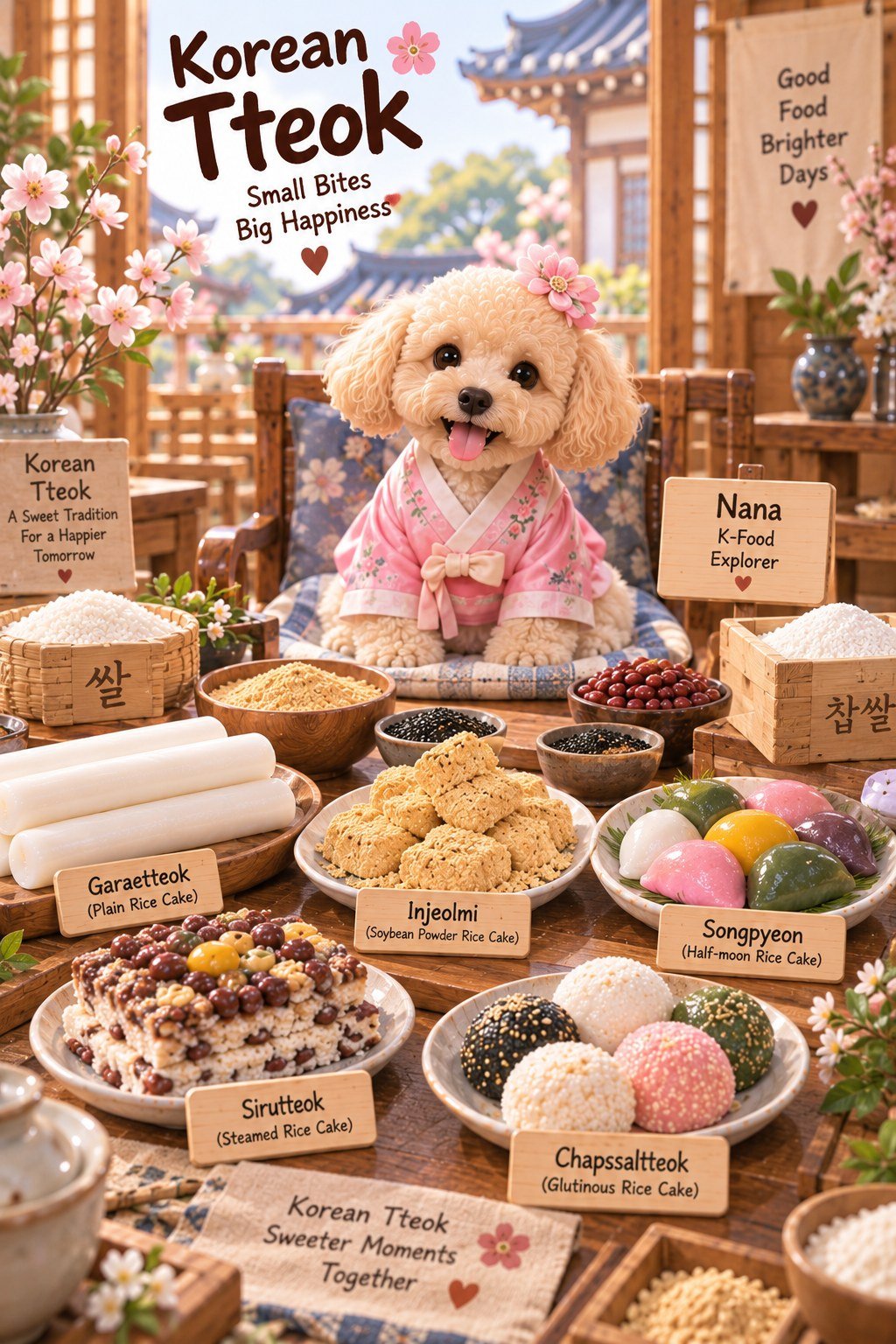
Garaetteok, injeolmi, songpyeon, sirutteok, and chapssaltteok represent only part of Korea’s diverse rice-cake tradition.
How Tteok Connects with Other K-Food
Tteokbokki demonstrates how cylindrical rice cakes become the central ingredient in one of Korea’s most recognizable spicy street foods.
Bingsu shows how injeolmi and small pieces of tteok can move into modern Korean dessert and café culture.
Hotteok and Bungeoppang provide useful comparisons with other Korean sweet foods, although their doughs, fillings, and cooking methods are very different from rice cakes.
Korean Corn Dog and Gimbap expand the collection into other portable Korean foods, while Mandu introduces filled Korean dumplings.
Korean Ramyeon and Buldak Bokkeummyeon represent two sides of Korean instant-noodle culture.
Kimchi, Bibimbap, and Kimchi Fried Rice expand the Wiki into fermentation and rice-centered meals.
Japchae, Jjajangmyeon, and Naengmyeon demonstrate three very different Korean noodle traditions.
Kimchi-jjigae, Sundubu-jjigae, and Samgyetang extend the collection into Korean stew and soup culture.
Korean BBQ, Galbi, Bulgogi, and Samgyeopsal represent the shared-table grilled-meat side of Korean dining.
Tteok & Insadong
Insadong provides a natural travel connection for traditional Korean sweets, tea, crafts, cultural streets, and contemporary interpretations of traditional food.
A tteok or Korean dessert stop can fit naturally into a walking itinerary through the area.
Tteok & Gwangjang Market
Gwangjang Market provides broader context for Korean market-food culture and traditional prepared foods.
Products and individual vendors change, so the market should not be treated as a guarantee that one specific rice cake or tteok shop will always be available.
Tteok & a Traditional Seoul Travel Day
Travelers can connect Korean rice-cake culture with visits to Gyeongbokgung Palace and Bukchon Hanok Village.
Traditional architecture, markets, cultural streets, tea, and Korean desserts can provide different perspectives on Korean heritage within the same itinerary.
Specific shop menus, opening hours, products, and seasonal selections should be checked when planning a visit.
FAQ
What is tteok?
Tteok is the broad Korean category of rice cakes. Different varieties can be steamed, pounded, shaped, sliced, coated, or filled and can range from soft and crumbly to dense, sticky, and highly chewy.
Is tteok the same as tteokbokki?
No. Tteok refers to the broad Korean rice-cake category, while tteokbokki is a specific dish made with rice cakes cooked with sauce and other ingredients. Cylindrical rice cakes used for tteokbokki are only one part of the much larger tteok tradition.
What is the difference between tteok and mochi?
Tteok belongs to Korean food tradition, while mochi belongs to Japanese food tradition. Both are broad rice-cake traditions and some individual varieties can share sticky or chewy characteristics, but the names, preparation methods, cultural uses, and varieties should not be treated as interchangeable.
What are the most common types of tteok?
Well-known examples include garaetteok, injeolmi, songpyeon, sirutteok, chapssaltteok, baekseolgi, and jeolpyeon. Each can differ substantially in rice type, shape, coating, filling, preparation, and texture.
Is all tteok sweet?
No. Some rice cakes are sweet or served as desserts, while others are mild or become ingredients in savory dishes such as tteokbokki and tteokguk.
Why does tteok become hard?
Cooked rice starch changes as tteok cools and sits, causing many varieties to become firmer over time. The rate depends on the type of rice cake, moisture, ingredients, storage conditions, and temperature.
Is tteok gluten-free?
Rice itself does not contain gluten, but a finished tteok product should not automatically be assumed to be gluten-free. Additional grains, sauces, fillings, coatings, processed ingredients, or shared preparation equipment can introduce gluten or cross-contact.
Where to Try Tteok
Tteok can be found at specialized Korean rice-cake shops, traditional markets, supermarkets, dessert cafés, restaurants, and businesses selling Korean traditional foods.
The selection varies according to the business, region, season, holiday, and occasion. A traditional tteok shop can offer a very different selection from a modern dessert café or packaged-food section.
Travelers looking for a specific variety should check current availability rather than assuming every rice-cake shop carries every type of tteok.
What to Check Before Choosing Tteok
Start by identifying the variety rather than choosing only by color or shape.
Check whether the tteok is plain, coated, filled, sweet, savory, intended for direct eating, or designed to be cooked in another dish.
Freshness, serving method, ingredients, storage instructions, and recommended reheating can also differ significantly between varieties.
First-Time Tteok Tips
- Try several varieties — tteok is a category, not one standardized rice cake.
- Start with small pieces — textures can be much denser and chewier than expected.
- Try garaetteok — it provides a simple reference for chewy Korean rice cake.
- Try injeolmi — roasted soybean powder adds a distinctly nutty Korean flavor.
- Try songpyeon — it introduces a filled rice cake closely associated with Chuseok.
- Check freshness — many rice cakes become firmer as they sit.
- Chew thoroughly — dense and sticky tteok should not be swallowed in large pieces.
Rice & Glutinous Rice
Korean rice cakes can use non-glutinous rice, glutinous rice, or recipe-dependent combinations and preparations.
Glutinous rice is particularly associated with sticky and elastic textures, while other rice preparations can produce firmer, softer, or more crumbly results.
The word “glutinous” describes stickiness and does not mean that the rice itself contains gluten.
Gluten & Additional Ingredients
Rice is naturally gluten-free, but tteok recipes and commercial products can contain additional ingredients.
Wheat-containing grains, sauces, flavorings, coatings, fillings, or processed ingredients can change the allergen profile.
People who must strictly avoid gluten should confirm the complete ingredient list and possible cross-contact rather than relying only on the rice base.
Soy & Injeolmi
Injeolmi is commonly coated with roasted soybean powder, making soy an important allergen consideration.
The powder can cling closely to the rice cake and surrounding serving surface, so simply brushing away visible powder does not necessarily eliminate exposure.
People with soy allergies should confirm the specific product and preparation environment.
Sesame
Sesame can appear in songpyeon fillings, coatings, decorative ingredients, or other rice-cake preparations.
Because fillings are enclosed inside some tteok, sesame may not be visible before the rice cake is bitten or cut.
People with sesame allergies should ask about fillings as well as exterior toppings.
Red Bean
Red bean can appear as a filling, coating, layer, or accompaniment in several Korean rice-cake preparations.
The sweetness and texture vary, and complete recipes can contain additional ingredients beyond red bean itself.
A red-bean tteok should therefore be evaluated according to the full recipe when dietary restrictions matter.
Nuts & Modern Fillings
Traditional and contemporary tteok can contain nuts or other fillings depending on the recipe.
Modern fusion rice cakes can also use chocolate, cream, cheese, fruit, or other ingredients that introduce additional allergens.
The same rice-cake name does not guarantee an identical ingredient list between different shops or manufacturers.
Shared Equipment & Cross-Contact
Rice-cake shops can prepare multiple products using shared steamers, work surfaces, containers, cutting tools, molds, and other equipment.
Soy, sesame, nuts, wheat, dairy, egg, and other ingredients used in one product can therefore create cross-contact concerns for another.
Anyone managing a serious food allergy should ask the business about its preparation environment rather than relying only on visible ingredients.
Tteok & Choking Safety
Dense, sticky, and elastic rice cakes require careful eating.
Cut tteok into manageable pieces when necessary, take small bites, and chew thoroughly before swallowing. Extra care is important for young children, older adults, and people with chewing or swallowing difficulties.
Eating challenges, oversized bites, or rapid consumption can increase risk and should not be treated as a normal way to experience tteok.
Hot Tteok Safety
Freshly steamed, cooked, or reheated tteok can be extremely hot.
Dense rice cake can retain heat internally even when the surface appears manageable.
Allow hot rice cakes and filled tteok to cool sufficiently before taking a large bite.
Storage
There is no single storage method appropriate for every type of tteok.
Storage requirements depend on moisture, filling, coating, packaging, intended shelf life, and whether the product is fresh or commercially packaged.
Follow the seller’s or manufacturer’s storage instructions when available, particularly for products containing perishable fillings.
Reheating Tteok
Appropriate reheating can soften some rice cakes that have become firm during storage.
The correct method depends on the variety and can include steaming, brief heating, or cooking directly in soup or sauce.
Reheated tteok can become very hot and should be allowed to cool to a comfortable temperature before eating.
Image Credits
Korean tteok family visual with Dad, Mom, K-Nana daughter, and Nana in hanbok exploring garaetteok, injeolmi, songpyeon, sirutteok, chapssaltteok, and other Korean rice cakes — K-Nana Studio original visual.
Korean tteok preparation visual with Mom in hanbok preparing rice flour, glutinous rice flour, soybean powder, red bean, sesame, and other traditional rice-cake ingredients while Nana watches from a separate safe seat — K-Nana Studio original visual.
Korean tteok-making visual with Dad in hanbok working steamed rice dough to create a chewy texture with garaetteok and injeolmi nearby while Nana remains safely separated from hot equipment and ingredients — K-Nana Studio original visual.
Korean tteok tasting visual with K-Nana daughter in hanbok comparing small pieces of injeolmi, songpyeon, chapssaltteok, garaetteok, and other rice cakes while Nana sits separately without touching the food — K-Nana Studio original visual.
Nana in pink floral hanbok seated separately as a K-Food mascot beside garaetteok, injeolmi, songpyeon, sirutteok, chapssaltteok, rice, rice flour, soybean powder, red bean, and sesame — K-Nana Studio original visual.
Disclaimer
This article is provided for general food, travel, and cultural information. Tteok ingredients, rice varieties, fillings, coatings, preparation methods, allergens, storage requirements, serving styles, and textures vary by product, maker, and recipe. Although rice itself does not contain gluten, finished rice cakes can contain wheat, soy, sesame, nuts, milk, egg, or other recipe-dependent ingredients, and shared equipment can create cross-contact risks. Dense, sticky, and highly chewy rice cakes can present a choking hazard, particularly for young children, older adults, and people with chewing or swallowing difficulties. Freshly cooked or reheated tteok can also retain substantial heat internally. People with allergies, medical conditions, swallowing difficulties, religious dietary restrictions, or other individual requirements should confirm ingredients and preparation directly with the seller or manufacturer and follow appropriate professional guidance when necessary.