
Bungeoppang is one of Korea’s most recognizable winter street foods. It is a fish-shaped pastry cooked in a special mold and traditionally filled with sweet red bean paste.
Despite its realistic fish shape, classic bungeoppang does not contain fish. The name comes from its appearance: “bungeo” refers to crucian carp, while “ppang” means bread.
Fresh bungeoppang is especially associated with cold Korean winters, when the sight and aroma of golden pastries cooking at street stalls become part of the seasonal street-food experience.
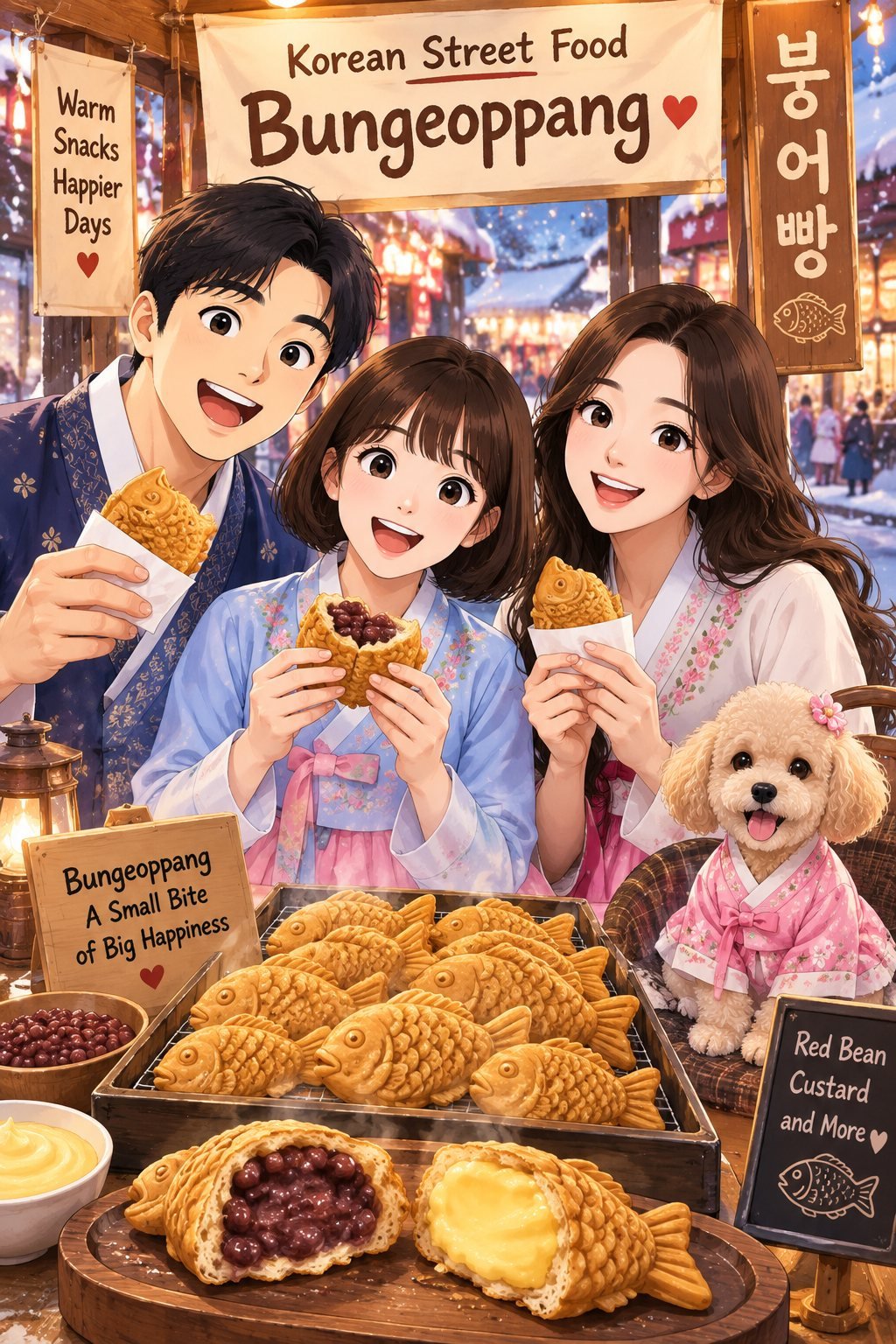
Golden fish-shaped pastries filled with warm red bean or custard are a familiar sight in Korea’s winter street-food culture.
Quick Guide
| Korean name | 붕어빵 |
| Romanization | Bungeoppang |
| Common English description | Korean fish-shaped pastry |
| Food type | Korean street food and winter snack |
| Traditional filling | Sweet red bean paste |
| Popular modern filling | Custard cream |
| Cooking method | Batter cooked in a heated fish-shaped mold |
| Common texture | Golden exterior with a soft interior and warm filling |
| Common setting | Winter street stalls and traditional-market areas |
| Important first-time tip | The filling can remain very hot even when the outside feels cooler |
What Is Bungeoppang?
Bungeoppang is a Korean pastry made by cooking batter and filling inside a fish-shaped metal mold.
The classic version contains sweet red bean paste, although custard and many other modern fillings are also available.
The mold gives the pastry its recognizable fish body, scales, fins, head, and tail while the heated surface creates its golden exterior.
What Does Bungeoppang Mean?
The name can be divided into two useful parts.
Bungeo refers to crucian carp, the fish represented by the pastry’s shape. Ppang is the Korean word commonly used for bread.
The name therefore describes the appearance of the snack rather than an ingredient inside it.
Does Bungeoppang Contain Fish?
Classic bungeoppang does not contain fish simply because it is shaped like one.
The familiar traditional filling is sweet red bean paste, and modern versions can contain custard, cheese, sweet potato, or other recipe-dependent fillings.
However, ingredients vary by vendor, so people with allergies or dietary restrictions should still check the actual recipe rather than relying only on the traditional description.
Why Is Bungeoppang Shaped Like a Fish?
The fish shape is created by a dedicated hinged cooking mold.
Each cavity forms the outline and surface details of the pastry. When batter is cooked between the two sides of the mold, details such as scales, fins, eyes, and the tail become visible.
The distinctive shape makes bungeoppang immediately recognizable even before the filling is revealed.
Bungeoppang & Japanese Taiyaki
Bungeoppang is historically related to Japan’s taiyaki tradition, which also uses fish-shaped molds and sweet fillings.
As the food developed in Korea, bungeoppang became embedded in Korean winter street-food culture and developed its own familiar name, market context, fillings, textures, and modern variations.
The two foods are closely related, but the names should not be treated as interchangeable descriptions for every fish-shaped pastry sold in Korea or Japan.
Bungeoppang vs. Taiyaki
Both foods can use fish-shaped molds and red bean filling, so their visual similarity is obvious.
Differences can appear in batter, thickness, crispness, shape, filling quantity, preparation, and regional or vendor-specific styles.
Rather than expecting one universal physical difference, travelers should understand bungeoppang as the Korean food tradition and taiyaki as the Japanese food tradition from which it is historically related.
Bungeoppang Batter
Bungeoppang begins with a pourable batter that spreads through the heated fish-shaped mold.
Recipes vary in flour, liquid, sweetness, egg, dairy, and other ingredients, which can change the pastry’s thickness and texture.
This batter structure is an important difference from Hotteok, which commonly begins with a soft dough that is filled, sealed, and pressed on a griddle.
Sweet Red Bean Filling
Sweet red bean paste is the classic filling most strongly associated with bungeoppang.
The filling is made from red beans prepared with sweetness to create a soft, dense center that contrasts with the cooked pastry shell.
Recipes differ in sweetness and texture. Some fillings can retain more visible bean pieces, while others are smoother.
Custard Bungeoppang
Custard is one of the best-known alternatives to red bean.
Its pale yellow color and creamy texture create a visibly different center when the pastry is broken open.
For international visitors who are unfamiliar with sweet red bean, custard can provide a more familiar flavor profile, although the ingredients and sweetness still vary by vendor.
Red Bean vs. Custard
Choosing between red bean and custard is one of the simplest ways to experience two different styles of bungeoppang.
Red bean provides a bean-based sweetness and denser texture, while custard is smoother and creamier.
Neither filling defines the only correct way to enjoy modern bungeoppang. Individual preference is part of the experience.
Preparing Bungeoppang
The heated mold is prepared before batter and filling are added.
A portion of batter is poured into the fish-shaped cavity, followed by an appropriate amount of red bean paste, custard, or another filling.
Additional batter helps enclose the filling before the mold is closed for cooking.
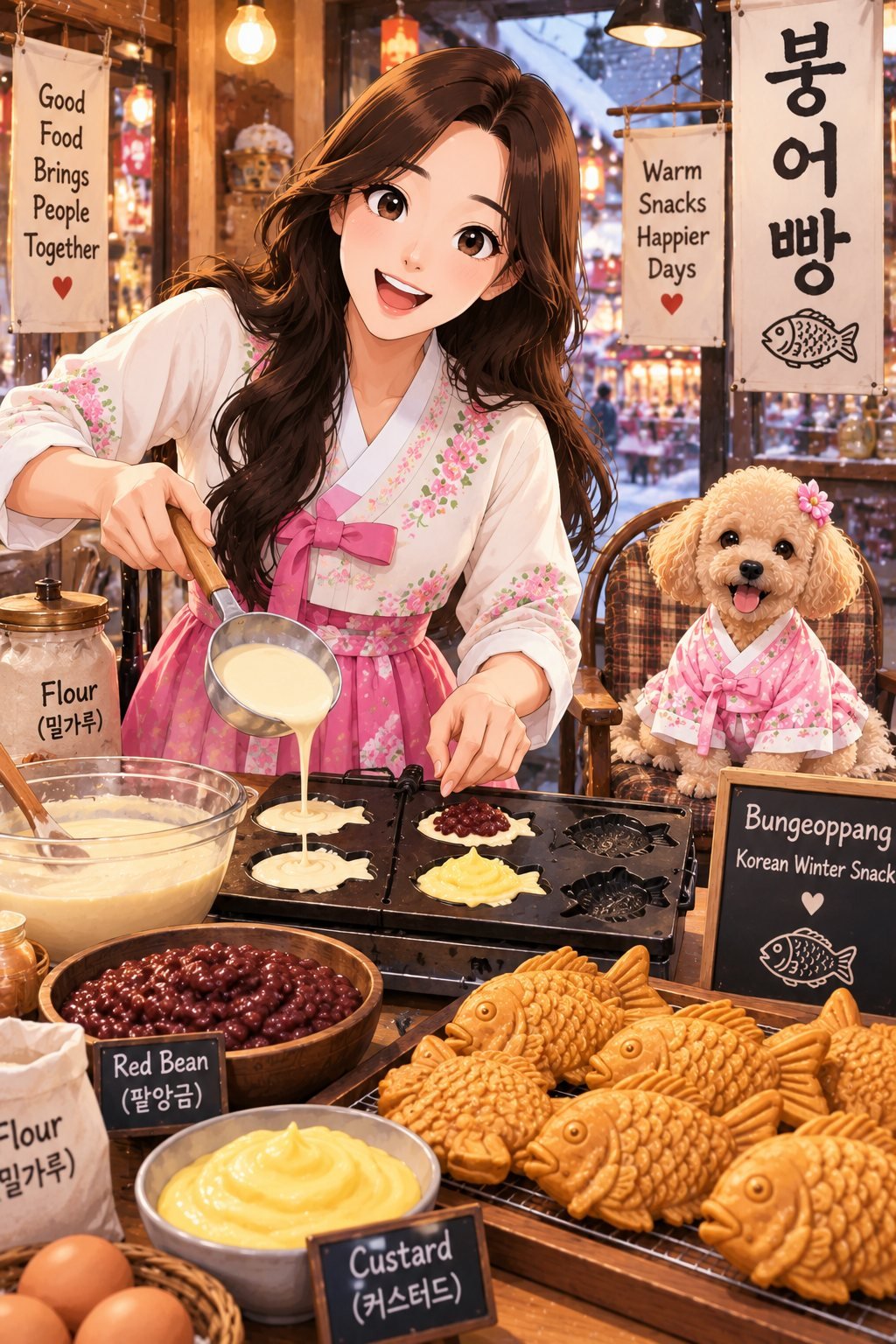
Batter, sweet red bean, and custard are placed into a heated fish-shaped mold before the pastry is closed and cooked.
How Bungeoppang Is Cooked
Heat from the mold cooks the batter while warming the filling inside.
The mold is managed so the pastry cooks on both sides and develops its recognizable golden surface.
Cooking time and heat vary according to the equipment, batter, filling, and desired texture.
How the Fish Shape Appears
The detailed appearance does not need to be carved into the finished pastry.
The mold itself contains the fish pattern, so the batter takes on the shape as it cooks against the heated metal.
A well-defined bungeoppang can show scales, fins, an eye, and a tail across its browned surface.
Crispy or Soft?
Bungeoppang texture can vary considerably.
Some versions emphasize thin, crisp edges and a firmer shell, while others are softer and more cake-like around the filling.
The batter recipe, mold temperature, cooking time, thickness, and how long the pastry sits after cooking can all affect the final texture.
Why the Tail Can Be Extra Crispy
The tail contains less space for filling than the wider body of the fish and can have a higher proportion of cooked pastry.
This can make the tail particularly crisp in some bungeoppang.
For that reason, diners who enjoy crisp pastry may experience the head and tail differently even within the same piece.
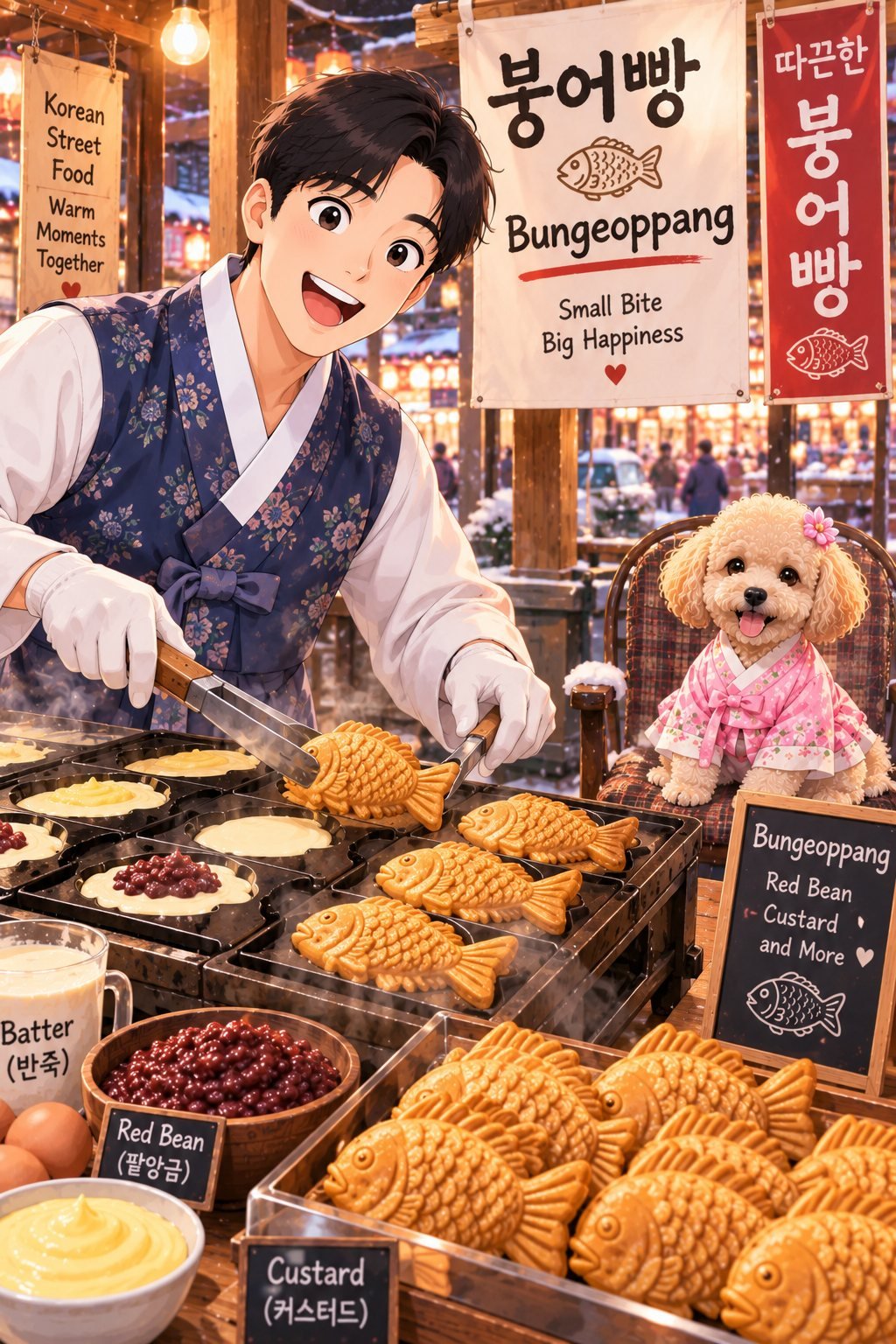
The heated mold creates bungeoppang’s fish shape, crisp golden surface, scales, fins, and tail while warming the filling inside.
Head First or Tail First?
A playful question often associated with eating bungeoppang is whether to start from the head or the tail.
There is no correct answer. Starting with the tail can emphasize crisp pastry first, while beginning with the wider body or head may reach the filling sooner depending on how the vendor filled the mold.
The debate is part of the fun surrounding the snack rather than a rule of Korean dining etiquette.
How Much Filling Is Inside?
The amount and distribution of filling vary between vendors.
Some bungeoppang contain filling throughout much of the body, while others leave more unfilled pastry around the head or tail.
The outside shape therefore does not guarantee exactly where the red bean or custard begins.
How to Eat Bungeoppang for the First Time
Allow a freshly cooked bungeoppang to cool before taking a large bite.
Start with a small bite from the head or tail and check the temperature of the filling before continuing.
Once red bean or custard becomes visible, remember that the center can remain considerably hotter than the outer pastry.
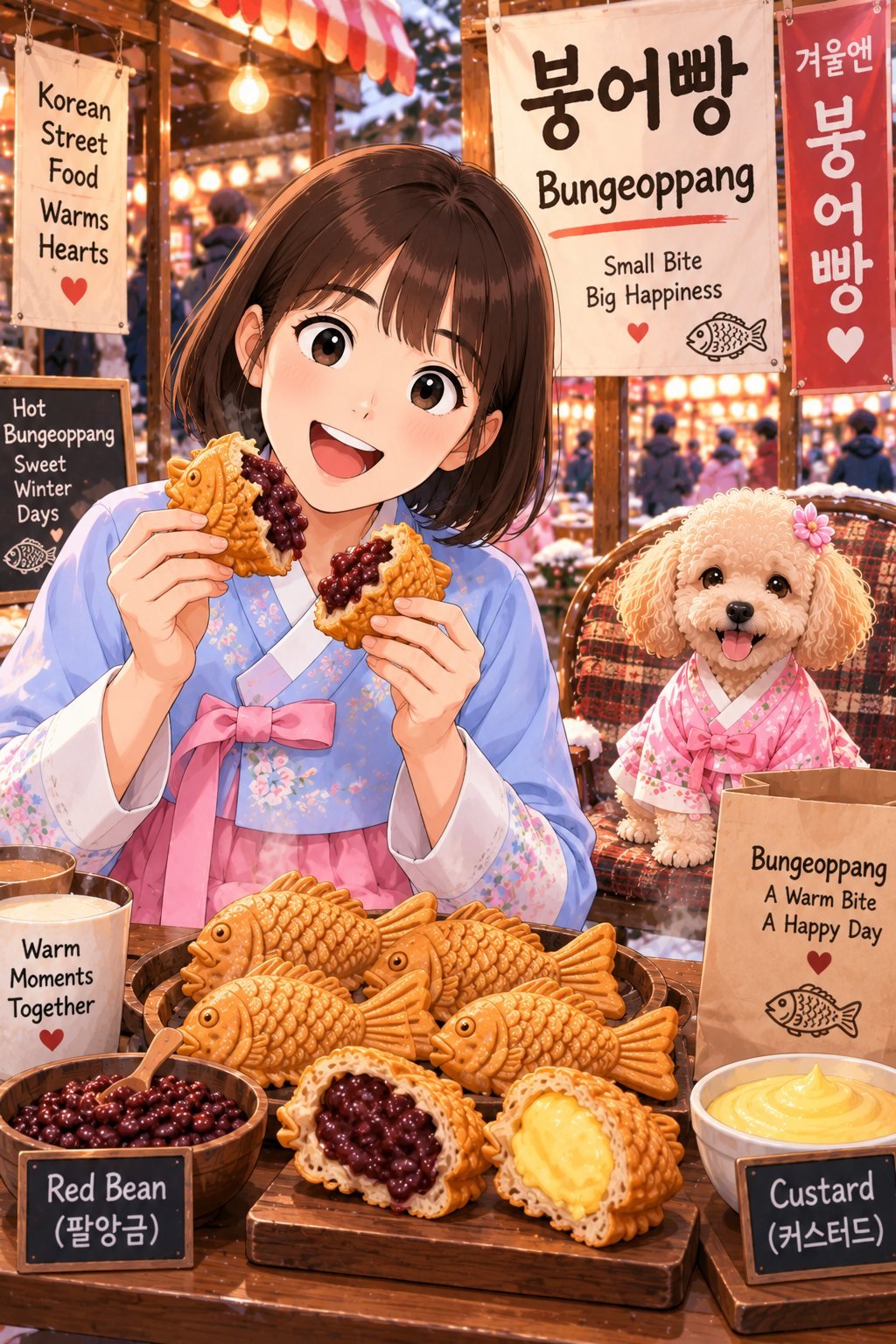
Red bean and custard are two of the most familiar bungeoppang fillings, but both can remain very hot inside a freshly cooked pastry.
Bungeoppang as Korean Winter Street Food
Bungeoppang has a particularly strong connection with cold weather in Korea.
A hot fish-shaped pastry served directly from a street stall provides warmth, sweetness, and portability during winter walks.
The steam from freshly cooked pastries, heated molds, paper bags, and cold outdoor air together create the seasonal atmosphere strongly associated with bungeoppang.
Bungeoppang at Korean Street Stalls
Street stalls allow customers to see the pastries cooking directly in their molds.
Fresh batches can move quickly from the cooking surface into simple paper packaging, making bungeoppang suitable for eating while walking.
Vendor locations and operating periods can change, particularly because some stalls are seasonal.
Is Bungeoppang Available All Year?
Bungeoppang is strongly associated with autumn and winter, but availability is not limited by one universal calendar.
Seasonal street vendors may disappear during warmer months, while permanent shops, cafés, markets, frozen products, or specialty businesses can make bungeoppang available at other times.
Travelers should check current local availability rather than assuming every neighborhood has a bungeoppang stall throughout the year.
Modern Bungeoppang Fillings
Red bean and custard remain familiar reference points, but modern bungeoppang can contain many other fillings.
Cheese, sweet potato, chocolate, cream, and other sweet or savory variations can appear depending on the vendor or product.
These variations preserve the recognizable fish-shaped format while expanding the snack beyond its classic red bean identity.
Bungeoppang vs. Hotteok
Hotteok and bungeoppang are both strongly associated with Korean winter street-food culture, but their construction is very different.
Hotteok commonly uses soft filled dough that is pressed and cooked on a griddle. Bungeoppang uses pourable batter cooked inside a fish-shaped mold.
Classic hotteok is strongly associated with melted brown sugar and cinnamon, while classic bungeoppang is strongly associated with sweet red bean paste.
Bungeoppang vs. Korean Corn Dog
Korean Corn Dog represents a different branch of Korean street-food culture.
Korean corn dogs commonly use sausage, mozzarella, or both on a stick and are deep-fried with a substantial coating. Bungeoppang is a molded pastry commonly filled with red bean or custard.
Both are portable and visually recognizable, but their ingredients, cooking methods, flavors, and seasonal associations are clearly different.
Why Bungeoppang Appeals to International Visitors
Bungeoppang has several characteristics that make it easy for international travelers to recognize and remember.
The fish shape is visually distinctive, the snack can be eaten by hand, and the filling becomes visible as soon as the pastry is broken open.
At the same time, the experience is strongly connected with Korean winter streets and markets, giving visitors both a food experience and a seasonal cultural memory.
Bungeoppang & Global K-Food
International interest in Korean food has expanded beyond major restaurant dishes into snacks, desserts, convenience foods, and street foods.
Bungeoppang fits naturally into this broader K-Food interest because it is visually recognizable and easy to explain as a Korean fish-shaped pastry.
Red bean introduces a traditional East Asian sweet ingredient, while custard and other modern fillings provide additional entry points for diners unfamiliar with sweet beans.
Bungeoppang in K-Drama & Korean Entertainment
Winter street-food scenes can help international audiences recognize foods before they encounter them during travel.
Bungeoppang’s distinctive shape makes it particularly easy to identify when it appears in Korean lifestyle, entertainment, travel, or food-related content.
Rather than belonging to one specific drama or celebrity, the snack is useful as part of the broader visual language of Korean winter street life.
Bungeoppang & Social Media
The fish-shaped exterior works especially well in photographs and short-form food videos.
Breaking a bungeoppang open also reveals an immediate visual contrast between the golden pastry and red bean, yellow custard, cheese, or another filling.
This combination of recognizable shape and visible filling makes the snack suitable for travel posts, Korean food videos, and other social-media content.
Bungeoppang Outside Korea
Korean-style fish-shaped pastries can also be encountered outside Korea through Korean cafés, dessert businesses, restaurants, markets, packaged products, and frozen-food channels.
International versions can use traditional red bean or locally adapted fillings.
Recipes and terminology vary, so a fish-shaped pastry sold outside Korea should not automatically be assumed to have exactly the same batter, filling, or texture as Korean street-stall bungeoppang.
Red Bean or Custard?
For many first-time diners, choosing the filling is the most important decision.
Red bean provides the classic bungeoppang experience and introduces the sweet bean flavor used in many Korean and East Asian desserts.
Custard provides a smoother, creamier alternative that may feel more familiar to diners accustomed to custard-filled pastries.
Other Bungeoppang Fillings
Modern bungeoppang can move far beyond the traditional red bean filling.
Depending on the vendor, café, or packaged product, fillings can include sweet potato, chocolate, cheese, cream, or other ingredients.
These variations demonstrate how a traditional street-food format can continue evolving while retaining its recognizable fish shape.
Mini Bungeoppang
Not every bungeoppang is the same size.
Smaller versions can provide a higher proportion of crisp exterior relative to filling and make it easier to sample several flavors.
Size, shape, filling quantity, and texture vary according to the mold and vendor.
How to Order Bungeoppang
Start by checking which fillings are currently available.
A stall may offer only red bean, while another can provide red bean, custard, or several additional options.
When buying several pieces, check whether different fillings can be mixed in one order and whether the vendor identifies them by shape, position, packaging, or another method.
Buying Bungeoppang at a Street Stall
Bungeoppang is commonly served in simple paper packaging because it is designed to be eaten as a casual portable snack.
Freshly cooked pieces can be very hot, so holding the paper does not mean the filling has cooled enough to eat immediately.
If several pieces are placed together, heat can also remain trapped inside the package.
How Much Does Bungeoppang Cost?
There is no universal price for bungeoppang.
Prices vary according to location, vendor, size, filling, ingredient costs, number of pieces, and time.
Travelers should check the current price displayed by the vendor rather than relying on an older travel article, video, or social-media post.
Why Bungeoppang Is Seasonal
The strongest cultural association is with Korea’s colder months.
Outdoor vendors can use heated molds to serve hot pastries during winter, creating a snack that contrasts naturally with cold weather.
Because individual stalls can operate seasonally, the number and location of vendors can change throughout the year.
Finding Bungeoppang in Korea
Bungeoppang can appear around traditional markets, neighborhood streets, shopping districts, transit areas, and other places with seasonal food stalls.
Availability changes frequently, so travelers should avoid building an entire itinerary around an unverified temporary stall.
Permanent shops, markets, cafés, or other established businesses can provide alternatives when seasonal street vendors are difficult to find.
The Complete Bungeoppang Experience
A classic bungeoppang experience combines a golden fish-shaped pastry, crisp edges, soft batter, and a warm sweet filling.
Red bean represents the traditional reference point, while custard and modern fillings demonstrate how the snack continues to evolve.
The winter setting adds another dimension through cold outdoor air, steaming pastries, glowing market lights, and freshly cooked food served directly from a hot mold.
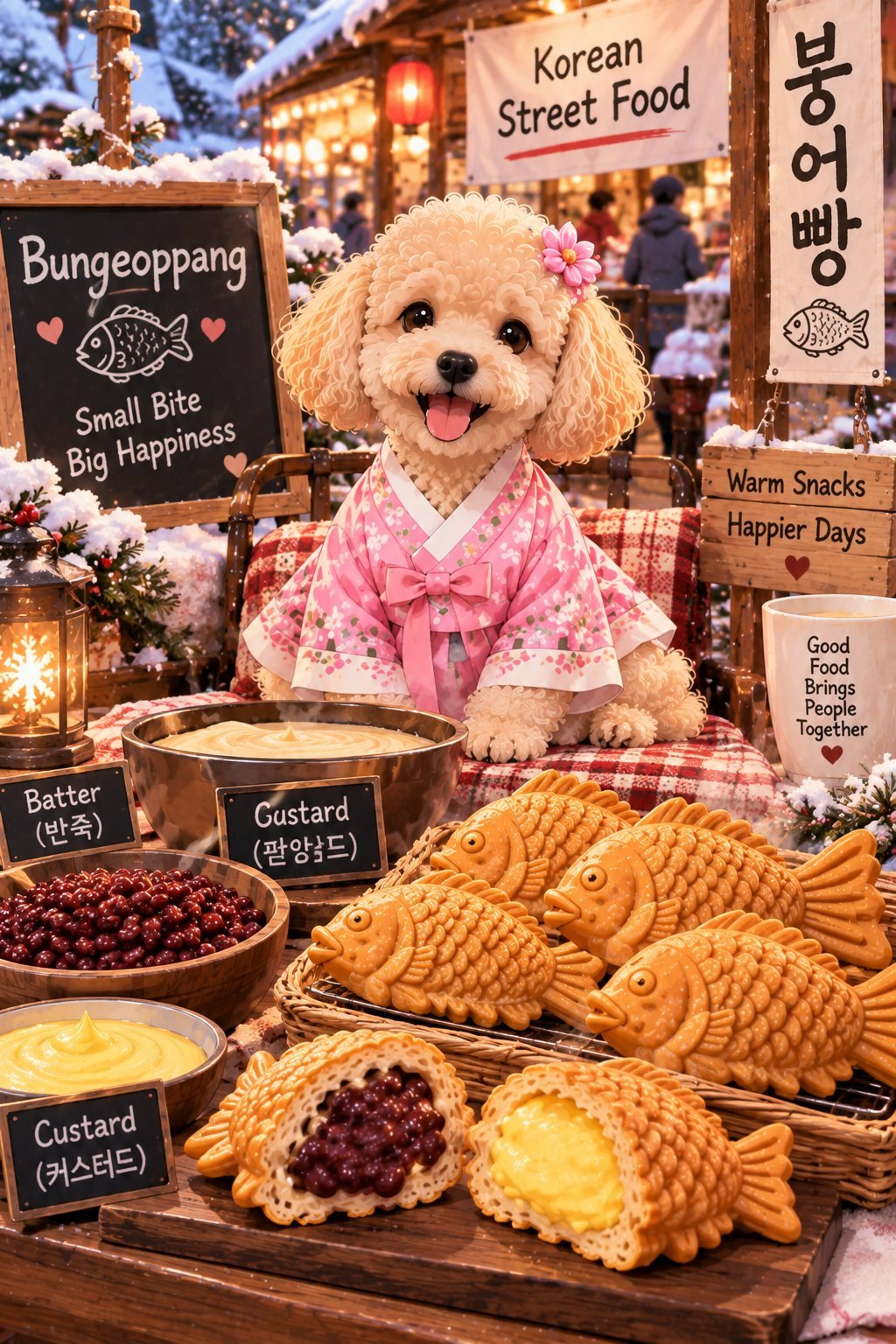
Golden fish-shaped pastries, warm red bean, creamy custard, and a cold winter-market setting capture the seasonal character of Korean bungeoppang.
How Bungeoppang Connects with Other K-Food
Hotteok is the closest companion for exploring Korean winter street-food culture. Both are served warm and commonly associated with colder weather, but their dough, fillings, shapes, and cooking methods are different.
Korean Corn Dog expands the street-food collection into deep-fried sausage, mozzarella, potato coatings, sugar, and sauces.
Tteokbokki introduces Korea’s spicy and chewy street-food culture, while Gimbap provides a portable rice-based food that can be eaten casually or on the go.
Mandu demonstrates another filled-food tradition through Korean dumplings, while Korean Ramyeon introduces instant noodles and convenience-store food culture.
Buldak Bokkeummyeon represents the globally visible K-Spicy noodle phenomenon, while Korean Fried Chicken adds another internationally recognized fried K-Food category.
Kimchi introduces Korean fermentation, while Bibimbap and Kimchi Fried Rice expand the collection into major Korean rice dishes.
Japchae, Jjajangmyeon, and Naengmyeon show very different Korean noodle traditions.
Kimchi-jjigae, Sundubu-jjigae, and Samgyetang extend the K-Food Wiki into Korean stews and soup.
Korean BBQ, Galbi, Bulgogi, and Samgyeopsal provide the shared-table grilled-meat side of Korean dining in contrast with portable street snacks.
Bungeoppang & Gwangjang Market
Gwangjang Market provides useful context for understanding Korean market-food culture.
Traditional markets bring together vendors, cooking sounds, aromas, snacks, meals, and customers in one environment, making them useful places for travelers to understand how Korean street and market foods are prepared and eaten.
Specific vendors and menus can change, so a market guide should not be interpreted as a guarantee that one particular bungeoppang stall will always be operating.
Bungeoppang & Insadong
Insadong provides another useful connection for travelers interested in Korean snacks, traditional streets, crafts, cafés, and cultural experiences.
Seasonal snacks can fit naturally into a walking itinerary, but current vendor availability should always be checked locally.
Bungeoppang & Hongdae
Hongdae offers a contrasting contemporary environment of youth culture, shopping, cafés, performances, and casual food.
Experiencing a traditional-style winter snack in a modern Seoul neighborhood demonstrates how older Korean street foods continue to exist alongside newer food trends.
Bungeoppang & a Seoul Winter Day
A winter itinerary can combine Korean food with major cultural destinations such as Gyeongbokgung Palace and Bukchon Hanok Village.
A warm street snack can provide a short food stop between outdoor attractions, but weather, opening hours, seasonal vendor locations, and current conditions should be checked separately when planning a trip.
FAQ
What is bungeoppang?
Bungeoppang is a Korean fish-shaped pastry commonly associated with winter street-food culture. Batter is cooked in a special fish-shaped mold with a filling inside, traditionally sweet red bean paste.
Does bungeoppang contain fish?
Classic bungeoppang does not contain fish simply because it is fish-shaped. The name refers to its appearance, while common fillings include sweet red bean paste, custard, and other modern variations.
What is inside bungeoppang?
Sweet red bean paste is the traditional filling, while custard is another widely recognized option. Modern versions can contain sweet potato, cheese, chocolate, cream, or other recipe-dependent fillings.
What is the difference between bungeoppang and taiyaki?
Bungeoppang is the Korean fish-shaped pastry tradition, while taiyaki is Japanese. The foods are historically related and can share red bean filling and fish-shaped molds, but batter, shape, thickness, texture, filling, and preparation can vary.
What is the difference between bungeoppang and hotteok?
Bungeoppang generally uses pourable batter cooked inside a fish-shaped mold, while hotteok commonly uses soft filled dough pressed on a griddle. Classic bungeoppang is associated with red bean, while classic sweet hotteok is strongly associated with melted brown sugar and cinnamon.
Is bungeoppang only available in winter?
No universal rule limits bungeoppang to winter, but it has a particularly strong cold-weather association in Korea. Seasonal street stalls may be more common during colder months, while permanent shops, cafés, markets, or packaged products can offer it at other times.
Should you eat bungeoppang from the head or tail?
Either is fine. The head-versus-tail question is a playful part of bungeoppang culture rather than a dining rule. The tail can be especially crisp in some versions, while starting from a wider section may reach the filling sooner.
Where to Try Bungeoppang
Bungeoppang can appear at seasonal street stalls, traditional-market areas, neighborhood streets, shopping districts, cafés, specialty shops, and other businesses selling Korean snacks.
Availability can change with season, weather, neighborhood, and individual vendor schedules.
Travelers looking for a particular stall should check current information rather than assuming an older travel post or social-media video still reflects the vendor’s location or operating hours.
What to Check Before Ordering
Start by identifying the available fillings. Red bean and custard are common reference points, but individual vendors can offer additional options.
Check whether the price applies to one pastry or multiple pieces and whether different fillings can be combined in the same order.
If allergies or dietary restrictions matter, confirm the batter and filling ingredients before ordering because the interior cannot always be identified from the outside.
First-Time Bungeoppang Tips
- Start with red bean — it provides the classic bungeoppang reference point.
- Try custard too — it offers a smoother and creamier comparison.
- Wait before biting — the filling can remain much hotter than the exterior.
- Try the tail — it can be particularly crisp depending on the pastry.
- Check modern fillings — cheese, sweet potato, chocolate, or cream can appear.
- Confirm ingredients — batter and fillings vary by vendor.
- Check current availability — many street stalls operate seasonally.
Food & Allergy Notes
Bungeoppang recipes are not standardized. Batter, red bean paste, custard, other fillings, cooking fats, and preparation environments can differ between vendors and products.
Wheat is common in the batter, while some recipes can contain milk, egg, soy, or other ingredients. Custard and modern fillings can introduce additional allergens.
People with allergies, intolerances, medical conditions, religious dietary restrictions, vegetarian or vegan requirements, or other individual needs should confirm ingredients and preparation directly with the vendor or manufacturer.
Wheat & Gluten
Conventional bungeoppang commonly uses wheat-based batter and should not automatically be considered gluten-free.
Even when a specialty version uses alternative flour, shared molds, containers, utensils, or preparation surfaces can create cross-contact.
People who must strictly avoid gluten should verify both ingredients and preparation conditions.
Milk & Dairy
Milk or other dairy ingredients can appear in some bungeoppang batter and fillings.
Custard is particularly important to check because recipes commonly use dairy ingredients unless a specific alternative formulation is used.
A red bean filling does not automatically confirm that the entire pastry is dairy-free because the batter itself must also be checked.
Egg
Egg can appear in bungeoppang batter or custard recipes.
Because the finished pastry does not reveal all of its ingredients visually, people avoiding egg should confirm the recipe rather than judging from appearance.
Commercial mixes and packaged bungeoppang can also have ingredient formulations different from street-stall recipes.
Red Bean Filling
Sweet red bean paste is plant-based in its basic form, but the complete filling recipe and surrounding pastry can contain additional ingredients.
Sweetness, texture, added fats, and other recipe components vary by producer.
Dietary decisions should therefore be based on the specific product or vendor rather than the assumption that all red bean bungeoppang is prepared identically.
Custard Filling
Custard creates a soft and creamy center but can contain milk, egg, or other recipe-dependent ingredients.
The filling can also retain significant heat because it is enclosed inside the pastry during cooking.
Allow freshly cooked custard bungeoppang to cool before taking a large bite.
Modern Fillings & Additional Allergens
Modern bungeoppang can contain cheese, chocolate, sweet potato, cream, nuts, or other ingredients depending on the vendor.
A shop offering several varieties may prepare them with shared utensils, containers, or molds.
Anyone managing a serious allergy should ask about both the selected filling and possible cross-contact with other varieties.
Shared Molds & Cross-Contact
Multiple bungeoppang fillings can be cooked using the same equipment.
Residue from batter, custard, cheese, nuts, or other ingredients can potentially contact another batch when equipment is shared.
People with serious food allergies should not assume that choosing a different filling eliminates cross-contact risk.
Hot Filling Safety
Red bean paste and custard can remain very hot inside freshly cooked bungeoppang.
The thin tail or exterior can cool faster than the thicker filled body, making surface temperature an unreliable guide to the temperature inside.
Take a small first bite and allow steam and heat to escape before eating the filling quickly.
Hot Mold & Cooking Safety
Bungeoppang molds become extremely hot during cooking.
The metal surfaces, handles, surrounding cooking equipment, steam, and hot batter can cause burns when handled improperly.
Children and pets should remain away from active cooking areas, and appropriate heat-resistant equipment should be used when operating the molds.
Storage & Reheating
Fresh bungeoppang is valued for its contrast between a warm filling and freshly cooked exterior.
If leftovers are stored, appropriate storage depends on the batter and filling. Custard, dairy-based fillings, and other perishable ingredients can require particular care.
Reheating can make the center very hot again, so reheated bungeoppang should be allowed to cool before eating.
Image Credits
Korean bungeoppang family winter street-food visual with Dad, Mom, K-Nana daughter, and Nana in hanbok enjoying golden fish-shaped pastries with red bean and custard fillings — K-Nana Studio original visual.
Korean bungeoppang preparation visual with Mom in hanbok preparing batter, sweet red bean paste, and custard in a fish-shaped mold while Nana watches from a separate safe seat — K-Nana Studio original visual.
Korean bungeoppang cooking visual with Dad in hanbok safely cooking golden fish-shaped pastries in a heated bungeoppang mold while Nana remains separated from the hot cooking area — K-Nana Studio original visual.
Korean bungeoppang tasting visual with K-Nana daughter in hanbok carefully enjoying a cooled red bean bungeoppang beside red bean and custard versions while Nana sits separately without touching the food — K-Nana Studio original visual.
Nana in pink floral hanbok seated separately as a K-Food mascot beside golden Korean bungeoppang, sweet red bean filling, custard filling, and representative ingredients in a winter-market setting — K-Nana Studio original visual.
Disclaimer
This article is provided for general food, travel, and cultural information. Bungeoppang batter, red bean paste, custard, modern fillings, allergens, cooking fats, preparation methods, prices, vendor locations, and seasonal availability can vary by business and product. Recipes may contain wheat, gluten, milk, egg, soy, nuts, or other recipe-dependent ingredients, and shared molds, utensils, containers, or preparation surfaces can create cross-contact risks. Freshly cooked or reheated bungeoppang can contain extremely hot fillings even when the exterior feels cooler, and heated molds and cooking equipment can cause burns. People with allergies, medical conditions, religious dietary restrictions, or other individual requirements should confirm ingredients and preparation directly with the vendor or manufacturer and follow appropriate professional guidance when necessary.