
Korean Corn Dog is one of the most recognizable foods in modern Korean street-food culture. A sausage, mozzarella cheese, or a combination of both is placed on a stick, covered with a thick coating, fried until golden, and finished with toppings or sauces.
What makes the Korean version especially distinctive is its variety. One corn dog may contain sausage, another may create a long mozzarella cheese pull, while a potato-coated version adds small crispy potato pieces to the exterior.
Sugar, ketchup, mustard, and other sauces can also create the sweet-and-savory combination that many international visitors associate with Korean corn dogs.
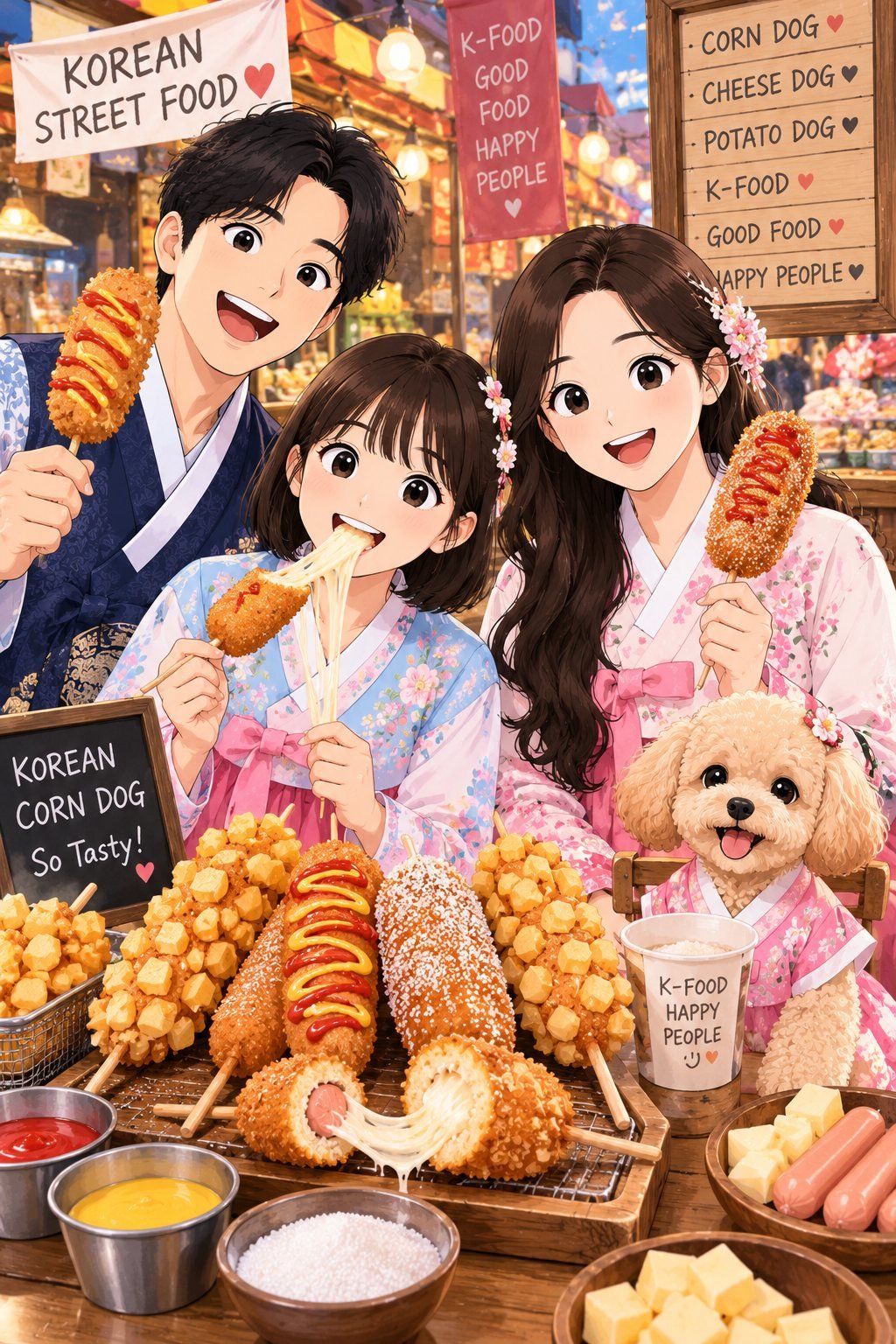
Sausage, stretchy mozzarella, crispy potato coating, sugar, ketchup, and mustard show why Korean corn dogs became one of the most recognizable modern K-Street Foods.
Quick Guide
| Common English name | Korean Corn Dog |
| Common Korean term | 핫도그 |
| Food type | Korean street food |
| Common fillings | Sausage, mozzarella cheese, or a combination of both |
| Popular variation | Potato-coated Korean corn dog |
| Exterior | Thick coating with breadcrumbs, potato pieces, or other recipe-dependent finishes |
| Cooking method | Deep-fried until golden and crisp |
| Common finishing | Sugar, ketchup, mustard, and recipe-dependent sauces |
| Famous visual feature | Mozzarella cheese pull |
| Important first-time tip | Fresh cheese and filling can remain extremely hot after frying |
What Is a Korean Corn Dog?
A Korean corn dog is a fried snack built around a filling on a wooden stick.
The filling is coated with a thick batter or dough-like mixture and an exterior coating before being fried. Depending on the version, the center may contain sausage, mozzarella cheese, or both.
After frying, the corn dog can be finished with sugar and sauces, creating a combination of crisp, chewy, salty, sweet, and creamy textures and flavors.
Why Is It Called a Korean Corn Dog?
“Korean Corn Dog” is the English name commonly used internationally to distinguish this Korean street-food style from familiar American corn dogs.
In Korea, foods of this general type are commonly described using the Korean term “hot dog” or 핫도그 rather than relying exclusively on the English expression “corn dog.”
International search terminology and Korean everyday terminology therefore do not always match exactly.
Korean Corn Dog vs. American Corn Dog
The American corn dog provides a useful comparison because both foods place a filling on a stick, coat it, and deep-fry it.
However, the Korean street-food version has developed a particularly wide range of fillings and exterior textures. Mozzarella cheese, half-sausage-and-half-cheese combinations, potato cubes, breadcrumbs, sugar, and multiple sauces are strongly associated with modern Korean corn dog culture.
The coating itself can also differ substantially from the cornmeal-based batter associated with many American corn dogs.
The Sausage Korean Corn Dog
The sausage version is one of the easiest styles to understand.
A sausage is placed on a wooden stick, covered with the coating, and fried until the exterior becomes golden.
Ketchup and mustard provide familiar savory and tangy flavors, while some Korean-style versions add sugar after frying for an additional sweet contrast.
Mozzarella Korean Corn Dog
Mozzarella changes the experience completely because the center can contain cheese instead of sausage.
When freshly cooked mozzarella is pulled apart, it can stretch into long strands. This dramatic “cheese pull” has become one of the most recognizable visual features of Korean corn dogs in international food content.
The cheese itself is relatively mild, allowing the fried coating, sugar, and sauces to contribute much of the surrounding flavor.
Half Sausage, Half Cheese
Some Korean corn dogs combine sausage and mozzarella on the same stick.
This allows the diner to experience both the stretchy cheese texture and the savory sausage in one snack.
The exact arrangement and proportions vary by shop, so the first bite does not always reveal which filling is positioned farther down the stick.
Potato Korean Corn Dog
Potato Korean corn dogs add small potato pieces to the exterior before frying.
The potato cubes become golden and provide a chunkier, crispier surface than a simple breadcrumb coating.
This variation is especially visually distinctive and is one of the styles international diners frequently associate with Korean corn dog shops.
Preparing the Fillings
Sausages and mozzarella are cut or portioned according to the desired corn dog style and placed securely on wooden sticks.
A shop can prepare sausage-only, cheese-only, half-and-half, or other combinations.
Because cheese softens significantly when heated, the preparation needs to keep the filling securely enclosed during coating and frying.
The Korean Corn Dog Coating
The coating needs to surround the filling sufficiently so it can develop a substantial fried exterior.
Recipes differ between shops and home preparations. Flour-based mixtures and other ingredients can be used to create different levels of softness, chewiness, thickness, and crispness.
The coated stick can then receive breadcrumbs, potato cubes, or another exterior ingredient before frying.

Sausage and mozzarella are placed on sticks, covered with a thick coating, and finished with breadcrumbs or potato pieces before frying.
Breadcrumb Coating
Breadcrumbs help create a rough, crisp exterior during frying.
The exact breadcrumb size and style can vary, affecting both appearance and texture.
A breadcrumb-coated corn dog can therefore look noticeably different from one covered with potato cubes even when the filling inside is identical.
Why Potato Cubes Stick to the Outside
Potato pieces are pressed onto the wet outer coating before the corn dog enters the fryer.
The coating helps hold the pieces in place, while frying cooks both the outer layer and the potato.
Some pieces can become more browned than others because their size and contact with the hot oil vary.
How Korean Corn Dogs Are Fried
Once coated, the corn dog is carefully placed into hot cooking oil.
The exterior cooks until golden while the filling heats inside. Cheese versions require particular attention because the mozzarella needs to become hot and stretchy without escaping through damaged coating.
The finished corn dog is removed carefully and allowed to drain before toppings and sauces are added.
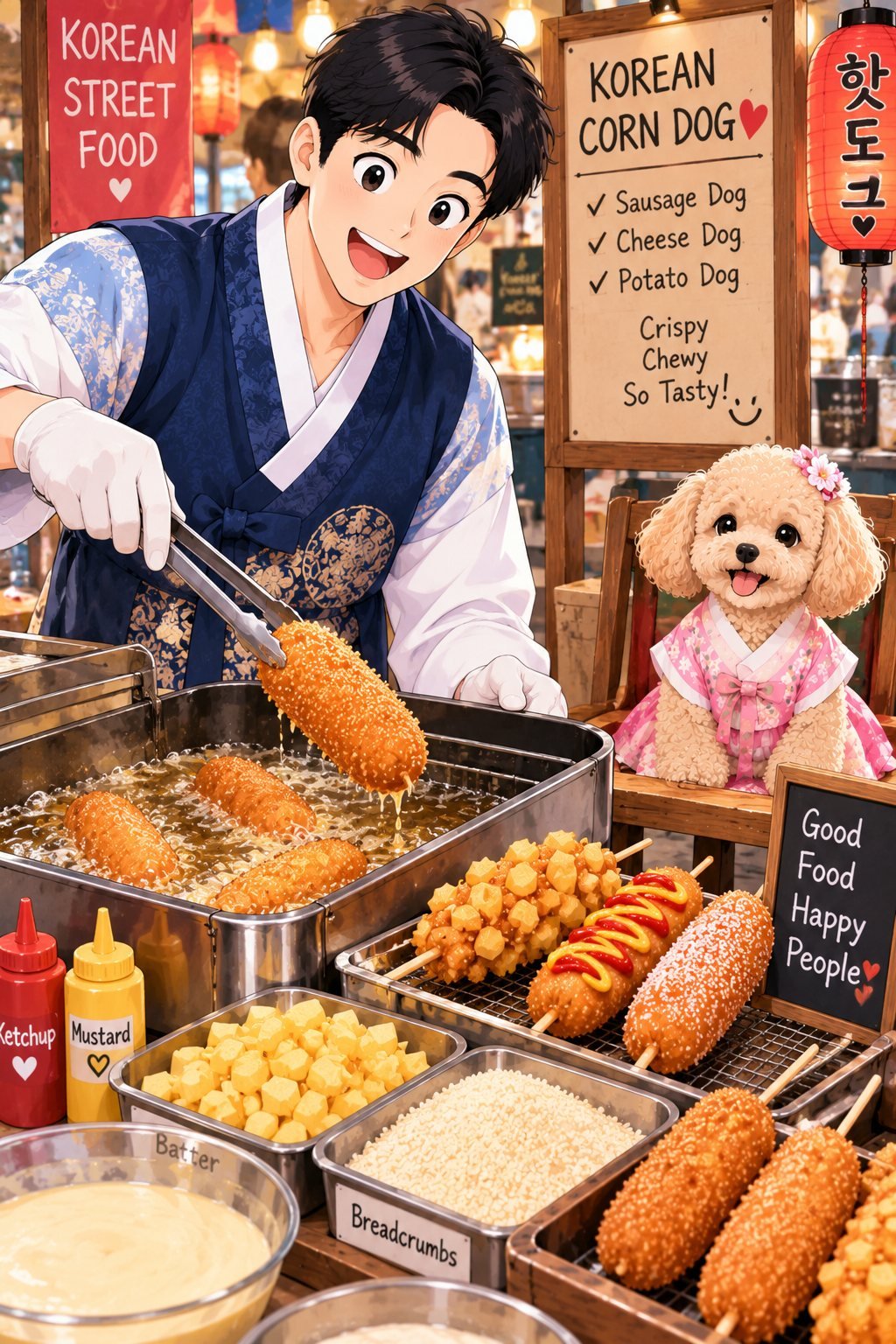
Deep-frying transforms the thick coating into a golden crust while heating sausage, mozzarella, and potato-coated variations inside.
Why Sugar Is Added After Frying
One characteristic that can surprise first-time international diners is the use of sugar on a savory-looking fried snack.
A light coating of sugar creates a sweet contrast with sausage, cheese, fried dough, ketchup, mustard, and other sauces.
Not every Korean corn dog needs to be sugared, and shops can offer different finishing options.
Ketchup & Mustard
Ketchup and mustard are two familiar finishing sauces for Korean corn dogs.
Ketchup contributes sweetness and acidity, while mustard adds sharper flavor. When combined with sugar on the exterior, the result can move between sweet, salty, tangy, creamy, and fried flavors in the same bite.
Individual shops can offer additional sauces and seasoning combinations.
Why Korean Corn Dogs Can Taste Sweet & Savory
The sweet-and-savory contrast is not produced by one ingredient alone.
Sausage contributes saltiness and savory flavor, mozzarella adds richness, the fried coating contributes toasted flavor and texture, sugar adds sweetness, and sauces introduce additional acidity or seasoning.
The balance changes significantly depending on the filling and toppings selected.
The Famous Mozzarella Cheese Pull
The cheese pull is one of the visual signatures that helped Korean corn dogs stand out in international food videos.
When properly melted mozzarella is bitten and pulled away from the fried coating, long strands of cheese can stretch between the diner and the corn dog.
The effect is visually dramatic, but freshly fried cheese can also be extremely hot.
How to Eat a Mozzarella Korean Corn Dog Safely
Allow a freshly fried corn dog to cool before taking the first bite.
Start with a manageable bite and keep control of the wooden stick. Do not pull hot cheese rapidly toward the face simply to create the longest possible cheese stretch.
The eating experience is more important than reproducing an exaggerated social-media cheese pull.
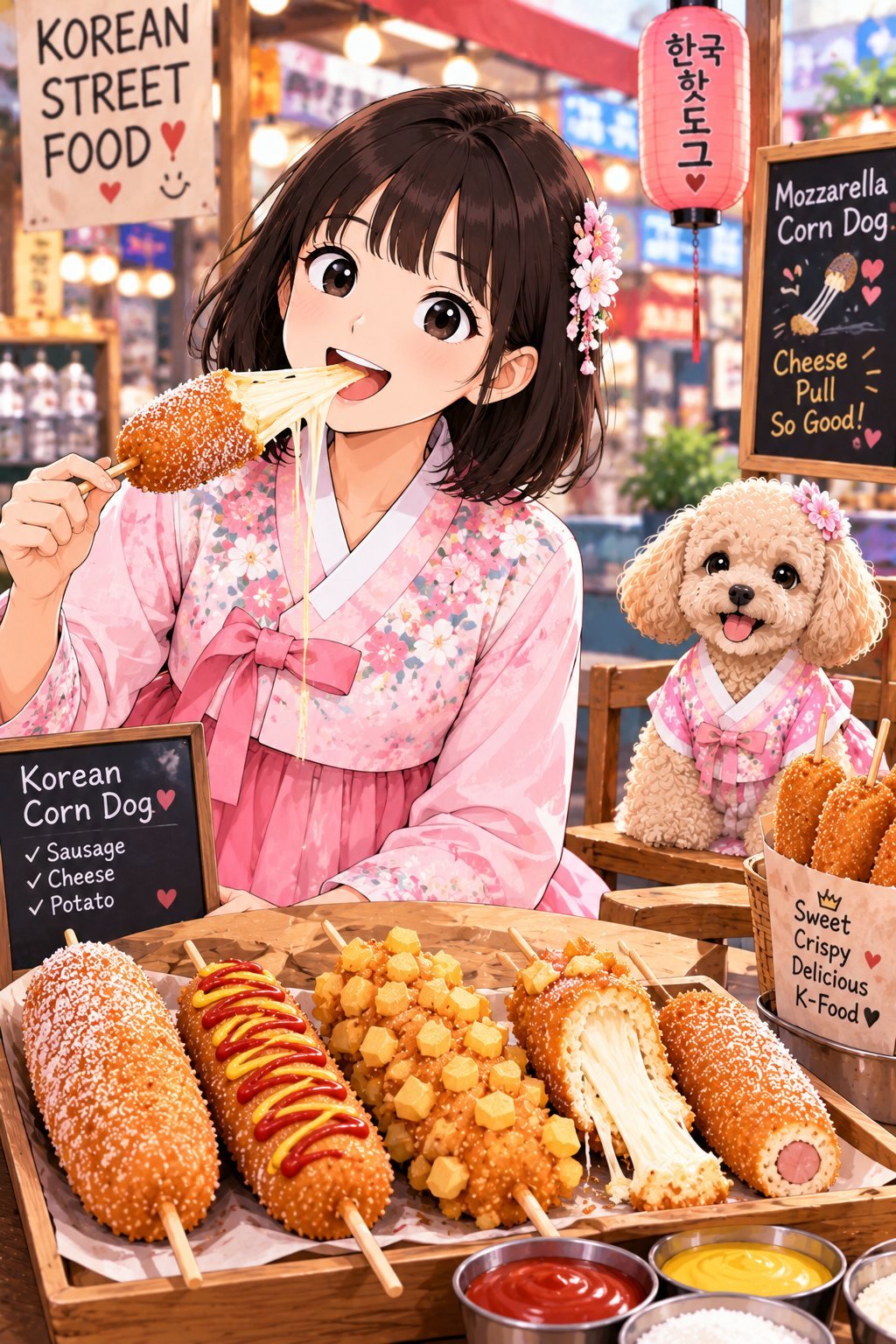
Mozzarella creates the famous Korean corn dog cheese pull, but freshly fried cheese should be allowed to cool before eating.
Korean Corn Dogs as Street Food
Korean corn dogs fit naturally into modern Korean street-food culture because they are portable, visually distinctive, and available in many customizable variations.
They can be eaten from the stick without requiring a full restaurant table, while different fillings and coatings make it easy for shops to offer multiple choices from the same basic format.
This combination of portability, customization, fried texture, and strong visual appeal also helped the food travel effectively beyond Korea.
Why Korean Corn Dogs Became Globally Recognizable
The Korean corn dog is especially well suited to visual food media.
Long mozzarella cheese pulls, potato-covered exteriors, colorful sauces, and sugar-coated crusts are immediately visible on camera. These characteristics helped Korean corn dogs become familiar to international audiences through social media, food videos, mukbang, and Korean street-food content.
Its global popularity is therefore connected not only to flavor but also to the highly visual experience of preparing and eating it.
Korean Corn Dogs & Global K-Food
Korean corn dogs moved beyond their role as a Korean street snack and became part of the wider international interest in K-Food.
The combination of familiar ingredients and distinctly Korean variations helped make the food accessible to international diners. Sausage and fried coating are easy concepts to understand, while mozzarella centers, potato exteriors, sugar, and customized sauces make the experience feel different from a conventional corn dog.
This balance between familiarity and novelty has helped Korean corn dogs travel across different food cultures.
The Role of Social Media
Social media gave Korean corn dogs an environment where their most distinctive characteristics could be understood almost instantly.
A viewer does not need to know Korean cuisine to recognize a long cheese pull, a crunchy potato-covered exterior, or a freshly fried snack covered with colorful sauces.
Short-form videos and food-focused posts can communicate those textures visually before a viewer has ever tasted the food.
Korean Corn Dogs & TikTok Culture
Korean corn dogs became particularly compatible with short-form video culture because the eating experience contains an immediate visual payoff.
A mozzarella corn dog can produce a dramatic cheese pull within seconds, while potato-coated and sauce-covered versions remain visually distinctive even in a very short video.
This helped introduce the food to international audiences who may initially have discovered it through online trends rather than through travel to Korea.
Korean Corn Dogs & Mukbang
Mukbang and other eating-focused videos provide another natural setting for Korean corn dogs.
The crisp exterior, stretchy cheese, sausage center, sauces, and different coatings allow creators to compare several versions in the same meal.
Online eating content can introduce the food, but exaggerated portions, very long cheese pulls, or fast eating should not be treated as instructions for how the snack needs to be consumed.
Korean Corn Dog Shops Outside Korea
As international interest increased, Korean-style corn dog shops and Korean street-food businesses expanded the food’s visibility outside Korea.
Menus abroad can include sausage, mozzarella, half-and-half, potato-coated, breadcrumb-coated, and other locally adapted variations.
The exact recipes and terminology can differ between countries and businesses, so a food sold internationally as a Korean corn dog does not necessarily follow one standardized Korean recipe.
Choosing Your First Korean Corn Dog
For a first experience, begin by choosing the filling rather than focusing only on the exterior.
A sausage corn dog provides the most familiar savory center. A mozzarella version emphasizes cheese and texture, while a half-sausage-and-half-cheese version provides both experiences on one stick.
After choosing the filling, consider whether you want a basic breadcrumb coating or a more substantial potato-covered exterior.
Sausage vs. Mozzarella
The two fillings create very different experiences.
Sausage provides a savory, meaty center with a firmer bite. Mozzarella is milder and softer when hot and can produce the famous stretchy cheese texture.
Neither is the required or more authentic choice. The better starting point depends on whether the diner wants savory sausage flavor or a cheese-focused experience.
What Is a Half-and-Half Korean Corn Dog?
A half-and-half version combines sausage and mozzarella on the same stick.
Depending on how the shop assembles it, one part of the corn dog can contain cheese while another contains sausage.
This format is useful for diners who want to experience both fillings without ordering two full corn dogs.
Should You Choose a Potato Corn Dog?
A potato-coated version adds another layer of texture and makes the snack more substantial.
The small potato pieces become fried along with the coating, producing a chunky and crisp exterior.
For someone mainly interested in the mozzarella cheese pull, a simpler coating can make the cheese the main feature. For someone interested in contrasting textures, the potato version provides a noticeably different experience.
Should You Add Sugar?
Sugar is one of the features that can make Korean corn dogs surprising to first-time diners.
A light coating adds sweetness to the fried exterior and contrasts with salty sausage, mild mozzarella, ketchup, mustard, and other sauces.
Whether sugar is added can depend on the shop and customer preference. Travelers who prefer a more savory flavor can check whether the sugar is optional before ordering.
Choosing the Sauces
Ketchup and mustard are familiar starting points, but Korean corn dog shops can offer additional sauces and seasonings.
Adding several sauces creates a stronger and more complex flavor, while using only one or two can make it easier to taste the fried coating and filling.
There is no requirement to reproduce a heavily decorated social-media version.
Korean Corn Dog & Tteokbokki
Tteokbokki is a natural companion when exploring Korean street-food culture.
Tteokbokki provides chewy rice cakes and a strongly seasoned sauce, while a Korean corn dog contributes a fried exterior, sausage or cheese, and optional sweetness.
The contrast demonstrates how Korean street-food menus can combine spicy, sweet, savory, chewy, crispy, and creamy textures within the same casual meal.
Korean Corn Dog vs. Hotteok
Hotteok and Korean corn dogs can both be eaten as portable Korean street foods, but their structures and flavor profiles are very different.
Hotteok uses filled dough pressed on a griddle and is strongly associated with melted brown sugar, cinnamon, nuts, or seeds in its classic sweet form.
Korean corn dogs are built around sausage or cheese on a stick, coated and deep-fried before receiving optional sugar and sauces.
Korean Corn Dog vs. Mandu
Mandu provides another useful comparison because it also encloses a filling, but Korean dumplings use wrappers and can be steamed, boiled, pan-fried, or deep-fried depending on the style.
Korean corn dogs instead place the filling on a stick and surround it with a much thicker fried coating.
The two foods therefore demonstrate very different uses of filled dough within Korean food culture.
Korean Corn Dog vs. American Corn Dog
The distinction becomes easiest to understand when comparing the complete eating experience rather than only the shape.
An American corn dog is commonly associated with a sausage coated in cornmeal-based batter and deep-fried. Korean versions frequently expand the concept through mozzarella, half-and-half fillings, potato cubes, breadcrumbs, sugar, and multiple sauces.
Individual recipes vary in both countries, so these differences describe common patterns rather than rigid rules applying to every corn dog.
The Complete Korean Corn Dog Experience
A Korean corn dog can combine a golden fried crust, chewy coating, savory sausage, stretchy mozzarella, crispy potato, sugar, ketchup, mustard, and other sauces in a single portable snack.
Its many variations are part of the appeal: two people visiting the same shop can choose noticeably different fillings, coatings, and finishes.
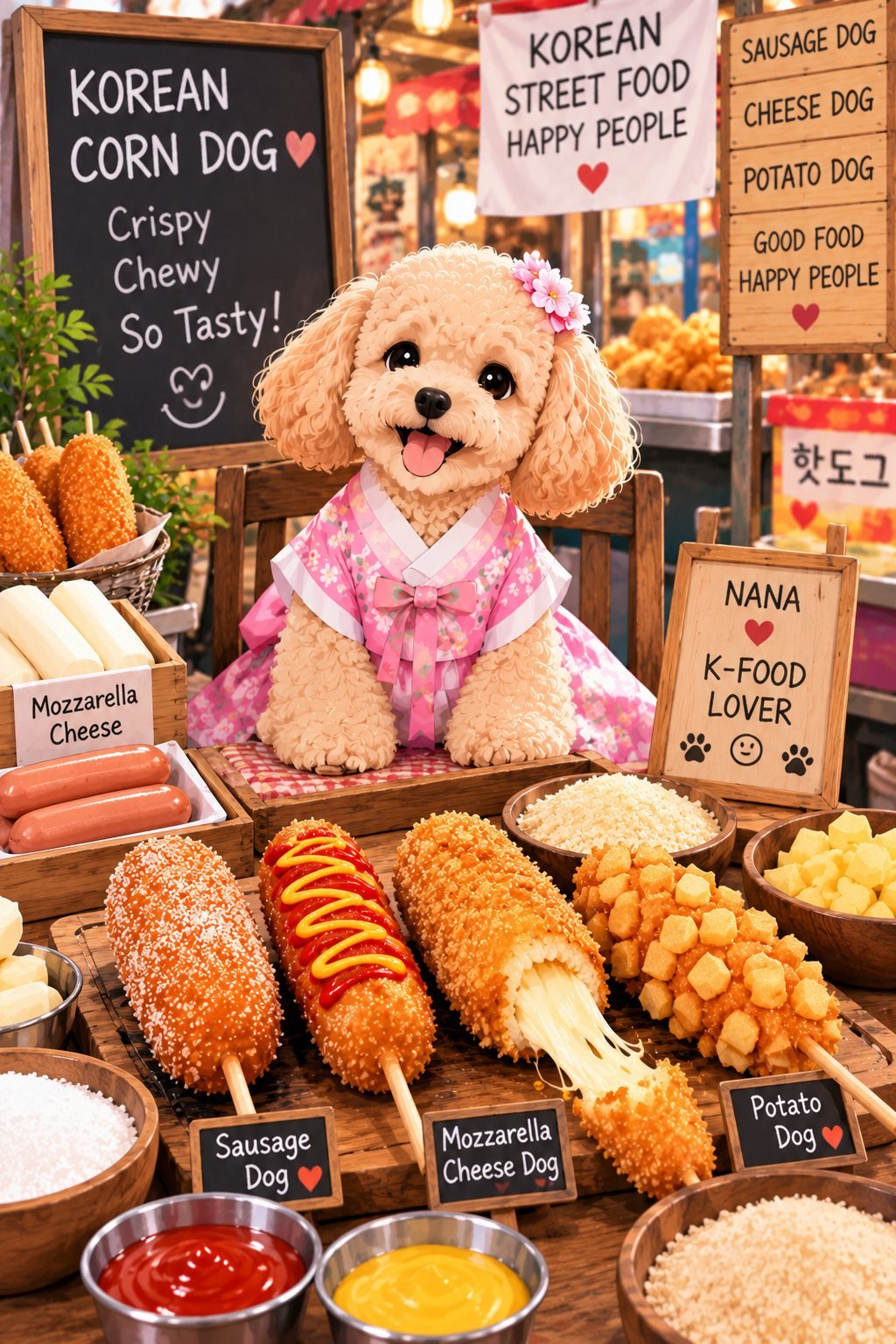
Sausage, mozzarella, potato coating, sugar, ketchup, and mustard represent the customizable character that helped Korean corn dogs become a global K-Street Food favorite.
How Korean Corn Dogs Connect with Other K-Food
Tteokbokki introduces the spicy and chewy side of Korean street food, while Hotteok provides a sweet filled-dough street snack with a completely different cooking method.
Gimbap represents another portable Korean food, while Mandu expands the collection into Korean dumplings and multiple cooking styles.
Korean Ramyeon explains Korea’s instant-noodle culture, while Buldak Bokkeummyeon explores the globally visible K-Spicy noodle phenomenon.
Korean Fried Chicken provides another globally recognized fried K-Food experience, although it centers on chicken pieces and sauce rather than a filled snack on a stick.
Korean BBQ, Galbi, Bulgogi, and Samgyeopsal show the shared-table grilled-meat side of Korean food in contrast with portable street snacks.
Bibimbap and Kimchi Fried Rice expand the collection into Korean rice meals, while Japchae, Jjajangmyeon, and Naengmyeon provide three very different noodle traditions.
Kimchi, Kimchi-jjigae, Sundubu-jjigae, and Samgyetang extend the K-Food Wiki from fermented side dishes to stews and soup.
Korean Corn Dogs & Gwangjang Market
Gwangjang Market helps international travelers understand the atmosphere of Korean market-food culture, where multiple aromas, cooking methods, snacks, and meals can exist within the same destination.
Specific vendors and menus change, so the market should not be presented as a guarantee that one particular Korean corn dog stall will always be operating.
The broader value of a market visit is experiencing Korean food culture in an environment where preparation and eating often happen close together.
Korean Corn Dogs & Hongdae
Hongdae provides a natural travel connection because contemporary youth culture, casual food, shopping, cafés, and social-media-friendly experiences come together in the area.
A Korean corn dog can work as a quick snack during a walking itinerary rather than requiring a full sit-down meal.
Korean Corn Dogs & a Seoul Travel Day
Travelers can contrast modern street-food culture with traditional Seoul by combining casual K-Food stops with Gyeongbokgung Palace, Bukchon Hanok Village, or Insadong.
This combination helps show that contemporary K-Food and traditional Korean cultural experiences can be part of the same travel day rather than separate types of tourism.
FAQ
What is a Korean corn dog?
A Korean corn dog is a Korean street food made by placing sausage, mozzarella cheese, or a combination of both on a stick, covering it with a thick coating, and deep-frying it until golden. Breadcrumbs, potato pieces, sugar, ketchup, mustard, and other finishes can be added depending on the version.
What is the difference between a Korean corn dog and an American corn dog?
American corn dogs are commonly associated with sausage and a cornmeal-based batter. Korean corn dogs often expand the format with mozzarella, half-sausage-and-half-cheese fillings, potato coatings, breadcrumbs, sugar, and multiple sauces. Recipes vary, so these are common differences rather than universal rules.
Do Korean corn dogs always contain sausage?
No. Some contain sausage, some contain mozzarella cheese, and others combine both. Shops can also offer additional fillings and variations, so the exact product should be checked before ordering.
Why do Korean corn dogs have sugar on them?
A light sugar coating creates a sweet contrast with the savory sausage, mild cheese, fried exterior, ketchup, mustard, and other sauces. Sugar is not necessarily used on every version and may be optional at some shops.
What is a potato Korean corn dog?
A potato Korean corn dog has small potato pieces attached to the exterior coating before frying. The potato becomes golden and crisp, creating a chunkier texture than a simple breadcrumb coating.
Why are mozzarella Korean corn dogs famous?
Mozzarella can stretch into long strands when the freshly cooked corn dog is bitten and pulled apart. This visual cheese-pull effect became especially recognizable through social media, short-form food videos, and mukbang.
Are Korean corn dogs spicy?
Not necessarily. Many basic versions focus on sausage, cheese, fried coating, sugar, ketchup, and mustard rather than chili heat. However, individual shops can offer spicy sauces, seasonings, or fillings.
Where to Try Korean Corn Dogs
Korean corn dogs can be found at street-food stalls, snack shops, markets, specialty corn-dog businesses, and other casual food locations.
They have also become widely available outside Korea through Korean street-food shops and businesses specializing in Korean-style corn dogs.
Menus vary significantly, so availability of mozzarella, potato, half-and-half, sugar-coated, or other versions depends on the individual business.
What to Check Before Ordering
First choose the filling: sausage, mozzarella, half-and-half, or another available option.
Next check the exterior. A basic breadcrumb coating and a potato-covered coating provide noticeably different textures.
Finally, decide whether you want sugar and which sauces or seasonings should be added. Do not assume every shop automatically prepares the same combination.
First-Time Korean Corn Dog Tips
- Choose the filling first — sausage and mozzarella create very different experiences.
- Try half-and-half — it can provide both cheese and sausage on one stick.
- Consider potato coating — it creates a chunkier, crispier exterior.
- Ask about sugar — some diners enjoy the sweet-savory contrast while others prefer a more savory finish.
- Do not overload the sauces — fewer sauces can make the filling and fried coating easier to taste.
- Wait before biting — cheese and sausage can remain extremely hot after frying.
- Control the stick — avoid pulling or waving a long cheese strand toward another person.
Food & Allergy Notes
Korean corn dog recipes vary between shops, packaged products, and home preparations.
The coating can contain wheat and other ingredients, while mozzarella introduces milk. Some batters or coatings can contain egg, and sausages can contain recipe-dependent meat, soy, dairy, seasonings, or other ingredients.
Breadcrumbs, potato coatings, sauces, seasonings, and shared frying oil can introduce additional allergens or cross-contact concerns.
People with allergies, intolerances, religious dietary restrictions, vegetarian requirements, or other dietary needs should confirm the filling, coating, sauces, frying environment, and ingredient information directly with the business or manufacturer.
Wheat & Gluten
Many Korean corn dog coatings use wheat flour or wheat-based breadcrumbs.
A potato exterior does not automatically make the corn dog gluten-free because potato pieces can be attached to a wheat-based coating underneath.
Shared preparation surfaces and frying equipment can also create cross-contact, so people who must strictly avoid gluten should verify both ingredients and preparation.
Milk & Mozzarella
Mozzarella Korean corn dogs contain dairy unless a specific alternative product is used.
Cheese can be completely enclosed inside the fried coating, making it difficult to identify from the exterior alone.
People avoiding milk should confirm whether the center contains cheese and whether dairy appears elsewhere in the recipe.
Egg in Batter or Coating
Egg can appear in some batter, dough, breadcrumb, or coating recipes.
Because recipes differ, the absence of visible egg does not confirm that a Korean corn dog is egg-free.
Check the specific recipe or product information when egg allergy or avoidance is relevant.
What Meat Is in the Sausage?
The sausage inside a Korean corn dog should not automatically be assumed to use one particular type of meat.
Depending on the product or business, sausage ingredients can vary and can include different meats or additional ingredients.
People who avoid pork, beef, chicken, or other animal products for religious, dietary, or personal reasons should confirm the sausage ingredients before ordering.
Shared Frying Oil & Cross-Contact
Korean corn dog shops can use the same preparation areas, utensils, or frying oil for multiple products.
Even when one corn dog appears to contain only a particular filling, shared equipment can create cross-contact with ingredients used in other menu items.
Anyone managing a serious food allergy should ask the business about its preparation environment rather than relying only on the visible ingredients.
Hot Cheese Safety
Melted mozzarella can remain extremely hot inside the fried coating.
A dramatic cheese pull can bring hot cheese close to the lips, face, hands, or clothing, particularly if the diner pulls the corn dog away quickly.
Allow the food to cool and keep cheese pulls short and controlled rather than attempting to reproduce exaggerated social-media videos.
Hot Oil & Frying Safety
Deep-frying involves very hot cooking oil and should be handled carefully.
Moisture, damaged coating, or inappropriate handling can cause hot oil to splash. Appropriate equipment and utensils should be used when lowering food into oil or removing it.
Children and pets should remain away from active frying areas.
Wooden Skewer Safety
The stick makes a Korean corn dog portable but also introduces a physical hazard if handled carelessly.
Keep the pointed end away from the face and other people, particularly when biting, walking, or creating a cheese pull.
Children should be supervised appropriately when eating food served on a skewer.
Storage & Reheating
Korean corn dogs are generally valued for their freshly fried exterior and hot filling.
If leftovers are stored, follow appropriate food-storage practices for sausage, cheese, batter, and other perishable ingredients.
Reheating can make the filling extremely hot again even when the exterior feels comfortable, so allow reheated corn dogs to cool before eating.
Image Credits
Korean corn dog family street-food visual with Dad, Mom, K-Nana daughter, and Nana in hanbok enjoying sausage, mozzarella, and potato Korean corn dogs with sugar, ketchup, and mustard — K-Nana Studio original visual.
Korean corn dog preparation visual with Mom in hanbok preparing sausage and mozzarella on skewers with batter, breadcrumbs, and potato cubes while Nana watches from a separate safe seat — K-Nana Studio original visual.
Korean corn dog frying visual with Dad in hanbok carefully deep-frying breadcrumb-coated and potato-coated Korean corn dogs while Nana remains safely separated from the hot oil and cooking equipment — K-Nana Studio original visual.
Mozzarella Korean corn dog visual with K-Nana daughter in hanbok carefully enjoying a cooled Korean corn dog with a stretchy cheese pull while Nana sits separately without touching the food — K-Nana Studio original visual.
Nana in pink floral hanbok seated separately as a K-Food mascot beside sausage, mozzarella, and potato Korean corn dogs with breadcrumbs, potato, sugar, ketchup, and mustard — K-Nana Studio original visual.
Disclaimer
This article is provided for general food, travel, and cultural information. Korean corn dog fillings, sausages, cheeses, batters, coatings, breadcrumbs, potatoes, sauces, allergens, frying oils, preparation methods, serving styles, and ingredients can vary by shop, product, and country. Recipes may contain wheat, gluten, milk, egg, soy, meat, or other recipe-dependent ingredients, and shared preparation areas or frying oil can create cross-contact risks. Freshly fried or reheated corn dogs can contain extremely hot cheese, sausage, or other fillings. Hot cooking oil can cause serious burns, and wooden skewers can cause injury if handled improperly. People with allergies, medical conditions, religious dietary restrictions, vegetarian requirements, or other individual needs should confirm ingredients and preparation directly with the business or manufacturer and follow appropriate professional guidance when necessary.