
Dakgalbi is a Korean chicken dish best known for combining seasoned chicken with cabbage, sweet potato, onion, green onion, tteok, and a spicy red sauce on a large heated griddle.
The ingredients cook together at the table, allowing the vegetables and chewy rice cakes to absorb the sauce while the chicken becomes the center of a warm, shareable meal.
Dakgalbi is especially associated with Chuncheon in Gangwon Province, making it both a popular Korean dish and an important part of regional food culture.
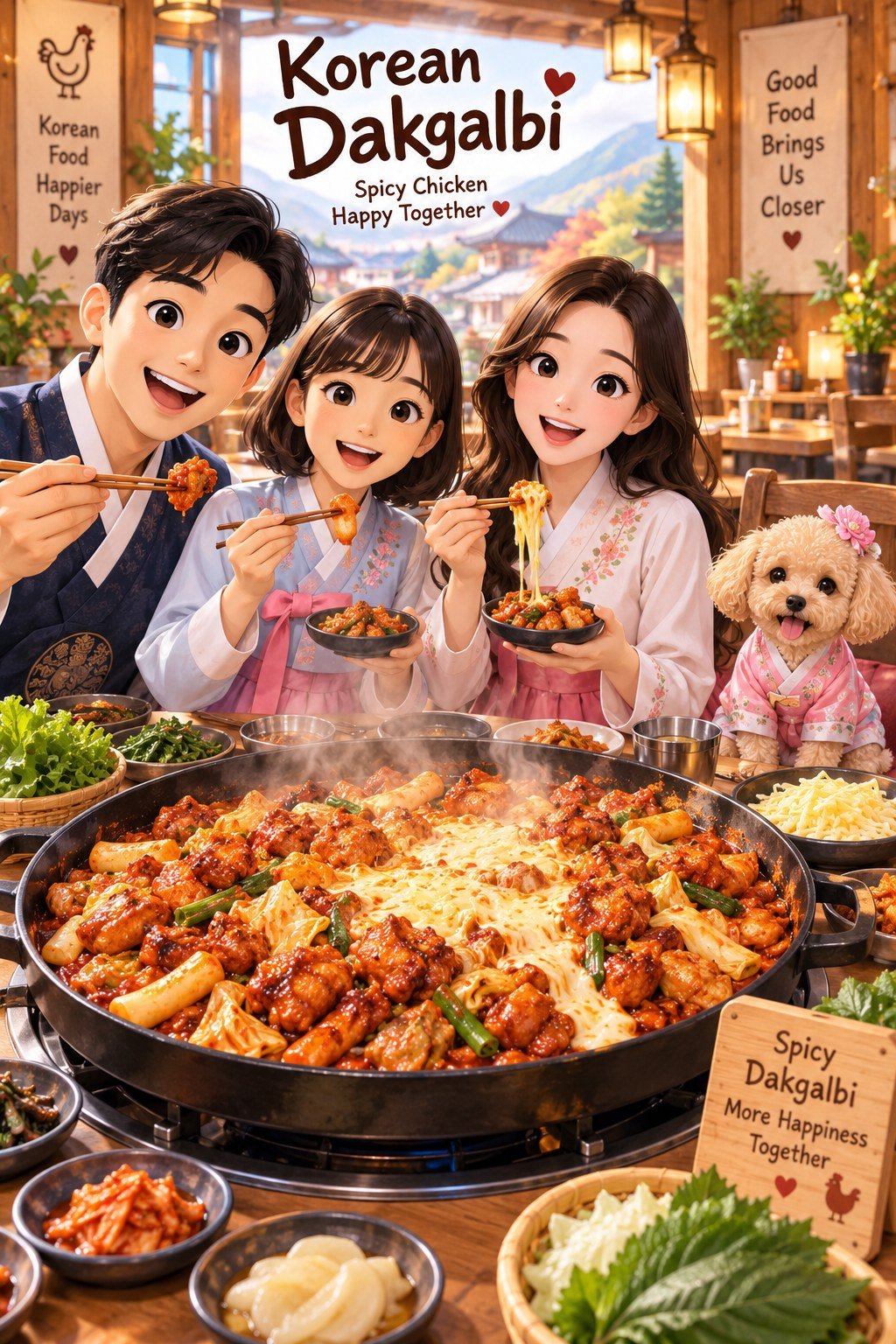
Chicken, cabbage, sweet potato, chewy tteok, spicy red sauce, and a large tabletop griddle create the distinctive Korean dakgalbi experience.
Quick Guide
| Korean name | 닭갈비 |
| Romanization | Dakgalbi |
| Common English description | Spicy Korean stir-fried chicken |
| Main ingredient | Chicken |
| Common vegetables | Cabbage, sweet potato, onion and green onion |
| Common addition | Tteok, or Korean rice cakes |
| Flavor profile | Spicy, savory and slightly sweet |
| Famous cooking style | Large tabletop griddle |
| Regional association | Chuncheon, Gangwon Province |
| Popular variation | Cheese Dakgalbi |
| Popular final course | Dakgalbi fried rice |
What Is Dakgalbi?
Dakgalbi is a Korean chicken dish commonly prepared with pieces of chicken, vegetables, rice cakes, and a seasoned red sauce.
In the familiar griddle style, the ingredients are cooked together on a wide metal cooking surface placed at the center of the table.
This creates a meal in which diners share chicken, vegetables, and tteok from the same griddle rather than receiving completely separate individual plates.
What Does Dakgalbi Mean?
The name 닭갈비 combines “dak,” meaning chicken, with “galbi,” a Korean word associated with ribs.
This can be confusing for first-time international diners because many modern servings of dakgalbi use boneless pieces of chicken and do not visibly contain ribs.
Dakgalbi should therefore be understood as the established name of the dish rather than as a guarantee that rib bones will appear in every serving.
Why Is It Called Dakgalbi If There Are No Ribs?
The modern name reflects the historical development of the dish rather than functioning as a precise description of the cut served by every restaurant today.
Contemporary griddle dakgalbi is much more easily recognized by seasoned chicken, vegetables, rice cakes, spicy sauce, and its shared cooking style.
Chicken cuts and the presence of bones can vary, so diners who need to know the exact cut should check with the restaurant.
Dakgalbi vs. Galbi
Galbi and dakgalbi are separate Korean dishes despite sharing the word “galbi.”
Galbi commonly refers to rib dishes such as marinated beef or pork ribs, often associated with Korean barbecue. Dakgalbi centers on chicken and is especially known for spicy seasoning and griddle cooking.
The protein, sauce, cooking method, vegetables, and overall dining experience are therefore clearly different.
What Chicken Is Used in Dakgalbi?
Dakgalbi commonly uses chicken cut into pieces that can cook evenly with the other ingredients.
Boneless chicken is widely used in modern griddle-style preparations because it is convenient to mix, portion, and share at the table.
The exact cut varies between restaurants and recipes, so one serving should not be treated as a universal standard for all dakgalbi.
What Does Dakgalbi Taste Like?
Dakgalbi commonly combines spicy, savory, slightly sweet, and garlicky flavors.
The chicken provides savory richness, cabbage and sweet potato contribute natural sweetness, and tteok adds a mild chewy component that carries the sauce well.
The balance changes according to the restaurant’s seasoning, ingredients, spice level, and optional additions.
The Spicy Red Dakgalbi Sauce
The red seasoning is one of the most recognizable features of griddle-style dakgalbi.
Recipes can include gochujang, gochugaru, soy sauce, garlic, sweetness, and other seasonings in different proportions.
Because recipes vary, two restaurants can serve dakgalbi with noticeably different levels of heat, sweetness, saltiness, and sauce thickness.
Gochujang & Gochugaru
Gochujang can contribute fermented chili flavor, body, sweetness, and saltiness, while gochugaru can add chili flavor, red color, and additional heat.
They can be combined with garlic, soy sauce, sweeteners, and other seasonings to build the restaurant’s sauce.
A dark or bright red appearance alone does not reveal exactly how spicy the finished dakgalbi will be.
Preparing Dakgalbi Ingredients
Chicken is cut into manageable pieces and prepared with the seasoning according to the recipe.
Cabbage, sweet potato, onion, green onion, and rice cakes are prepared separately so the ingredients can be added to the cooking surface appropriately.
Raw chicken should remain separated from ready-to-eat foods, clean utensils, and finished dishes during preparation.
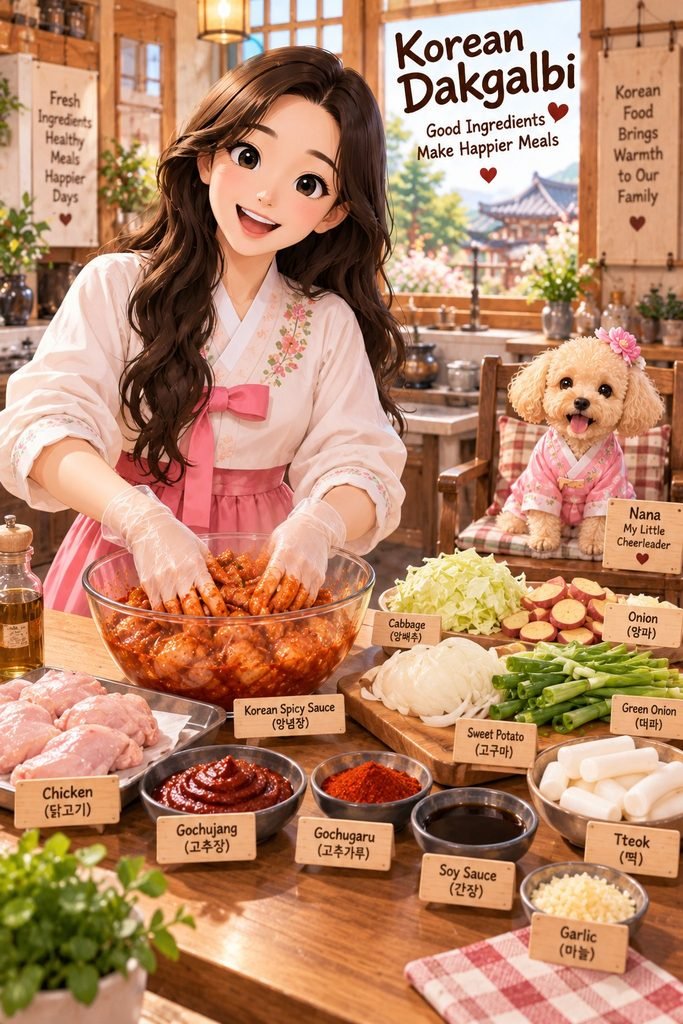
Chicken, cabbage, sweet potato, onion, green onion, tteok, and spicy red seasoning form the basic structure of classic griddle-style dakgalbi.
Cabbage in Dakgalbi
Cabbage is one of the vegetables most strongly associated with the familiar griddle version.
It initially adds bulk and texture, then gradually softens as it cooks and becomes coated with the spicy sauce.
Its mild natural sweetness also provides contrast with chili-based seasoning.
Sweet Potato in Dakgalbi
Sweet potato adds another layer of natural sweetness and a denser vegetable texture.
As the pieces cook, their centers soften while their sweetness contrasts with the spicy sauce.
Because thick sweet-potato pieces can take longer to soften than some vegetables, they should be cooked sufficiently before eating.
Tteok in Dakgalbi
Tteok adds one of the most recognizable textural contrasts in dakgalbi.
The rice cakes become coated in spicy sauce while retaining their dense, chewy structure.
Some restaurants include tteok in the basic serving, while others can offer additional rice cakes as an optional extra.
How Dakgalbi Is Cooked
The prepared chicken, vegetables, tteok, and seasoning are placed on a large heated griddle.
The ingredients are turned and mixed as they cook so the chicken heats thoroughly and the sauce spreads across the vegetables and rice cakes.
As moisture is released and the ingredients soften, the separate components gradually become one glossy, richly seasoned dish.
Why Dakgalbi Uses a Large Griddle
The wide cooking surface provides enough space for chicken, vegetables, tteok, and optional additions to cook together.
It also creates the communal style associated with the dish because several diners can share from one central cooking surface.
The griddle remains very hot during the meal and should be treated as active cooking equipment rather than as an ordinary serving plate.
When Is the Chicken Ready to Eat?
Chicken needs to be thoroughly cooked before consumption.
The pieces can vary in thickness, and the red sauce can make visual judgment more difficult, so the exterior color alone should not be used as the only indication of doneness.
When restaurant staff manage the cooking, diners should follow their instructions about when the chicken is ready.
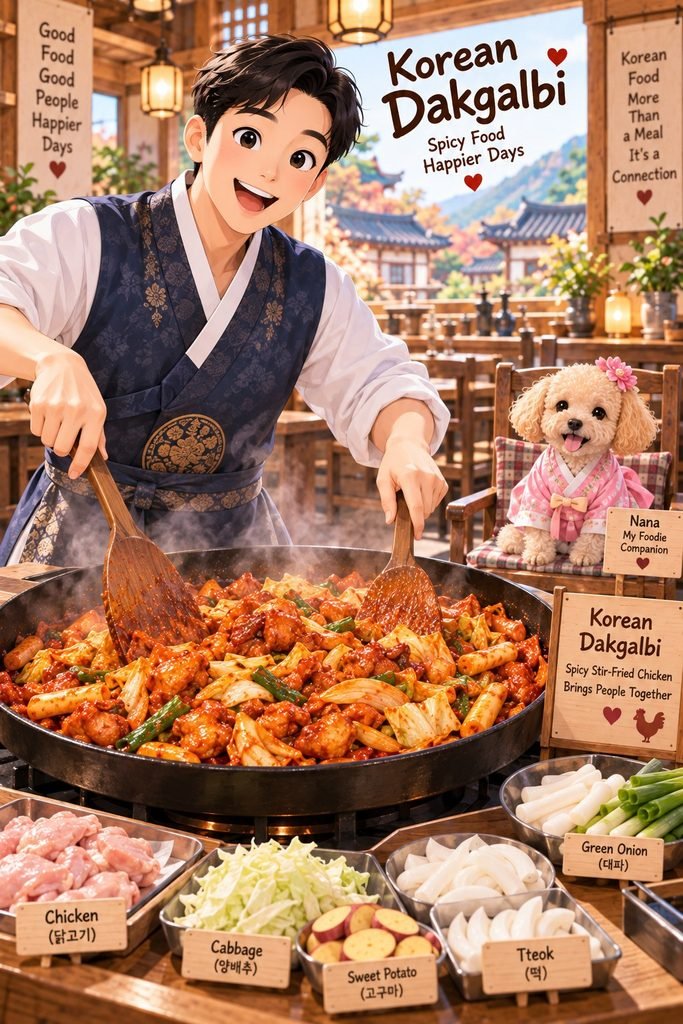
The ingredients are mixed across a hot griddle until the chicken is thoroughly cooked and the vegetables and rice cakes are coated in the spicy sauce.
What Is Chuncheon Dakgalbi?
Chuncheon in Gangwon Province is the Korean city most strongly associated with dakgalbi.
The dish became closely connected with the city’s food identity, and eating dakgalbi became a recognizable part of visiting Chuncheon.
Restaurants still differ in chicken cuts, seasoning, accompaniments, cooking techniques, and menu options, so Chuncheon dakgalbi should not be treated as one completely standardized recipe.
Chuncheon Dakgalbi Culture
Dakgalbi demonstrates how a food can become strongly linked with a Korean destination.
For visitors to Chuncheon, the meal can become part of the travel experience rather than simply a chicken dish available anywhere.
Specific restaurant menus, prices, opening hours, and preparation styles can change and should be checked when planning a visit.
Cheolpan Dakgalbi
Cheolpan dakgalbi refers to dakgalbi cooked on a metal griddle or iron plate.
This is the familiar style in which chicken, cabbage, sweet potato, tteok, sauce, and optional additions are cooked together on a wide tabletop surface.
The format also makes it easy to add noodles, extra rice cakes, cheese, or other restaurant-specific ingredients.
Sutbul Dakgalbi
Sutbul dakgalbi refers to a charcoal-grilled style of dakgalbi.
Instead of mixing chicken with a large quantity of vegetables and rice cakes on one griddle, the chicken is cooked over charcoal.
This produces a different aroma, texture, cooking process, and eating experience from cheolpan dakgalbi.
Cheolpan vs. Sutbul Dakgalbi
Cheolpan dakgalbi emphasizes the shared griddle and the combination of chicken, vegetables, rice cakes, and sauce.
Sutbul dakgalbi emphasizes charcoal grilling and the flavor produced by direct heat.
Both belong to dakgalbi culture, but international visitors should check which style a restaurant specializes in before expecting the large mixed griddle presentation.
Cheese Dakgalbi
Cheese dakgalbi is a popular modern variation that adds melted cheese to the spicy chicken.
Mild cheese can provide creaminess and richness while contrasting with the chili-based sauce.
Cheese is an optional variation and should not be treated as an ingredient required for traditional or standard dakgalbi.
How Spicy Is Dakgalbi?
Dakgalbi is commonly spicy, but there is no universal heat level.
Restaurants use different quantities of chili paste, chili flakes, sweetness, and other seasonings, and some businesses offer selectable spice levels.
People sensitive to chili should ask about the restaurant’s seasoning before ordering rather than judging only from the red appearance.
What Is Sari?
Sari refers to additional ingredients that can be added to a dish.
Dakgalbi restaurants can offer extra tteok, udon noodles, ramyeon noodles, cheese, or other restaurant-specific additions.
Adding several sari can substantially increase both the portion size and the amount of starch or cheese in the meal.
Noodles in Dakgalbi
Udon-style noodles, ramyeon noodles, or other available noodles can be mixed with the sauce and remaining ingredients on the griddle.
The noodles absorb seasoning and provide another texture alongside chicken, vegetables, and chewy rice cakes.
Available noodle types differ by restaurant and should be checked on the menu.
Eating Dakgalbi as Ssam
Cooked chicken can also be enjoyed with lettuce or other wrapping greens when they are provided.
A small piece of chicken and selected accompaniments can be placed inside the leaf and eaten as a wrap.
The available greens, sauces, garlic, and other accompaniments vary by restaurant.
Dakgalbi Fried Rice
Fried rice is one of the most recognizable ways to finish a cheolpan dakgalbi meal.
After most of the chicken and vegetables have been eaten, rice can be added to the seasoned mixture remaining on the hot griddle.
Kimchi, seaweed flakes, green onion, sesame, or other restaurant-specific ingredients can then be mixed into the rice.
Why Fried Rice Comes at the End
The fried rice uses the sauce and small pieces of food remaining from the main dakgalbi rather than beginning as an unrelated dish.
As the rice cooks, it absorbs the concentrated seasoning left on the griddle.
This creates a natural final course and is one of the experiences first-time diners frequently associate with a complete griddle dakgalbi meal.
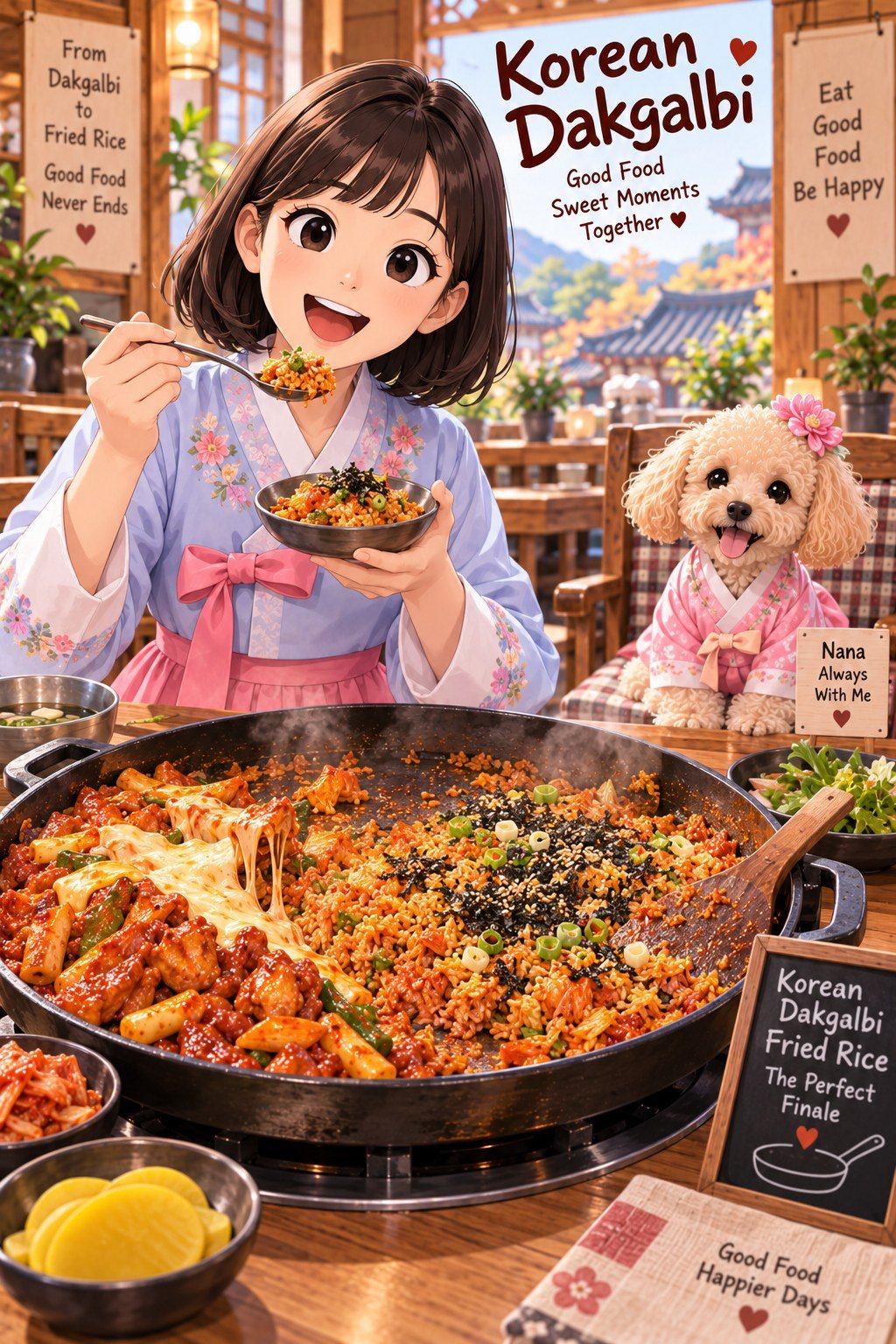
Rice fried in the remaining dakgalbi seasoning turns the end of the shared griddle meal into a distinctive final course.
Dakgalbi vs. Bulgogi
Bulgogi commonly uses thinly sliced marinated meat with a savory-sweet flavor profile.
Dakgalbi centers on chicken and is much more strongly associated with spicy red seasoning, cabbage, sweet potato, rice cakes, and large-griddle cooking.
The protein, seasoning, ingredients, and dining format therefore create clearly different Korean dishes.
Dakgalbi vs. Korean Fried Chicken
Korean Fried Chicken uses frying to create a crisp chicken exterior and can then be served plain or with different sauces.
Dakgalbi does not depend on a fried crust. Its familiar griddle version cooks chicken directly with sauce, vegetables, and rice cakes.
Both are Korean chicken dishes, but their textures, cooking methods, accompaniments, and dining styles are substantially different.
Dakgalbi as a Shared Korean Meal
The central griddle makes dakgalbi naturally suited to group dining.
Chicken, vegetables, tteok, optional sari, and final fried rice can all develop on the same cooking surface over the course of the meal.
This progression—from cooking the chicken to adding extras and finishing with fried rice—is an important part of understanding dakgalbi as an experience rather than only as spicy chicken.
Dakgalbi & Korean Group Dining Culture
Dakgalbi works particularly well as a shared meal because the main ingredients are cooked together on one large griddle.
Rather than receiving a completely finished individual plate, diners can watch the chicken and vegetables cook, choose additional ingredients, share from the same pan, and finish the meal with fried rice.
This makes the cooking process itself part of the dining experience.
What to Expect at a Dakgalbi Restaurant
A typical griddle-style meal begins with chicken, vegetables, rice cakes, and seasoning arranged on a heated cooking surface.
Depending on the restaurant, staff may handle most of the cooking or diners may be expected to participate after receiving instructions.
Side dishes, wrapping greens, sauces, additional ingredients, and serving procedures vary, so first-time visitors should follow the restaurant’s guidance.
Should You Stir Dakgalbi Yourself?
Do not assume that every restaurant expects customers to manage the griddle.
Some restaurants have staff who stir, turn, and monitor the chicken until it is ready, while others allow customers to participate.
If the procedure is unclear, wait for staff instructions rather than moving raw chicken around the table unnecessarily.
How to Order Dakgalbi for the First Time
Start by checking the restaurant’s minimum order and portion system because dakgalbi is commonly designed as a shared meal.
Then check the cooking style, spice level, and whether the basic serving already includes tteok or other additions.
Optional sari such as noodles, cheese, or extra rice cakes can usually be considered after understanding the size of the basic order.
Choosing the Spice Level
Spice terminology varies by restaurant, so labels such as mild, medium, or spicy are relative rather than universal measurements.
People unfamiliar with Korean chili-based dishes can begin with a less intense option when one is available.
Adding cheese can change the overall flavor and richness, but it should not be treated as a guaranteed way to eliminate chili heat.
When Should You Add Sari?
The timing depends on the ingredient and the restaurant’s cooking procedure.
Rice cakes can cook alongside the main ingredients, while noodles or cheese may be added at another stage.
When staff are managing the griddle, follow their suggested timing so ingredients cook properly and the pan does not become overcrowded.
Cheese Dakgalbi as a Modern Variation
Cheese dakgalbi has become one of the visually distinctive modern versions of the dish.
Melted cheese can be served directly over the chicken or arranged so pieces of spicy chicken can be combined with cheese while eating.
The result adds a creamy dairy element to a dish traditionally centered on chicken, vegetables, rice cakes, and spicy seasoning.
Dakgalbi Fried Rice: Save Room for the Finish
First-time diners can easily become full before reaching the fried-rice stage because chicken, vegetables, tteok, noodles, and cheese can create a substantial meal.
If fried rice is an important part of the experience, portioning the earlier additions accordingly can leave room for the final course.
The amount of rice and available additions vary by restaurant.
Dakgalbi & Chuncheon Travel
Chuncheon’s association with dakgalbi gives the dish a strong regional identity within Korean food tourism.
Travelers can encounter multiple restaurants and different interpretations of the dish rather than expecting one restaurant to define all Chuncheon dakgalbi.
This makes regional comparison part of the experience: seasoning, cooking style, side dishes, charcoal grilling, and griddle preparation can differ from place to place.
Dakgalbi Street & Restaurant Areas
Chuncheon is known for areas where multiple dakgalbi restaurants operate near one another, reinforcing the city’s association with the dish.
However, restaurants can open, close, relocate, change menus, or alter operating hours.
Travelers should check current business information before visiting a specific restaurant rather than relying on an older food or travel guide.
Dakgalbi & Global K-Food
Dakgalbi provides international diners with a different side of Korean chicken culture from fried chicken.
Its appeal combines spicy Korean seasoning, a communal tabletop cooking experience, chewy rice cakes, vegetables, customizable additions, and the fried-rice finish.
These elements allow dakgalbi to connect several internationally recognizable Korean food concepts within one meal.
Why Dakgalbi Works in Food Videos
A large griddle creates visible changes throughout the meal.
Raw ingredients become glossy and richly seasoned as they cook, cheese can melt across the dish, noodles can be added, and the remaining sauce can eventually become fried rice.
This progression makes dakgalbi visually suitable for restaurant videos, travel content, short-form food clips, and mukbang.
Dakgalbi & Mukbang
Mukbang can highlight the contrasting textures of chicken, vegetables, chewy tteok, noodles, cheese, and fried rice.
However, online videos can show unusually large portions or fast eating for entertainment.
They should not be treated as instructions for portion size, eating speed, or handling food that is still cooking on a hot griddle.
Dakgalbi vs. Tteokbokki
Tteokbokki and dakgalbi can both feature red chili-based seasoning and chewy rice cakes, but their main ingredients are different.
Tteokbokki centers on tteok, while dakgalbi centers on chicken and commonly includes cabbage, sweet potato, onion, and other vegetables.
The two dishes can therefore share some flavors and ingredients without being interchangeable.
Dakgalbi vs. Kimchi Fried Rice
Kimchi Fried Rice is a rice dish in its own right, while dakgalbi fried rice usually appears as the final stage of a dakgalbi meal.
The latter uses seasoning and small ingredients remaining on the griddle after the main chicken course.
This context is what makes dakgalbi fried rice part of the progression of the meal rather than simply another serving of fried rice.
Dakgalbi vs. Samgyeopsal
Samgyeopsal provides another example of Korean shared-table cooking but centers on slices of pork belly grilled at the table.
Dakgalbi uses chicken and is much more strongly associated with red seasoning, vegetables, rice cakes, and mixing ingredients together on the griddle.
Both demonstrate communal Korean dining while providing very different flavors and cooking techniques.
Dakgalbi vs. Korean BBQ
Korean BBQ broadly introduces Korea’s tabletop grilling culture, particularly meat cooked over a grill and eaten with accompaniments.
Cheolpan dakgalbi instead develops as a mixed griddle dish in which seasoned chicken, vegetables, tteok, and optional sari cook together.
The tabletop setting may look similar to a first-time visitor, but the cooking process and final meal are different.
The Complete Dakgalbi Experience
A full griddle-style dakgalbi meal can progress through several stages.
Chicken, cabbage, sweet potato, onion, green onion, and tteok cook first in spicy seasoning. Diners can then add noodles, cheese, extra rice cakes, or other available sari before finishing with fried rice.
This progression helps explain why dakgalbi is experienced not simply as one plate of spicy chicken but as a customizable shared meal.
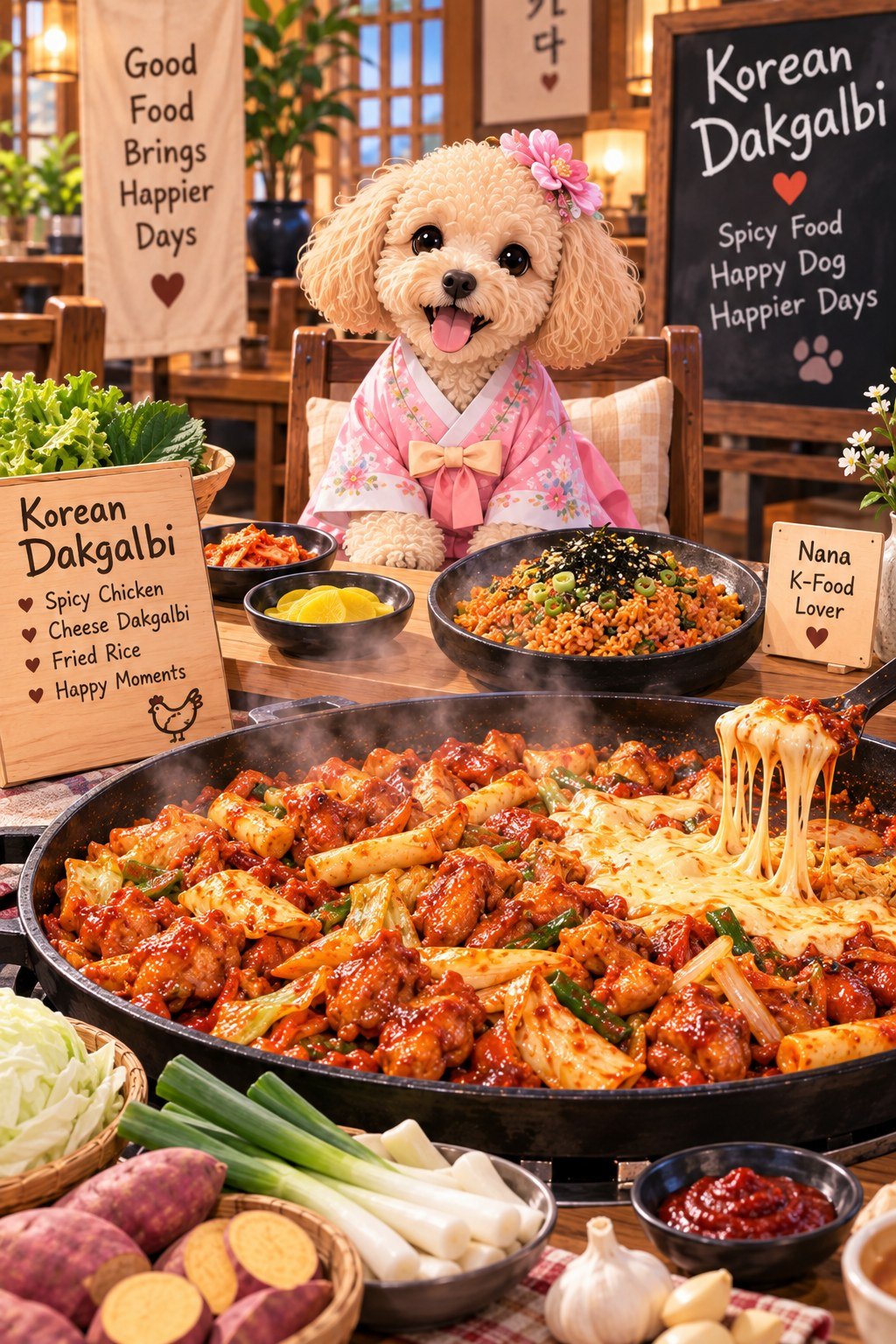
Spicy chicken, vegetables, chewy rice cakes, melted cheese, and final fried rice show the customizable progression of a Korean dakgalbi meal.
How Dakgalbi Connects with Other K-Food
Galbi provides the most important name comparison because the two dishes share “galbi” but use different meats, seasonings, and cooking styles.
Bulgogi offers a savory-sweet marinated-meat comparison, while Korean Fried Chicken demonstrates a completely different fried approach to Korean chicken.
Tteok explains the Korean rice cakes that add chewy texture to many dakgalbi servings, while Tteokbokki shows what happens when rice cake becomes the main ingredient of a spicy dish.
Kimchi Fried Rice provides a useful comparison with the fried-rice stage that commonly finishes a dakgalbi meal.
Samgyeopsal and Korean BBQ expand the shared-table dining cluster into Korean grilling culture.
Korean Ramyeon and Buldak Bokkeummyeon connect dakgalbi with Korea’s noodle and K-Spicy food culture.
Kimchi, Bibimbap, and Gimbap provide additional entry points into fermentation, rice meals, and portable Korean food.
Mandu, Japchae, Jjajangmyeon, and Naengmyeon extend the collection into dumpling and noodle traditions.
Kimchi-jjigae, Sundubu-jjigae, and Samgyetang provide contrasting examples of Korean stew and soup culture.
Dakgalbi & a Korea Food Trip
Dakgalbi adds an important regional dimension to a Korean food itinerary because of its strong association with Chuncheon.
A traveler can experience Korean barbecue and street foods in Seoul while using a Chuncheon visit to explore a dish closely connected with another Korean city.
Restaurant availability, transportation, prices, menus, and operating hours should be checked using current information when planning a specific trip.
Dakgalbi & Seoul Food Culture
Travelers do not need to visit Chuncheon simply to understand what dakgalbi is because the dish is also available in Seoul and elsewhere in Korea.
However, its Chuncheon connection remains important cultural context and helps explain why the city appears so frequently in discussions of dakgalbi.
Trying the dish in different locations can also reveal variations in seasoning, cooking style, additions, and presentation.
FAQ
What is dakgalbi?
Dakgalbi is a Korean chicken dish commonly prepared with chicken, cabbage, sweet potato, onion, green onion, tteok, and spicy red seasoning. One of its best-known forms is cooked and shared on a large tabletop griddle.
Why is dakgalbi called “galbi” if it uses chicken?
The established name reflects the history and development of the dish. Many modern dakgalbi restaurants use boneless chicken pieces, so the word “galbi” should not be interpreted as a guarantee that visible chicken ribs will be served.
Is dakgalbi very spicy?
Dakgalbi commonly has noticeable chili heat, but spice levels vary by restaurant and recipe. Some businesses offer different heat levels, while others use one house seasoning.
What is Chuncheon dakgalbi?
Chuncheon in Gangwon Province is strongly associated with dakgalbi and has developed a regional food identity around the dish. Restaurants can still differ in seasoning, chicken cuts, cooking methods, side dishes, and optional additions.
What is the difference between cheolpan and sutbul dakgalbi?
Cheolpan dakgalbi is cooked on a metal griddle with chicken, vegetables, tteok, and sauce. Sutbul dakgalbi emphasizes chicken grilled over charcoal, creating a different aroma, texture, and dining experience.
What is cheese dakgalbi?
Cheese dakgalbi is a modern variation that combines spicy chicken with melted cheese. The mild and creamy cheese contrasts with the chili-based seasoning but is not required in standard dakgalbi.
Why is fried rice served after dakgalbi?
After most of the chicken and vegetables are eaten, rice can be fried directly in the remaining seasoning on the griddle. This allows the rice to absorb the concentrated sauce and makes fried rice a natural final course of the meal.
Where to Try Dakgalbi
Dakgalbi can be found in Chuncheon, Seoul, and other areas of Korea, as well as at Korean restaurants outside the country.
Chuncheon has the strongest regional association with the dish, but restaurant styles can include large-griddle dakgalbi, charcoal-grilled versions, cheese variations, and different combinations of additional ingredients.
Current menus, prices, operating hours, spice levels, and cooking styles should be checked directly with the restaurant when planning a specific visit.
What to Check Before Ordering
First check whether the restaurant serves cheolpan dakgalbi, sutbul dakgalbi, or another variation.
Then check the portion system, minimum order, spice level, and which ingredients are included in the basic serving.
Optional tteok, noodles, cheese, or other sari can increase the size of the meal considerably, so it can be useful to understand the basic portion before adding extras.
First-Time Dakgalbi Tips
- Check the cooking style — cheolpan and sutbul dakgalbi provide different experiences.
- Ask about spice level — red color alone does not indicate exact chili heat.
- Wait for the chicken — do not eat it before it has been thoroughly cooked.
- Try the tteok — chewy Korean rice cakes provide an important texture contrast.
- Add sari carefully — noodles, cheese, and extra rice cakes can make the meal much larger.
- Save room for fried rice — it is one of the most recognizable ways to finish griddle dakgalbi.
- Watch the griddle — the tabletop cooking surface can remain extremely hot throughout the meal.
Raw Chicken & Food Safety
Raw chicken requires careful handling because it can carry harmful microorganisms.
Raw chicken, its juices, utensils, and preparation surfaces should remain appropriately separated from cooked food and ready-to-eat ingredients.
Hands, utensils, and surfaces that contact raw chicken should be handled and cleaned appropriately before they are used with cooked food.
Cooking Chicken Thoroughly
Dakgalbi chicken should be thoroughly cooked before it is eaten.
Pieces can differ in size and thickness, while dark red seasoning can make visual inspection more difficult.
When restaurant staff are cooking the meal, diners should follow their instructions about when the chicken is ready rather than tasting pieces early.
Cross-Contamination
Utensils used to handle raw chicken should not be casually reused for cooked chicken or ready-to-eat foods without appropriate handling.
This is particularly important during tabletop cooking because raw and cooked ingredients can appear close together on the same dining surface.
Restaurants can use different cooking procedures, so follow staff guidance and keep personal plates and ready-to-eat side dishes away from raw chicken juices.
Soy
Soy sauce and other soy-containing ingredients can appear in dakgalbi seasoning.
Restaurant sauce recipes vary, and soy can also appear in side dishes or additional sauces.
People with soy allergies should confirm the seasoning and accompaniments rather than judging only from visible ingredients.
Wheat & Gluten
Chicken, vegetables, and plain rice cakes do not by themselves determine whether the complete dish is gluten-free.
Soy sauce, processed seasonings, noodles, sauces, rice-cake formulations, and other ingredients can contain wheat or gluten.
Shared cooking and preparation equipment can also create cross-contact, so people who must strictly avoid gluten should confirm the complete preparation with the restaurant.
Sesame
Sesame seeds or sesame oil can appear in seasoning, garnishes, fried rice, side dishes, or other components of a dakgalbi meal.
Because sesame may be incorporated into a sauce rather than remaining visible on top, appearance alone is not sufficient for allergy assessment.
People with sesame allergies should ask about both the main dish and accompaniments.
Dairy & Cheese Dakgalbi
Standard dakgalbi does not need cheese, but cheese dakgalbi introduces dairy into the meal.
Additional cheese sauces, processed cheese products, or other dairy-containing ingredients can vary by restaurant.
People avoiding milk should confirm both the main order and optional additions.
Tteok & Chewing Safety
Tteok can be dense, sticky, and highly chewy.
Rice cakes should be eaten in manageable pieces and chewed thoroughly before swallowing. Extra care is important for young children, older adults, and people with chewing or swallowing difficulties.
Hot rice cakes can also retain considerable heat after cooking on the griddle.
Hot Griddle Safety
The tabletop griddle used for cheolpan dakgalbi can remain extremely hot throughout the meal and while fried rice is being prepared.
Avoid touching the metal surface, rim, cooking utensils, or other heated equipment unless restaurant staff indicate that it is safe to do so.
Children and pets should remain appropriately separated from hot cooking equipment.
Hot Cheese & Sauce
Melted cheese, spicy sauce, rice cakes, and other ingredients can remain very hot after leaving the griddle.
Allow food to cool sufficiently before taking a large bite, particularly when cheese or dense rice cake can retain heat internally.
A dramatic cheese stretch should not take priority over comfortable and safe eating.
Leftovers & Storage
Cooked dakgalbi contains chicken and other perishable ingredients and requires appropriate food handling if it is kept for later.
Storage conditions and safe keeping time depend on preparation, temperature, ingredients, packaging, and local food-safety guidance.
When taking leftovers away, follow restaurant instructions where provided and reheat stored chicken appropriately before eating.
Image Credits
Korean dakgalbi family restaurant visual with Dad, Mom, K-Nana daughter, and Nana in hanbok enjoying spicy chicken, cabbage, sweet potato, tteok, and cheese on a large tabletop griddle — K-Nana Studio original visual.
Korean dakgalbi ingredient-preparation visual with a parent in hanbok preparing chicken, cabbage, sweet potato, onion, green onion, tteok, and spicy red seasoning while Nana watches from a separate safe seat — K-Nana Studio original visual.
Korean dakgalbi cooking visual with a parent in hanbok safely cooking chicken, vegetables, and tteok on a hot tabletop griddle while Nana remains separated from the cooking area — K-Nana Studio original visual.
Korean dakgalbi fried-rice visual with K-Nana daughter in hanbok enjoying fried rice prepared with remaining dakgalbi seasoning, kimchi, seaweed, green onion, and sesame while Nana sits separately from the hot griddle — K-Nana Studio original visual.
Nana in pink floral hanbok seated separately as a K-Food mascot beside Korean dakgalbi, cheese dakgalbi, dakgalbi fried rice, chicken, cabbage, sweet potato, tteok, and spicy red seasoning — K-Nana Studio original visual.
Disclaimer
This article is provided for general food, travel, and cultural information. Dakgalbi ingredients, chicken cuts, sauces, spice levels, tteok, noodles, cheese, side dishes, allergens, preparation methods, serving sizes, and restaurant procedures can vary by business and recipe. Raw chicken requires appropriate handling and should be thoroughly cooked before consumption. Recipes can contain soy, wheat, gluten, sesame, milk, or other allergens, and shared preparation or cooking equipment can create cross-contact risks. Tteok can present a choking hazard if eaten in large pieces or without adequate chewing, while hot griddles, sauces, cheese, rice cakes, and cooking equipment can cause burns. People with allergies, medical conditions, swallowing difficulties, religious dietary restrictions, or other individual requirements should confirm ingredients and preparation directly with the restaurant or manufacturer and follow appropriate professional guidance when necessary.