
Buldak Bokkeummyeon is a Korean instant fried-noodle product known internationally for its intense spicy flavor and its connection with the global “fire noodle” phenomenon. Unlike the soup-style Korean ramyeon many first-time visitors encounter, the original Buldak is designed as a largely brothless noodle dish coated with concentrated spicy sauce.
The original product was launched by Samyang Foods in April 2012. Samyang officially classifies it as an “instant fried noodle” and today describes the Buldak line as a global K-Spicy brand.
Its international identity developed far beyond the basic idea of an instant noodle. Extreme-spice reactions, online challenge videos, mukbang, social media, new flavor variations, and customized ways of eating the noodles helped turn Buldak into one of the most recognizable examples of modern Korean spicy-food culture.
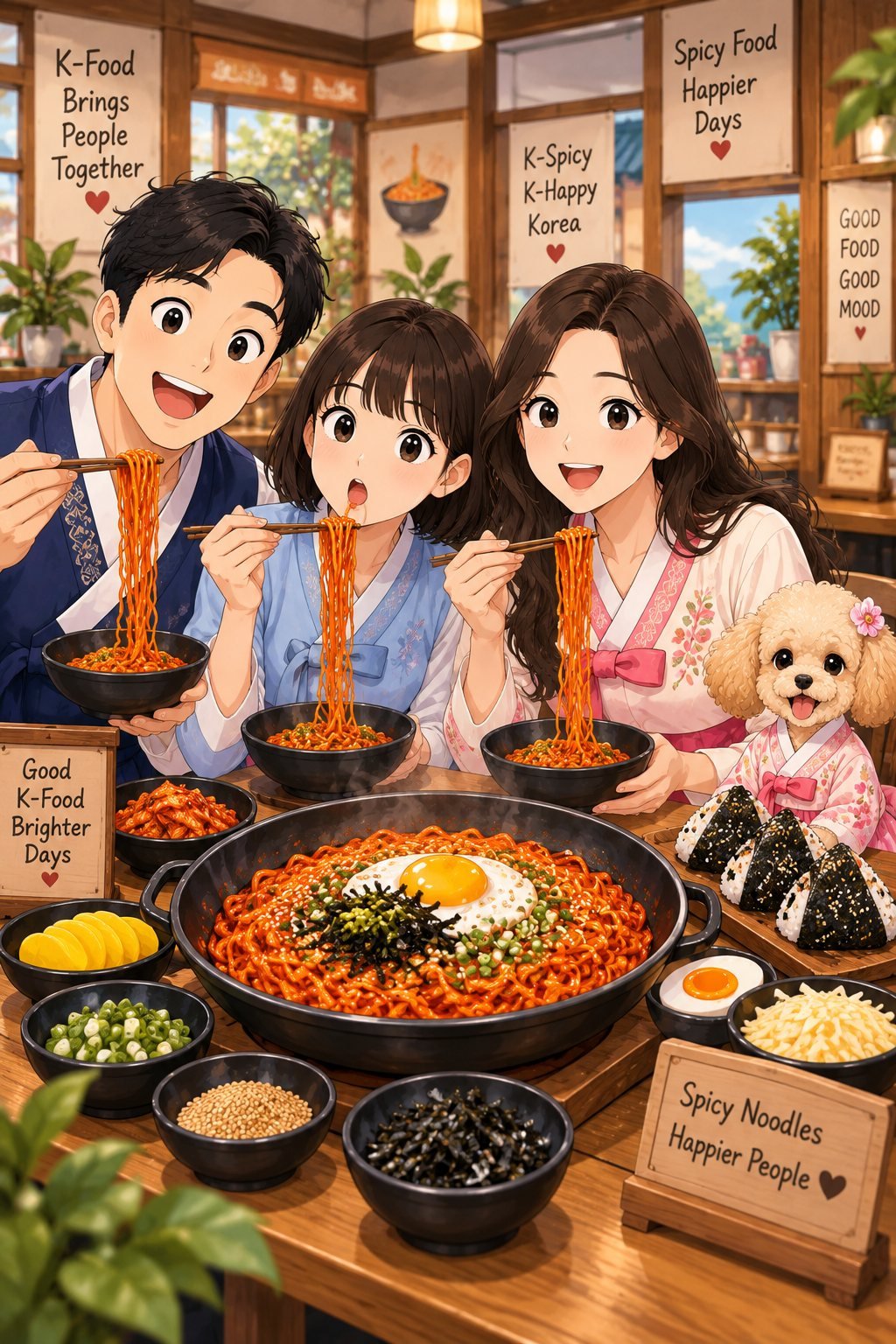
Glossy spicy noodles, concentrated sauce, simple toppings, and playful reactions capture the K-Spicy experience associated with Buldak-style stir-fried noodles.
Quick Guide
| Korean name | 불닭볶음면 |
| Common English names | Buldak Bokkeummyeon, Buldak Ramen, Hot Chicken Flavor Ramen |
| Manufacturer | Samyang Foods |
| Original launch | April 2012 |
| Food type | Instant fried noodles |
| Style | Mostly brothless, sauce-coated noodles |
| Known for | Intense spicy flavor and global K-Spicy culture |
| Common custom additions | Egg, cheese, seaweed, green onion, rice or other recipe-dependent additions |
| Important first-time tip | Heat level and preparation instructions vary by Buldak product, so check the specific package before cooking |
What Is Buldak Bokkeummyeon?
Buldak Bokkeummyeon is a specific instant-noodle product and brand line produced by Samyang Foods rather than a generic name for every spicy Korean noodle.
The original version combines quick-cooking noodles with a concentrated hot-chicken-style sauce and finishing components. The noodles are prepared with much less liquid in the final dish than a typical soup ramyeon.
This produces a strongly coated noodle texture in which the sauce remains concentrated around the noodles rather than being diluted throughout a full bowl of broth.
What Does “Buldak Bokkeummyeon” Mean?
The Korean name helps explain the concept of the product.
“Buldak” literally combines the ideas of “fire” and “chicken,” a name associated with intensely spicy chicken flavor. “Bokkeum” refers to stir-frying or frying, while “myeon” means noodles.
The full name therefore communicates the central idea: intensely spicy, hot-chicken-style stir-fried noodles.
A Product Launched in 2012
Samyang Foods launched the original Buldak product in April 2012.
The company’s current official product information lists the original as an instant fried noodle, distinguishing its format from the large family of Korean instant noodles designed primarily around soup broth.
Over time, Buldak expanded from one spicy noodle product into a broader brand with multiple noodle variations and products extending beyond noodles.
Buldak vs. Korean Ramyeon
K-Nana Studio’s Korean Ramyeon Guide introduces the much broader world of Korean instant noodles, including packet noodles, cup noodles, soup-style products, convenience-store dining, and Han River ramyeon.
Buldak belongs inside that larger instant-noodle culture, but it has a much narrower and more distinctive identity.
Its defining experience centers on concentrated spicy sauce, brothless or near-brothless preparation, intense heat, flavor variations, customization, and the global social-media culture that developed around eating it.
Soup Ramyeon vs. Buldak-Style Stir-Fried Noodles
A typical soup-style ramyeon retains enough cooking liquid to become a bowl of seasoned broth with noodles.
Buldak-style preparation removes most of the cooking water before the concentrated sauce is mixed with the noodles according to the product directions.
Because there is far less liquid in the finished dish, the sauce remains concentrated on the noodle surface. This contributes to the strong flavor and heat associated with the experience.
Step 1: Cooking the Noodles
The first stage resembles other instant noodles: the dried noodle block is cooked in hot water until it reaches the intended texture.
However, this is only the beginning of the process. The noodles are not simply served in all of that cooking water as they would be in many soup-style ramyeon products.
Cooking time and water quantity should follow the directions for the specific product because Buldak varieties and package formats can differ.
Step 2: Removing Most of the Water
After the noodles are cooked, most of the hot water is removed according to the product instructions.
This step is one of the clearest differences for someone accustomed only to Korean soup ramyeon.
Removing the liquid requires particular care because boiling water, steam, the pot, and the noodles can all cause burns.
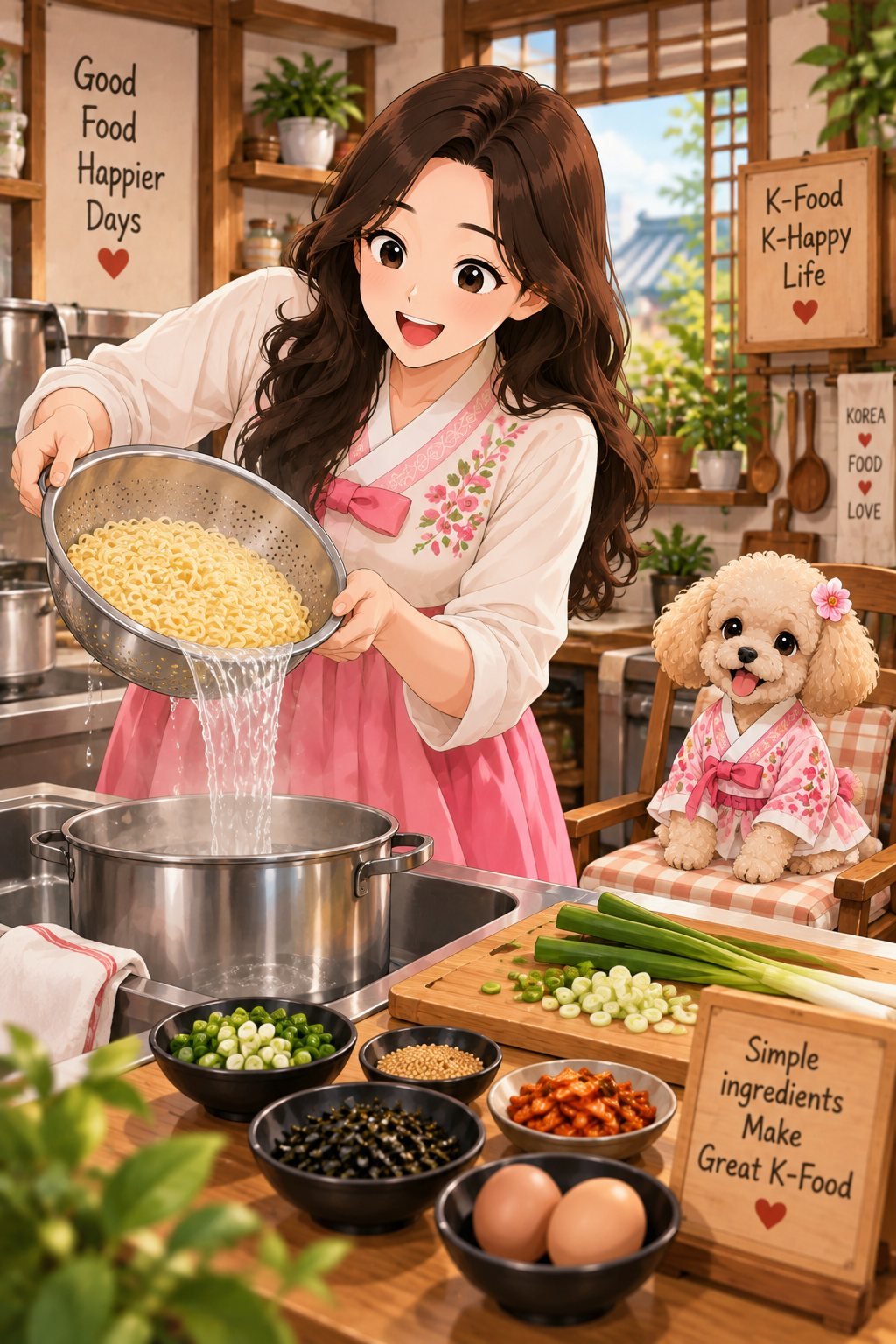
Removing most of the cooking water prepares the noodles for the concentrated sauce that defines the brothless Buldak-style experience.
Step 3: Adding the Spicy Sauce
The concentrated sauce is mixed with the cooked noodles according to the instructions for the specific Buldak product.
Because the finished dish contains relatively little liquid, the sauce coats the noodle strands directly.
This concentrated coating is one reason the flavor and chili heat can feel substantially different from spicy seasoning dispersed through a large quantity of soup.
Step 4: Mixing or Stir-Frying
The noodles and sauce are thoroughly combined so that the seasoning coats the noodles rather than remaining concentrated in only one part of the pan.
Depending on the specific product instructions, preparation can involve additional mixing or heating before the finishing components are added.
Do not assume that every Buldak variation uses exactly the same preparation method. Carbonara-style, cheese-style, cup, packet, and other versions can have different directions.
Step 5: Finishing the Noodles
After the sauce has been distributed, finishing ingredients are added according to the particular product.
The original product is officially described by Samyang as spicy noodles accompanied by sesame seeds and grilled seaweed flakes.
Home cooks may then add their own toppings, but those custom additions should be distinguished from the standard contents supplied with the packaged product.
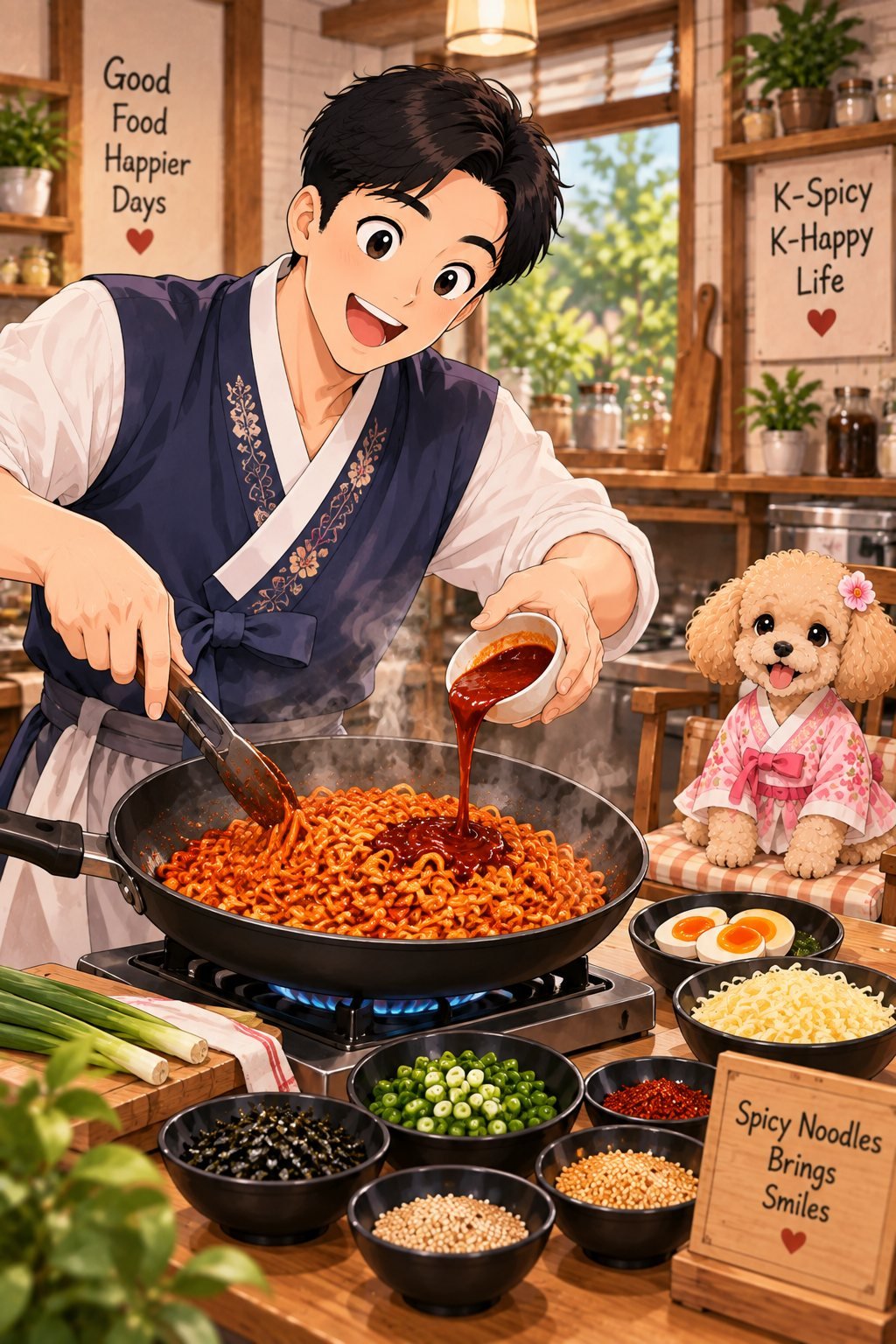
With most of the water removed, concentrated spicy sauce coats the noodles before the final garnishes are added.
Why Does Buldak Taste So Intense?
The experience is not created by chili heat alone. Concentrated seasoning combines heat with savory, sweet, salty, and aromatic elements.
Because the noodles are sauce-coated rather than floating in a large quantity of broth, those flavors remain concentrated in each mouthful.
Different Buldak varieties alter this balance, which is why two products within the same brand family can feel substantially different even though both are associated with spicy noodles.
What Is K-Spicy?
“K-Spicy” is a contemporary expression used to describe the internationally recognizable appeal of Korean spicy flavors and food experiences.
Buldak has become closely associated with that idea. Samyang itself currently describes Buldak as a “Global Icon of K-Spicy.”
In this context, K-Spicy is not one standardized heat level. It can include the combination of chili intensity, seasoning, sweetness, savory flavor, social-media culture, customization, and the entertainment value surrounding spicy-food experiences.
Buldak Is Not One Fixed Heat Level
The Buldak family contains multiple variations, and they should not be assumed to have identical spice intensity or flavor profiles.
Some versions emphasize extreme heat, while others combine the spicy base with cheese, creamier flavors, or other ingredients.
For first-time buyers, the exact product name and package information matter more than simply recognizing the word “Buldak.”
Original Buldak
The original version remains the foundation of the Buldak identity.
Samyang’s official product information lists the original 140 g packet at 530 kcal and identifies it as an instant fried noodle. Product specifications can change or differ by market, so the current package should always be treated as the primary source for nutrition, allergens, preparation, and serving information.
The original also provides the reference point from which many later Buldak variations developed.
Carbonara Buldak
Carbonara-style Buldak combines the spicy identity of the brand with a creamier flavor direction.
Samyang introduced Carbo Buldak Bokkeummyeon in 2017, initially as a limited product associated with the brand reaching a major cumulative sales milestone.
The variation demonstrates an important part of Buldak’s development: the brand did not remain limited to one extreme-spice experience but expanded into combinations that modify the balance between heat, richness, and other flavors.
Cheese & Other Buldak Variations
Cheese-flavored and other Buldak products further expand the range of experiences within the brand.
The existence of multiple variations also means that statements about one product’s spice level, ingredients, calories, allergens, or preparation method should not automatically be applied to the entire Buldak family.
Always check the exact package being prepared.
The Rise of the Buldak Challenge
Buldak’s global story is closely connected with online challenge culture.
People filmed themselves tasting the intensely spicy noodles and sharing their reactions through video platforms and social media. The combination of visible red noodles, strong physical reactions, and an easily repeated food challenge helped the format travel internationally.
Samyang now describes the Buldak line as the origin of the “fire noodle challenge,” reflecting how closely the brand became associated with this online phenomenon.
From Spicy Noodles to a Global Cultural Phenomenon
The challenge was only one part of the expansion. Mukbang, recipe videos, social media, Korean entertainment, international retail distribution, and new flavor variations continued introducing Buldak to audiences outside Korea.
By September 2025, Samyang Foods reported that cumulative Buldak-series sales had surpassed 8 billion units and that the products were being exported to more than 100 countries.
This scale helps explain why Buldak can be studied not only as a packaged noodle but also as a case study in the globalization of modern K-Food.
Trying Very Spicy Noodles for the First Time
First-time diners do not need to treat Buldak as a competition.
Prepare the specific product according to its instructions, start with a manageable portion, and allow the hot noodles to cool sufficiently before eating.
People have very different tolerances for chili heat. A reaction seen in a challenge video should not determine how much or how quickly another person eats.
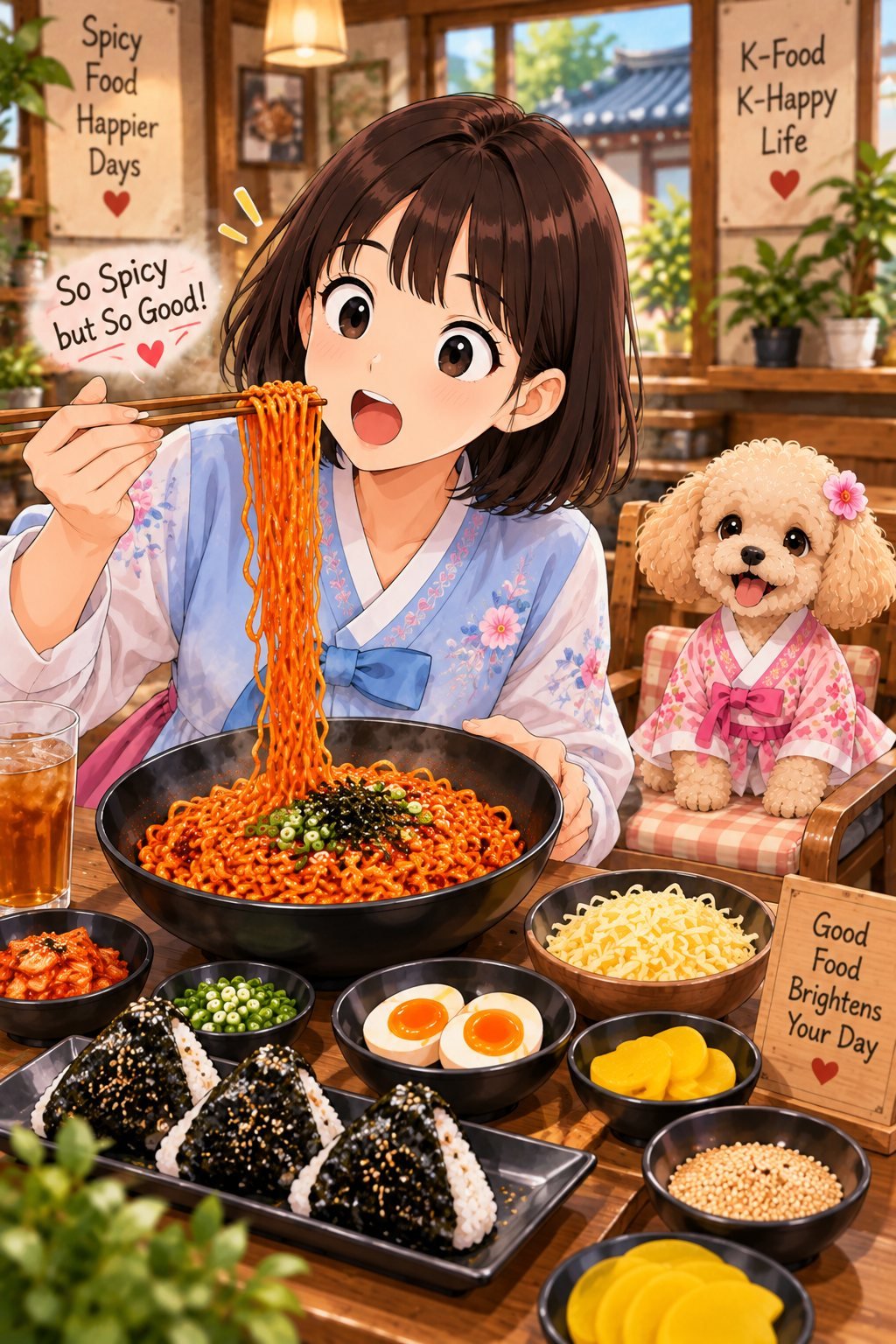
The K-Spicy experience can be explored at an individual pace without turning intense heat into a competition.
Why Customizing Buldak Became Part of the Fun
Buldak’s concentrated sauce and strong flavor make it a natural base for customization.
Online cooks and everyday consumers combine spicy noodles with ingredients such as egg, cheese, rice, seaweed, green onion, or other foods according to preference.
These combinations can change richness, texture, portion size, and the perception of heat, creating a recipe culture around the original packaged noodle.
Egg with Spicy Stir-Fried Noodles
Egg provides a mild flavor and contrasting texture beside strongly seasoned noodles.
It can appear as a fried egg, boiled egg, or another preparation depending on the recipe.
Adding egg does not remove the chili compounds from the sauce, but the combination can change how the overall mouthful tastes and feels.
Cheese with Buldak
Cheese is one of the most recognizable ingredients paired with very spicy Korean noodles.
Melted cheese adds richness and a softer texture while changing the flavor balance of the dish.
Again, this does not literally eliminate the spicy ingredients. It creates a different eating experience by combining them with dairy richness.
Triangle Gimbap & Convenience-Store Style Combinations
Triangle gimbap can provide rice and seaweed alongside intensely seasoned noodles, creating a more substantial meal and a contrasting texture.
This type of combination also connects Buldak with Korea’s broader convenience-food culture, where instant noodles, Gimbap, eggs, cheese, drinks, and other ready-to-eat foods can be combined according to personal preference.
These combinations are flexible rather than a single official recipe.
Buldak as a K-Spicy Experience
Buldak Bokkeummyeon began as a packaged instant fried noodle, but its cultural reach now extends into challenges, mukbang, customized recipes, multiple flavor variations, sauces, snacks, and international K-Food culture.
That combination makes it different from a general introduction to Korean ramyeon. Understanding Buldak means understanding both the food in the bowl and the global culture that developed around eating, modifying, filming, and sharing it.
Why Buldak Became a Global K-Spicy Icon
Buldak Bokkeummyeon developed an international identity that extends beyond the ordinary idea of instant noodles. Its unusually intense heat, glossy red sauce, chewy noodles, and easily recognizable eating experience made it particularly suitable for online videos and social sharing.
For many international consumers, trying Buldak became an introduction not only to Korean instant noodles but also to the broader idea of “K-Spicy” — the strong, highly seasoned side of modern Korean food culture.
This does not mean that all Korean food is extremely spicy. Korean cuisine includes mild soups, grilled meats, rice dishes, noodles, dumplings, fermented foods, and many other flavor profiles. Buldak represents one highly visible part of that much larger food culture.
The Buldak Challenge
One of the most important factors in Buldak’s international visibility was the online challenge culture that developed around its intense heat.
People filmed themselves preparing the noodles, tasting them, reacting to the spice, and challenging friends or family members to try the same experience.
These videos spread through YouTube and later through other social platforms, helping transform a packaged noodle product into a recognizable global internet phenomenon.
Why Spicy-Food Challenges Work So Well Online
Extreme spice produces immediate and highly visible reactions. Facial expressions, pauses between bites, requests for drinks, and surprise at the intensity can all be understood even when viewers and creators do not share the same language.
The noodles themselves are also visually distinctive. Their glossy red coating and long strands create an easily recognizable image on camera.
However, an entertaining online reaction should not be interpreted as a recommendation to consume extreme spice quickly or competitively.
Buldak & Mukbang Culture
Buldak also became closely associated with online mukbang and food-content culture.
The combination of long noodles, concentrated sauce, strong color, and intense spice reactions makes the dish visually effective in eating videos.
Creators have also combined the noodles with cheese, eggs, rice, seaweed, dumplings, and other foods, helping spread the idea that Buldak can be customized rather than eaten in only one fixed way.
From Challenge Food to Customizable Meal
The global Buldak story is therefore not limited to “Can you survive the heat?”
Many diners instead treat the noodles as a base for customization. They change the texture, richness, portion, or perceived heat by combining the noodles with other ingredients.
This recipe-hack culture is an important distinction between simply trying an extremely spicy product once and incorporating spicy stir-fried noodles into an everyday meal.
Cheese & Buldak
Cheese is one of the most recognizable additions to intensely spicy Korean noodles.
Melted cheese adds richness and a creamy texture that contrasts with the concentrated spicy sauce. It can reduce the perception of heat for some diners, although the chili components remain in the food.
Different cheeses melt and taste differently, so there is no single required cheese for a customized bowl.
Egg & Buldak
Egg provides another familiar contrast to spicy noodles.
A fried egg can be placed on top, while boiled or soft-cooked eggs can be served alongside the noodles depending on preference.
The relatively mild egg can provide a break between strongly seasoned mouthfuls, while the yolk adds richness when combined with the sauce.
Gim, Sesame & Green Onion
Gim or shredded seaweed, sesame seeds, and green onion are simple toppings that can change the aroma and texture without completely transforming the noodles.
Seaweed adds savory character, sesame provides a nutty note, and green onion contributes freshness.
These ingredients are also familiar across many Korean meals, making them natural additions to customized spicy noodles.
Samgak Gimbap & Spicy Noodles
Samgak gimbap, the triangular packaged rice snack commonly found in Korean convenience stores, can provide a rice-based contrast to intensely seasoned noodles.
Rather than increasing the spice level, rice gives diners another texture and a relatively mild food to alternate with the noodles.
This combination also reflects the broader Korean convenience-store habit of combining individually packaged foods into a personalized meal.
Why Convenience Stores Matter
Buldak and other Korean instant noodles fit naturally into Korea’s convenience-store food culture because they can be combined with ready-to-eat rice, eggs, cheese, drinks, gimbap, and other packaged foods.
This allows customers to create their own combinations without following a formal restaurant recipe.
K-Nana Studio’s Korean Ramyeon Guide explains Korean packet noodles, cup noodles, convenience-store dining, and Han River ramyeon in broader detail.
K-Ramen Hacks
The expression “ramen hack” or “ramyeon hack” is commonly used online for ways of modifying instant noodles beyond the basic package instructions.
With spicy stir-fried noodles, this can include cheese, egg, seaweed, green onion, rice, dumplings, or other ingredients.
Some combinations focus on reducing the perceived intensity, while others add new flavors or simply make the meal larger.
Buldak & Jjajang-Style Noodles
Another form of customization combines spicy noodles with jjajang-style instant noodles, producing a mixture of concentrated spicy sauce and dark savory jjajang-inspired seasoning.
This type of combination is sometimes described informally with names created by combining the identities of the two noodle styles.
It should not be confused with traditional restaurant Jjajangmyeon, which uses noodles with a cooked chunjang-based sauce and other ingredients.
Carbonara-Style Buldak
One of the best-known directions within the broader Buldak product family combines the spicy identity with a creamier, richer flavor profile.
Carbonara-style versions became particularly recognizable among international consumers because they preserve the spicy-noodle concept while presenting it in a different balance from the original style.
Specific ingredients, allergens, preparation instructions, and heat levels depend on the actual product and market, so consumers should check the package rather than assuming every variation follows the same formula.
Cheese-Style Variations
Cheese-oriented variations follow a similar idea: combining the concentrated spicy noodle experience with richer dairy-associated flavors.
They should still be treated as separate products rather than assuming that adding cheese to an original package produces exactly the same recipe.
Product formulas can also differ by market or change over time.
Extra-Spicy Variations
The Buldak family has also become known for versions designed around even stronger heat.
For first-time diners, a more intense version should not automatically be treated as the best introduction simply because it appears more challenging.
Checking the specific product and understanding personal spice tolerance is more useful than selecting noodles solely for the purpose of proving that an extreme heat level can be finished.
Trying K-Spicy Without Turning It into a Competition
The cultural experience does not depend on finishing the hottest possible product or eating it as quickly as possible.
A diner can take a small portion, eat slowly, combine the noodles with other foods, or stop if the intensity becomes uncomfortable.
The objective of a food guide is to understand flavor, preparation, and culture — not to encourage pain or endurance challenges.
How Buldak Differs from Regular Korean Ramyeon
The broad Korean ramyeon category includes soup noodles, mild varieties, seafood flavors, meat-inspired broths, jjajang-style noodles, and brothless products.
Buldak Bokkeummyeon occupies a much more specific position: it is strongly identified with concentrated spicy sauce, brothless preparation, and a global culture built around intense heat.
That is why Buldak deserves to be understood as a specialized case within the larger Korean instant-noodle world rather than as a replacement for the entire category.
Buldak vs. Tteokbokki
Tteokbokki and Buldak can both introduce international diners to highly seasoned Korean spicy flavors, but their foundations are very different.
Tteokbokki is centered on chewy rice cakes cooked in sauce, while Buldak Bokkeummyeon is an instant noodle product centered on chewy wheat-based noodles and concentrated spicy seasoning.
Their shared red appearance therefore does not mean they have the same texture, ingredients, preparation, or cultural background.
Buldak vs. Korean Fried Chicken
Korean Fried Chicken demonstrates another internationally visible way Korean food combines strong seasoning with casual eating culture.
Spicy or sweet-spicy chicken relies on fried texture and sauce-coated poultry, while Buldak focuses on noodles and concentrated seasoning.
Both, however, demonstrate how bold flavors can become recognizable parts of modern global K-Food culture.
Buldak & the Wider K-Spicy Experience
K-Spicy should not be interpreted as one universal flavor or heat level.
Kimchi combines fermentation with chili seasoning, Kimchi-jjigae transforms fermented kimchi into a hot stew, and Sundubu-jjigae combines soft tofu with a strongly seasoned broth.
Buldak contributes a different experience through concentrated sauce and stir-fried instant noodles.
The Complete K-Spicy Noodle Experience
A Buldak-style meal can begin with glossy spicy stir-fried noodles and expand through egg, cheese, green onion, seaweed, sesame, rice, or other customized additions.
The most important point is that the experience is flexible. It can be approached as a spicy-food challenge, a customized convenience meal, an internet food phenomenon, or simply a strongly seasoned bowl of noodles.
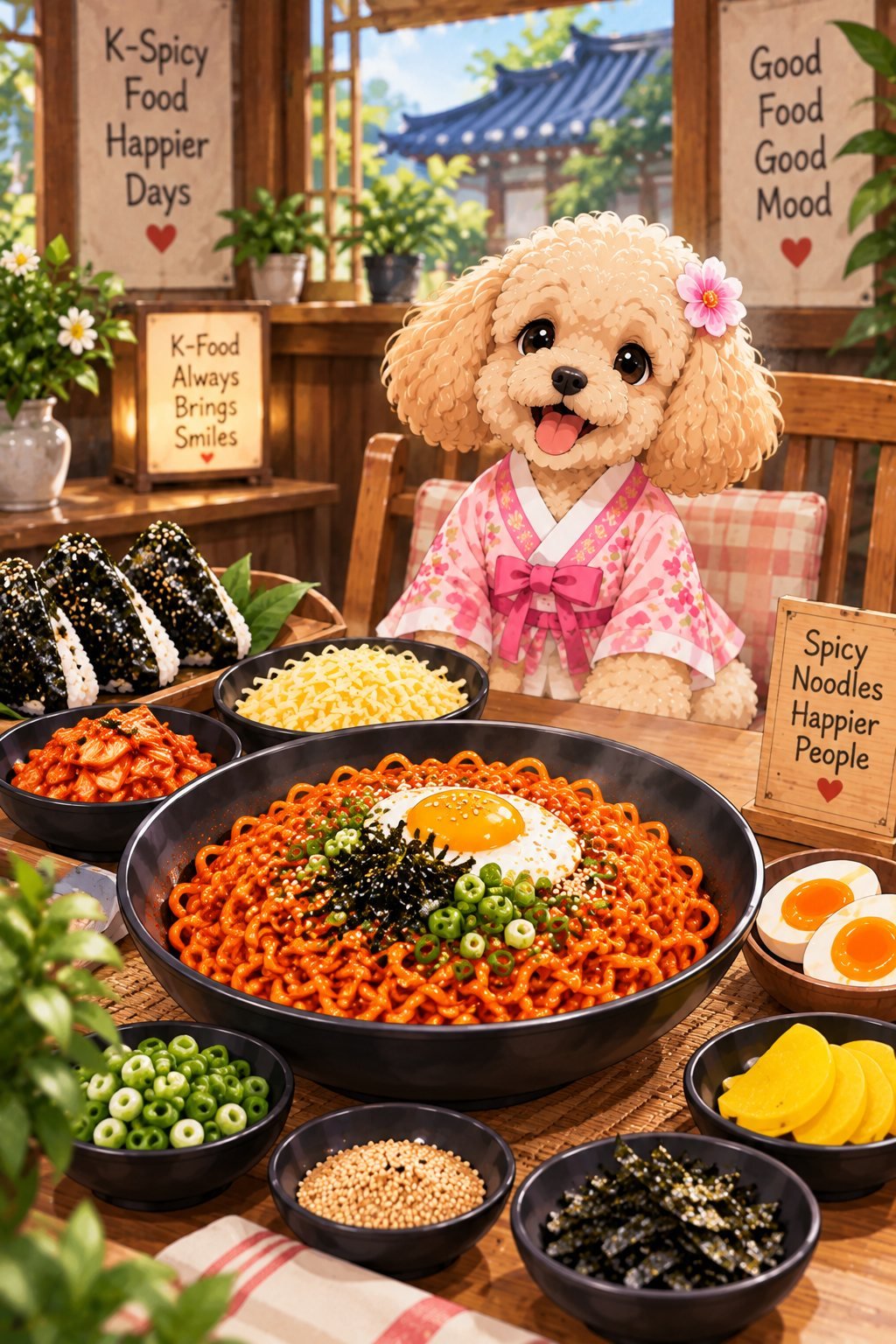
Fiery stir-fried noodles, egg, cheese, seaweed, sesame, green onion, and rice represent the customizable side of modern K-Spicy culture.
How Buldak Connects with Other K-Food
Korean Ramyeon provides the essential wider context for understanding packet noodles, cup noodles, soup ramyeon, convenience-store dining, and Korean instant-noodle culture.
Tteokbokki provides another internationally familiar K-Spicy experience through chewy rice cakes and red sauce.
Kimchi, Kimchi-jjigae, and Sundubu-jjigae show how Korean chili flavors can appear alongside fermentation and hot broth.
Korean Fried Chicken provides another globally recognizable example of bold modern Korean flavor, while Kimchi Fried Rice demonstrates how strong fermented seasoning can be integrated into an everyday rice meal.
Jjajangmyeon helps explain the Korean black-bean noodle tradition behind jjajang-inspired instant-noodle combinations.
Gimbap and Mandu provide milder rice and dumpling comparisons that can also appear alongside strongly seasoned noodles.
Buldak & a Korea Travel Day
Travelers do not need to visit a specialist restaurant to encounter Buldak products or Korean spicy instant-noodle culture. Convenience stores and supermarkets are natural places to explore different instant-noodle formats and related foods.
A casual food stop can fit easily into a day exploring Hongdae, where contemporary youth culture, cafés, shopping, and K-Culture experiences come together.
Travelers can then contrast modern convenience food with traditional Seoul experiences at Gyeongbokgung Palace, Bukchon Hanok Village, Insadong, or the food culture of Gwangjang Market.
FAQ
What is Buldak Bokkeummyeon?
Buldak Bokkeummyeon is a Korean instant stir-fried noodle product line known internationally for concentrated spicy sauce and a brothless eating style. It occupies a distinctive position within the much broader world of Korean ramyeon.
Is Buldak the same as regular Korean ramyeon?
No. Korean ramyeon includes many soup and brothless varieties ranging from mild to extremely spicy. Buldak is a specific branded product family particularly associated with intense heat, stir-fried preparation, online challenge culture, and K-Spicy.
Does Buldak Bokkeummyeon have broth?
It is generally prepared as a brothless or nearly brothless noodle dish rather than a full bowl of noodle soup. Preparation instructions vary by product, so the directions on the specific package should always take priority.
Is every Buldak variety equally spicy?
No. The product family includes multiple variations with different flavor profiles and perceived heat levels. Consumers should check the exact product rather than assuming that every package provides the same spicy experience.
What can you eat with Buldak?
Common customizations seen in K-Spicy noodle culture include egg, cheese, gim, sesame, green onion, rice, samgak gimbap, dumplings, and other foods. These are optional combinations rather than requirements for eating the noodles.
What is the Buldak Challenge?
The Buldak Challenge refers broadly to online content in which people try intensely spicy Buldak noodles and share their reactions. This social-media phenomenon helped increase international awareness of the product and K-Spicy culture, but extreme or competitive eating is not necessary to experience the food.
Is Buldak safe for everyone to try?
Individual tolerance to spicy food varies considerably. People who experience significant discomfort with very spicy foods, or who have relevant allergies, dietary restrictions, or health concerns, should check the specific product information and make an individual decision rather than treating an online challenge as a serving recommendation.
Choosing Buldak for the First Time
First-time diners should begin by identifying the exact Buldak variety rather than purchasing based only on package appearance or online popularity.
Check whether the product is designed around an original-style spicy profile, a creamier or cheese-oriented flavor, or an intentionally more intense heat level.
Also confirm whether the product is a packet, cup, or another format because preparation instructions can differ.
The most extreme version is not automatically the best introduction. Choosing according to personal spice tolerance makes it easier to focus on flavor and texture rather than simply enduring heat.
How to Approach the First Bite
Freshly prepared noodles can be both intensely spicy and physically hot from cooking.
Allow the noodles to cool sufficiently, begin with a manageable portion, and eat at a comfortable pace.
There is no reason to finish the entire serving if the spice level becomes unpleasant. A K-Food experience does not require completing an endurance challenge.
Where to Find Buldak
Buldak products are widely associated with supermarkets, convenience stores, Korean grocery stores, and international retailers that carry Korean instant noodles.
Selection varies by country, store, and time. Some locations may carry only a few varieties while others offer a much broader range.
When traveling in Korea, convenience stores and supermarkets can also provide an easy opportunity to compare Buldak with the much wider Korean instant-noodle category.
Read the Actual Package
Product names, ingredients, allergens, nutrition information, preparation directions, serving sizes, and formulas can vary between Buldak varieties and markets.
The package for the specific product being prepared should therefore take priority over generalized instructions found in articles, social-media videos, or recipes.
This is especially important when comparing original, cheese-oriented, creamy, or extra-spicy variations.
Food & Allergy Notes
Buldak products are manufactured packaged foods, and ingredient formulations vary by variety and market.
Depending on the specific product, ingredients or allergen information may involve wheat, soy, sesame, milk, egg, or other components.
Additional foods used in customized recipes can introduce further allergens. Cheese introduces dairy, egg adds egg allergens, dumplings can contain wheat, soy, meat, seafood, sesame, or other ingredients, and packaged rice products can contain their own fillings and seasonings.
People with allergies, intolerances, religious dietary restrictions, vegetarian or vegan requirements, or other dietary needs should check the actual package and any additional ingredients used in the meal.
Spice Tolerance Varies
There is no universal definition of a comfortable spice level.
A product that one diner considers enjoyable can feel overwhelmingly hot to another. Previous experience with moderately spicy Korean food does not necessarily predict how someone will react to an especially intense spicy noodle product.
Online reactions should therefore be treated as entertainment or personal experiences rather than a reliable measurement of what another person should be able to tolerate.
Extreme Spice Challenge Safety
Eating extremely spicy food quickly, consuming unusually large quantities, or continuing after significant discomfort is not necessary for enjoying Buldak or understanding K-Spicy culture.
Do not use another person’s challenge result as a target. Eating speed, portion size, spice tolerance, age, health circumstances, and individual responses differ.
If significant or persistent symptoms occur after eating, stop the challenge or meal and seek appropriate medical advice when necessary.
Children & Extreme Spice
Products known for unusually intense heat should not be treated as toys, dares, or competitions for children.
Parents and caregivers should consider the specific product, ingredients, heat level, and the child’s individual circumstances rather than relying on viral challenge content.
Sodium & Nutrition Information
Instant noodle products can contain substantial sodium, but nutrition values vary by product, serving size, and market.
Check the nutrition panel on the actual package and confirm whether the listed values refer to the complete package or another defined serving.
Adding cheese, processed foods, sauces, dumplings, or other ingredients can also change the overall nutritional composition of the meal.
Boiling Water & Drain Safety
Preparing brothless instant noodles can involve boiling water and then removing most of that hot liquid before adding sauce.
This draining stage requires particular care because a pot, steam, noodles, and water can all cause burns.
Use stable cookware and an appropriate draining method. Keep children and pets away from the cooking area and avoid holding a hot pot in an unstable position.
Hot Pan & Sauce Safety
Some preparation methods involve mixing or briefly heating the drained noodles and sauce in a hot pan.
Concentrated sauce and residual water can splatter when heated. Use appropriate utensils and keep hands and clothing away from the hot cooking surface.
The finished noodles can remain very hot even when there is little or no visible broth.
Storage & Added Ingredients
Unopened packaged noodles should be stored according to the manufacturer’s directions and applicable date information.
Once egg, cheese, meat, seafood, dumplings, or other perishable foods are added, the finished meal needs to be handled according to appropriate food-safety practices for those ingredients.
Leftovers should be stored appropriately rather than left at room temperature for an extended period.
Image Credits
K-Spicy noodle family dining visual with Dad, Mom, K-Nana daughter, and Nana in hanbok experiencing glossy red Korean spicy stir-fried noodles with egg, green onion, seaweed, sesame, and Korean side dishes — K-Nana Studio original visual.
Korean spicy stir-fried noodle preparation visual with Mom in hanbok safely draining cooked curly noodles while Nana watches from a separate seat away from hot water and cooking equipment — K-Nana Studio original visual.
Korean spicy stir-fried noodle cooking visual with Dad in hanbok mixing drained noodles with concentrated red spicy sauce and finishing them with green onion, seaweed, and sesame while Nana remains separately seated — K-Nana Studio original visual.
K-Spicy customization visual with K-Nana daughter in hanbok carefully trying glossy spicy stir-fried noodles alongside egg, cheese, seaweed, and triangular rice while Nana sits separately without touching food — K-Nana Studio original visual.
Nana in pink floral hanbok seated separately as a K-Food mascot beside Korean spicy stir-fried noodles with egg, cheese, green onion, seaweed, sesame, and triangular rice — K-Nana Studio original visual.
Trademark & Affiliation Notice
Buldak and Buldak Bokkeummyeon are referenced in this article solely for identification, cultural commentary, and general informational purposes. K-Nana Studio is not affiliated with, sponsored by, endorsed by, or an official representative of Samyang Foods unless explicitly stated otherwise. Product names, trademarks, and brand names remain the property of their respective owners. K-Nana Studio original visuals used in this guide are independent illustrative scenes and are not official product packaging, logos, advertising materials, or brand characters.
Disclaimer
This article is provided for general food, travel, product-identification, and cultural information. Buldak product names, varieties, ingredients, allergens, nutrition values, sodium levels, spice intensity, serving sizes, preparation methods, packaging, and formulas can vary by product, country, and time. Always check and follow the current instructions, ingredient list, allergen information, nutrition information, warnings, and storage guidance printed on the specific product being consumed. Individual responses to extremely spicy food vary, and viral spicy-food challenges should not be treated as serving recommendations or endurance targets. Eggs, cheese, meat, seafood, dumplings, rice products, and other added ingredients require appropriate food handling. Boiling water, steam, hot cookware, concentrated sauce, and freshly prepared noodles can cause burns. People with allergies, dietary restrictions, relevant health concerns, or other individual requirements should use the actual product information and seek appropriate professional advice when necessary.