Introduction to Green Tea in Korean Skincare
Green tea in Korean skincare refers to cosmetic ingredients derived from green tea and added to products such as serums, essences, creams, and wash-off masks. Depending on the formula, a label may identify green tea water, an extract, polyphenols, or a specially processed green tea material.
This guide explains these forms, the benefits reported in the supplied cosmetic-science and manufacturer sources, common product formats, routine placement, selection checks, and basic precautions. Because formulas differ, green tea on the front of a package does not tell you everything about a product.
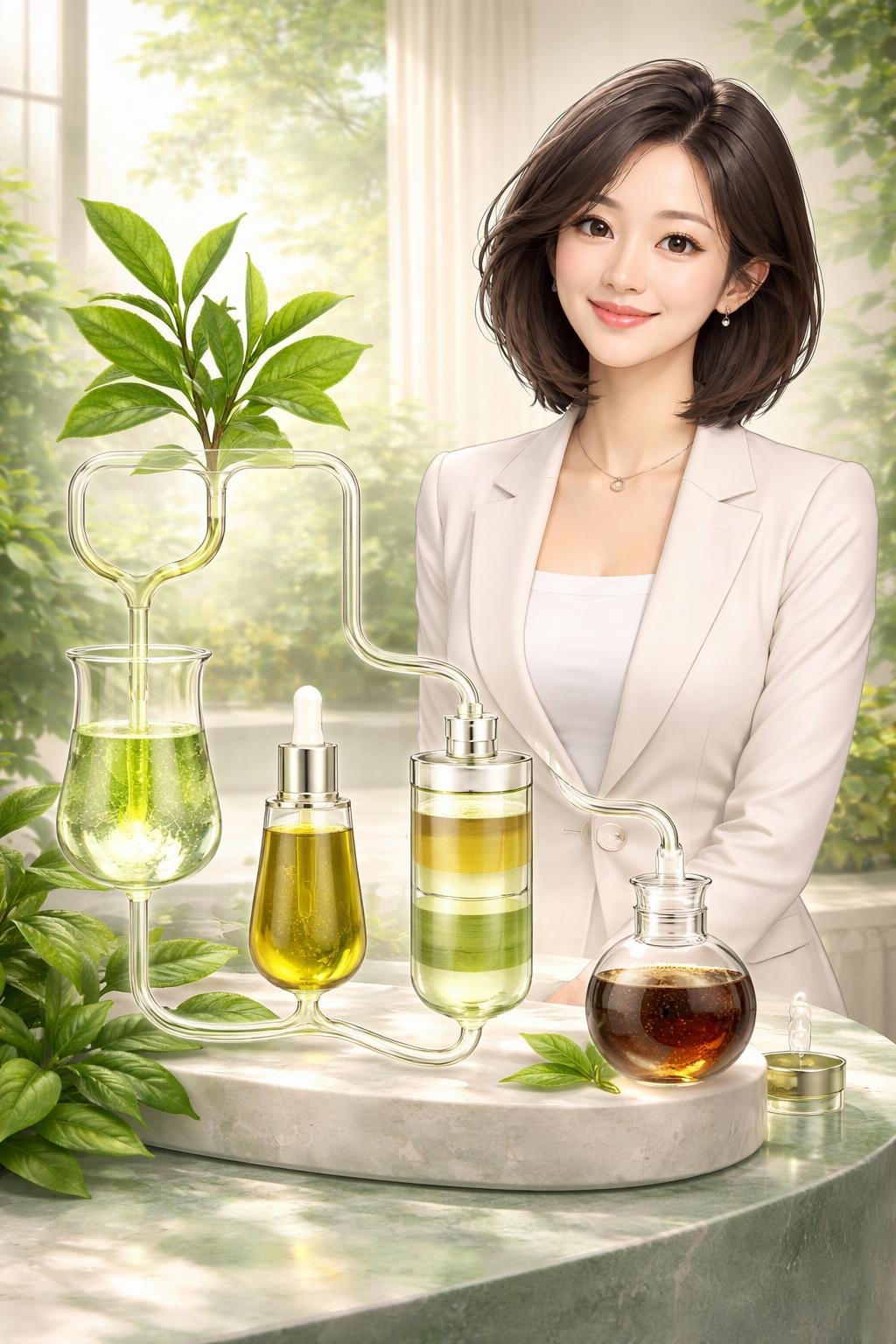
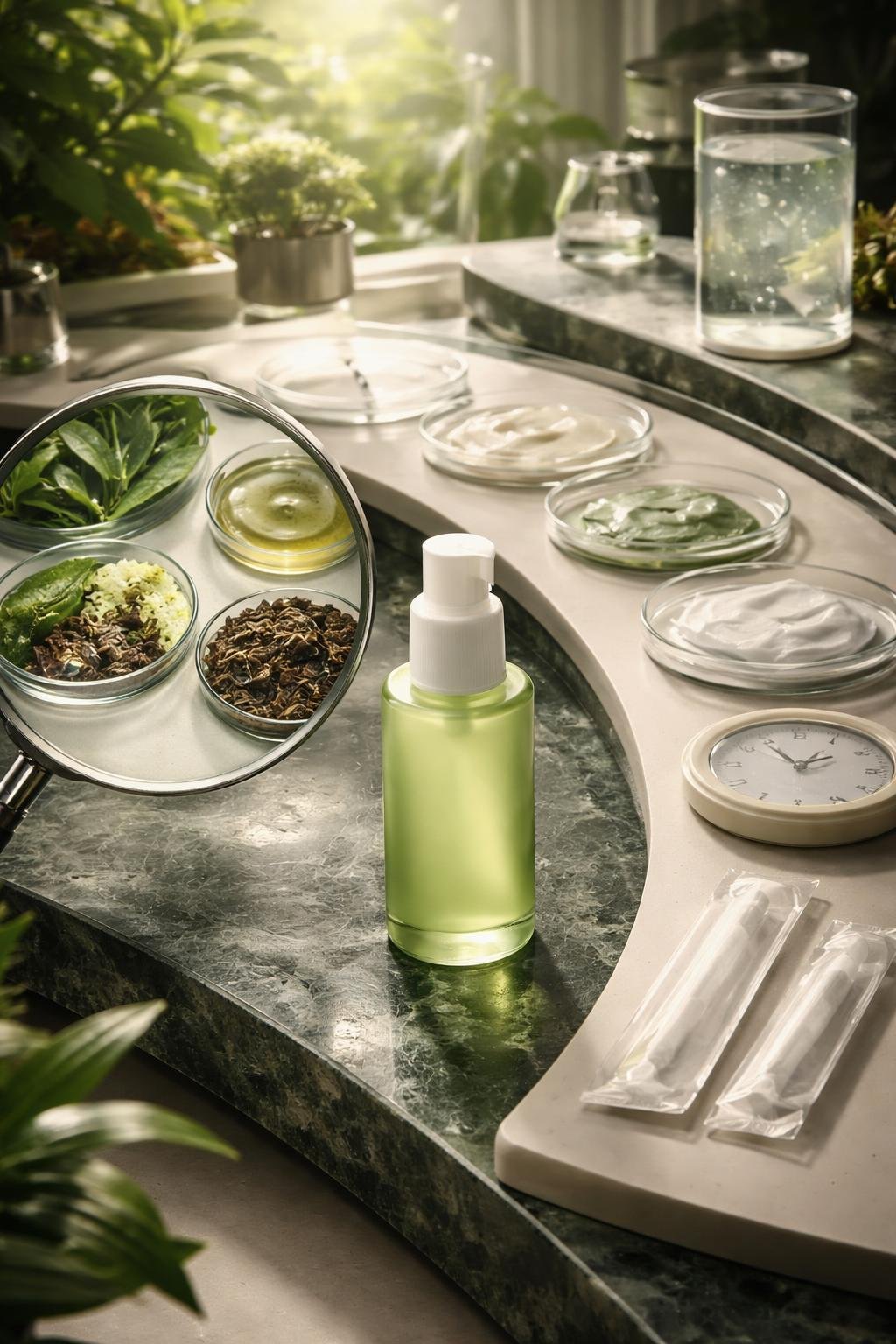
Educational visual 1: The accompanying core-concept visual presents green tea leaves alongside simplified representations of water, extract, serum, cream, and mask formats. It is an illustration rather than a depiction of a verified product.
Quick Guide
| Key point | Beginner guidance |
|---|---|
| What it is | Skincare containing a green tea-derived material, such as green tea water, extract, polyphenols, or processed green tea. |
| Common formats | Serums, essences, creams, and wash-off masks are documented examples. |
| Companion ingredients | Some cited formulas combine green tea materials with hyaluronic acid. One manufacturer also highlights theanine in its skincare-specific green tea. |
| Routine position | A serum or essence commonly goes before moisturizer. A cream generally serves as a later moisturizing step, while a wash-off mask is used and removed according to its label. |
| Frequency | One cited serum is directed for morning and evening use, but that direction should not be applied automatically to every green tea product. |
| What to check | Read the current ingredient list, product directions, warnings, and manufacturer information because formulas and instructions can change. |
The product format and complete formula matter more than the words “green tea” alone.
What Green Tea in Korean Skincare Is
Green tea can enter a cosmetic formula in several forms. Green tea water is a water-based material associated with tea extraction, while an extract contains selected tea-derived components in a form determined by the manufacturer’s process. Labels and official product information are needed to identify what a particular formula actually contains.
Polyphenols are tea-derived compounds discussed in cosmetic research. The supplied Korean cosmetic-science article reports antioxidant, anti-inflammatory, cell-protective, and other skin-protective activities associated with green tea polyphenols. These research findings help explain interest in green tea as a cosmetic material, but they do not guarantee that every finished product will produce the same effects for every user.
Green tea may also be processed for a specific formulation. A documented Korean brand example uses green tea leaves that were fermented and aged with cedar for 100 days to create a material called black green tea. This is a particular manufacturer’s method, not a standard that applies to all Korean products.
Manufacturer descriptions and ingredient research answer different questions. Research can examine the properties of green tea compounds or materials, while a manufacturer describes its own formula, intended use, and marketed benefits. Neither should be treated as proof of guaranteed clinical results from an unrelated product.
Green Tea Product Types and Ingredient Formulations
Serums and essences
Serums and essences are lightweight formats commonly placed before moisturizer. In the supplied official examples, Innisfree combines its Beauty Green Tea material with hyaluronic acid in a serum, while another regional page describes an essence containing Jeju green tea water and hyaluronic acid.
The manufacturer describes Beauty Green Tea as a variety developed specifically for skincare. Its Taiwan product page also highlights theanine, an amino acid associated there with the moisturizing properties of the material. These are product-specific manufacturer statements rather than descriptions of every green tea extract.
Creams
A cream places green tea-derived material in a richer moisturizing format. The cited Amorepacific announcement describes a black green tea cream intended to provide nourishment and hydration. Its properties cannot be assumed to match those of a lighter serum or another brand’s cream.
Wash-off masks
The same announcement describes a wash-off mask formulated with 55% black green tea extract. It attributes soothing, cooling, exfoliating, and moisture-retention functions to that product. The 55% figure belongs to this documented mask and should not be generalized to other masks or used to rank products without considering their complete formulas.
Why formulation details matter
Green tea water, Beauty Green Tea, and fermented and aged black green tea are not interchangeable labels. The cited black green tea line also highlights gallic acid for antioxidant care, while the serum and essence examples pair green tea materials with hyaluronic acid. Concentration, processing, companion ingredients, and product format can all differ.
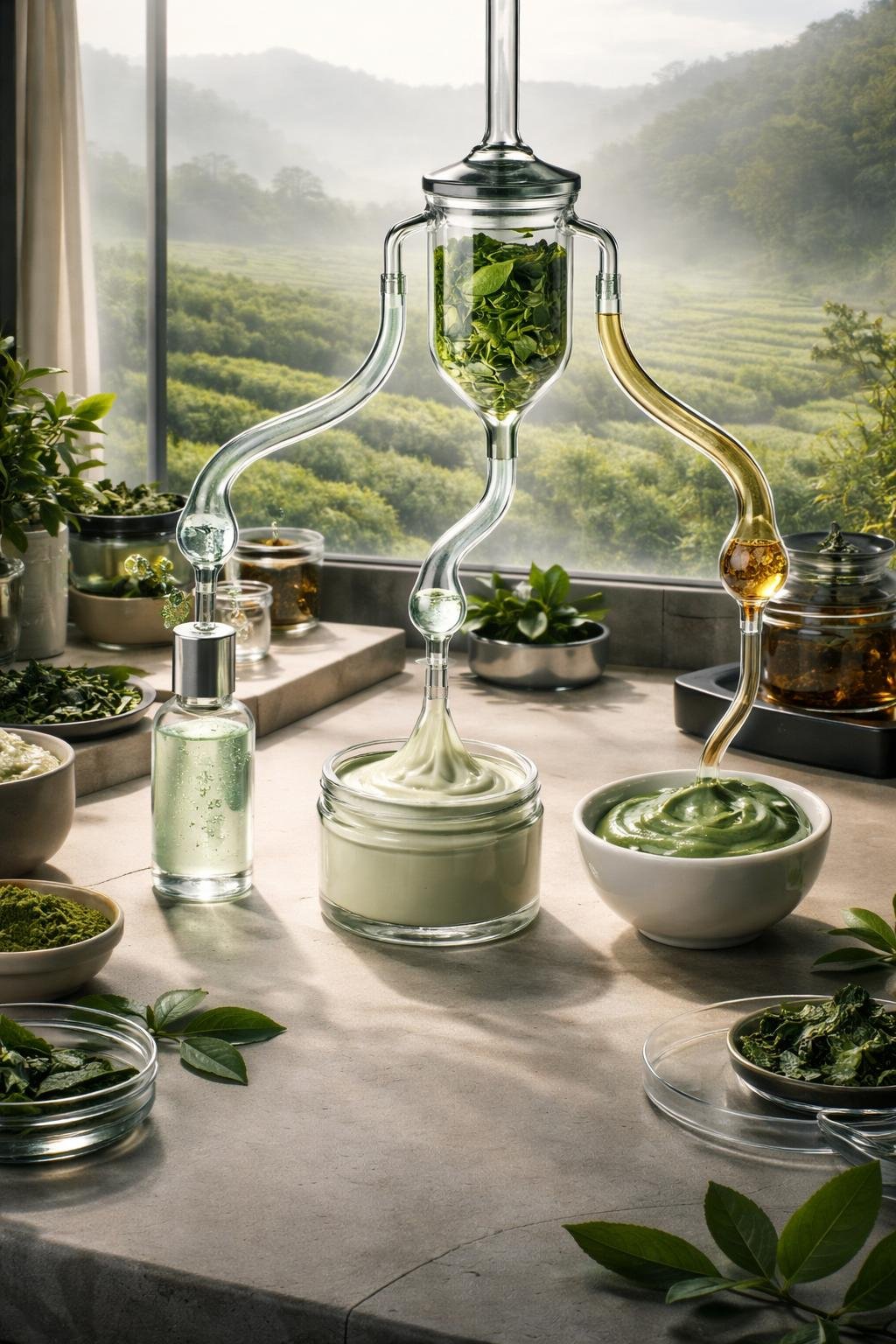
Educational visual 2: The accompanying product-and-ingredient visual compares illustrated serum, essence, cream, and wash-off mask formats with green tea water, hyaluronic acid, theanine, gallic acid, and processed green tea labels. It does not reproduce actual packaging or formulas.
How to Use Green Tea Skincare
Serum or essence
- Cleanse the skin using the products appropriate for your routine.
- Apply any thinner leave-on steps that the relevant labels direct you to use first.
- Apply the green tea serum or essence before moisturizer unless its current directions specify another order.
- Follow with moisturizer and, during a daytime routine, the sun-protection step appropriate for you.
The cited Innisfree serum page supports morning and evening application before moisturizer for that serum. This is useful as a product-specific example, not a universal frequency rule.
Cream
A green tea cream generally belongs in the moisturizing part of a routine. If both a serum and cream are being used, a typical example is to apply the lighter serum first and the cream later. Follow the directions for the actual products because texture and intended use can vary.
Wash-off mask
Apply a wash-off mask only as directed by its current label, including the amount, contact time, frequency, and rinsing instructions. Do not copy the schedule for a serum, because a mask is a different format intended to be removed.
Introduce it gradually
When adding a new product, begin with one new formula rather than several unfamiliar products at once. A gradual introduction makes it easier to notice how your skin responds and to distinguish the new product from the rest of the routine.
Common mistakes include treating every green tea formula as identical, using a wash-off product as a leave-on treatment, assuming that more frequent application must be better, and ignoring the manufacturer’s current directions.
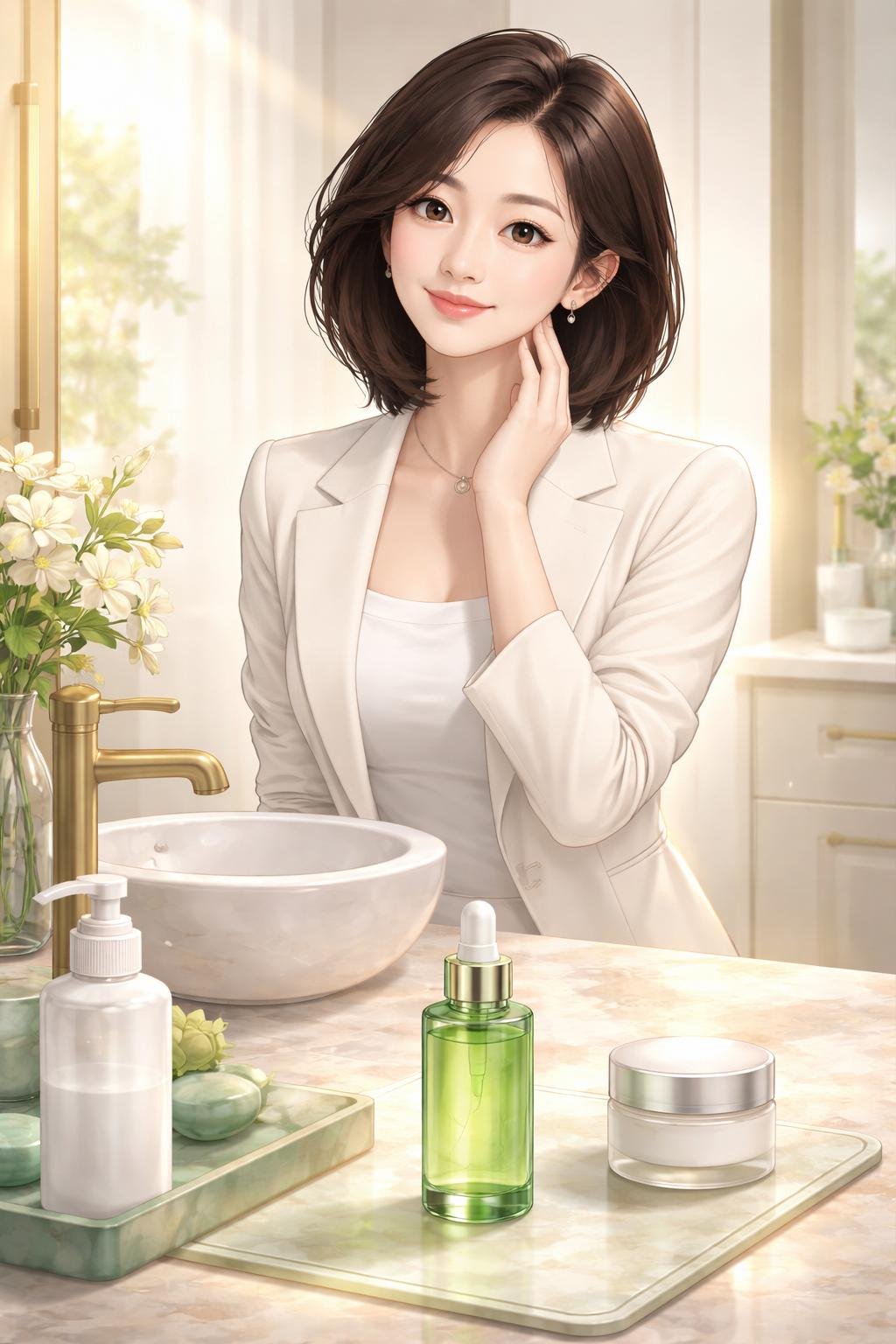
Educational visual 3: The accompanying routine-order visual shows a simplified example of cleansing, serum or essence, moisturizer, and daytime sun protection, with a separate branch for a wash-off mask. The order remains subject to each product’s directions.
How to Choose a Green Tea Product Safely
- Identify the derivative: Look for the exact green tea material stated in the current ingredient list or official product information rather than relying only on front-label imagery.
- Choose a suitable format: Decide whether you want a leave-on serum, essence, or cream, or a rinse-off mask with separate usage directions.
- Review companion ingredients: A formula may include hyaluronic acid, fragrance components, exfoliating materials, or numerous other ingredients that influence how the complete product feels and performs.
- Check instructions and warnings: Confirm routine position, suggested frequency, contact time for masks, and any manufacturer precautions.
- Verify the current formula: Packaging, ingredient lists, and regional versions can change, so consult the current label and official manufacturer information.
If you are uncertain about tolerance, consider patch testing the complete product on a small area according to appropriate product guidance before wider use. Patch testing cannot guarantee that irritation will never occur.
Green tea skincare can still cause discomfort or irritation for some people because individual responses differ and products contain more than one ingredient. Stop using a product if it causes a concerning reaction. Significant or persistent skin concerns should be discussed with an appropriate healthcare professional rather than self-diagnosed from an ingredient label.
Educational visual 4: The accompanying selection-and-safety visual highlights an ingredient list, usage directions, formula date check, small-area test, and stop-and-assess reminder. It is educational and does not represent a guarantee of safety.
Green Tea in Korean Beauty Culture and Product Development
Green tea has a documented place in Korean cosmetic research and product development. A 2005 article in the Journal of the Society of Cosmetic Scientists of Korea describes green tea as a favored functional cosmetic material and reviews skin-related activities associated with its polyphenols.
A separate Korean brand example connects product development with Jeju-grown tea. Official Innisfree pages describe Beauty Green Tea as a variety developed for skincare and identify Jeju green tea water in a moisturizing essence. An Amorepacific announcement also documents a black green tea line made with Jeju-grown leaves that were fermented and aged with cedar for 100 days.
These examples show how one Korean company has developed and marketed distinct tea-derived materials across several product formats. They do not prove that every Korean green tea product uses Jeju tea, skincare-specific cultivars, fermentation, the same concentrations, or the same manufacturing methods.
K-Nana Beauty Guide
Fictional guide: Nana is a fictional female beauty guide used only to demonstrate routine decisions. The scenarios below are examples, not personal reviews, reported results, or instructions for a specific product.
Example: adding a green tea serum
Nana checks whether the serum is a leave-on product and reads its current directions. In this sample routine, she places it after cleansing and thinner steps but before moisturizer. She does not assume twice-daily use unless the label for that exact serum supports it.
Example: choosing a green tea cream
Nana wants a moisturizing format rather than another lightweight step. She compares complete ingredient lists, directions, and formula information instead of selecting a cream solely because green tea appears prominently on the package.
Example: using a wash-off mask
Nana treats the mask as a separate rinse-off product. She follows its stated contact time and frequency, rinses it as directed, and avoids leaving it on overnight unless the manufacturer explicitly identifies it as an overnight product.
These fictional examples illustrate how to read directions and place different formats in a routine. Readers should adapt any example to their actual product labels and individual skin responses.
Frequently Asked Questions
What does green tea do in a cosmetic formula?
Green tea supplies tea-derived materials such as water, extracts, or polyphenols. Cosmetic research has reported antioxidant and other skin-protective activities associated with green tea polyphenols, while manufacturers may formulate green tea materials into moisturizing or other product types. The finished formula determines what a particular product is designed to do.
Can green tea serum be used daily?
It depends on the serum. The cited Innisfree serum is directed for morning and evening use, but another formula may have different instructions or may not suit every user. Check the current label and introduce a new product according to your skin’s response.
Where does green tea belong in a skincare routine?
A green tea serum or essence usually goes before moisturizer, while a green tea cream generally belongs in the moisturizing stage. A wash-off mask follows its own application and rinsing directions.
Are all green tea products formulated alike?
No. Products can contain green tea water, extracts, skincare-specific green tea materials, or processed forms such as fermented and aged black green tea. Concentrations, companion ingredients, textures, and directions also vary.
Can green tea skincare irritate the skin?
Yes, irritation is possible with any cosmetic formula. A reaction may relate to the green tea material, another ingredient, the product format, or individual sensitivity. Stop using a concerning product and seek appropriate professional advice for significant or persistent symptoms.
Final Takeaway
To choose green tea skincare, identify the exact tea-derived material, consider whether the format fits your routine, and examine companion ingredients and current directions. Use a serum or essence before moisturizer when its label supports that order, and treat wash-off masks according to their separate instructions.
Keep expectations realistic. Ingredient research and manufacturer descriptions provide useful context, but they do not guarantee the same result from every formula or for every person.
Educational visual 5: The final practical-reminder visual summarizes four steps: identify the green tea form, check the whole formula, follow product-specific directions, and observe individual skin responses. It is illustrative rather than evidence of product performance.
References
- Manufacturer source: Greentea Hyaluronic Serum 80ml | Innisfree
|
INNISFREE Malaysia — https://my.innisfree.com/products/single-green-tea-seed-hyaluronic-serum. - Manufacturer source: Green Tea Seed Hyaluronic Acid Moisturizing Essence 130ml [Large Version]
| INNISFREE Taiwan — https://tw.innisfree.com/en/products/innisfree-green-tea-seed-hyaluronic-serum-130ml-en. - Manufacturer group source: 이니스프리, ‘블랙 그린티 라인’ 3종 선보여 – 아모레퍼시픽 스토리(AMOREPACIFIC STORIES) — https://stories.amorepacific.com/%EC%9D%B4%EB%8B%88%EC%8A%A4%ED%94%84%EB%A6%AC-%EB%B8%94%EB%9E%99-%EA%B7%B8%EB%A6%B0%ED%8B%B0-%EB%9D%BC%EC%9D%B8-3%EC%A2%85-%EC%84%A0%EB%B3%B4%EC%97%AC/.
- Cosmetic-science source: 녹차의 피부보호효과
/ 대한화장품학회
대한화장품학회지/
이병곤(태평양기술연구원 피부과학연구소)
[한국전통지식포탈-논문] — https://koreantk.com/ktkp2014/thesis/thesis-view.view?ctrlNo=HJPHBN_2005_v31n4s54_311&tempLang=ko.
The manufacturer sources support product-specific formulations, directions, and marketed benefits, while the cosmetic-science source provides the research context discussed in this article.
Image Credits
- Core green tea concept: An original AI-generated educational visual of green tea leaves and simplified cosmetic ingredient formats.
- Products and ingredients: An original AI-generated educational comparison of serum, essence, cream, mask, and selected formulation terms.
- Routine order: An original AI-generated educational diagram showing example placement for leave-on products and a separate rinse-off mask path.
- Selection and safety: An original AI-generated educational checklist covering labels, directions, formula verification, and cautious introduction.
- Final reminder: An original AI-generated educational summary of recognizing, selecting, and using green tea skincare.
All five visuals are illustrative. They do not depict verified products, authentic packaging, documented application results, clinical outcomes, or real events.
Disclaimer
This article provides general educational information and is not medical advice, diagnosis, or treatment. Cosmetic formulations, ingredients, labels, availability, and prices can change, and individual skin responses vary.
Verify current product details, ingredient lists, directions, and warnings with the official manufacturer. Consult an appropriate healthcare professional about significant or persistent skin concerns.
AI-generated images are illustrative and may not accurately represent actual products, packaging, ingredients, application results, or clinical outcomes.