
What Are K-Pop Photocards?
K-Pop photocards are small collectible cards that commonly feature an artist or group member. They are widely associated with physical K-Pop albums, merchandise, events, and fan collecting culture.
For many fans, part of the fun comes from not always knowing which card they will receive until they open an album or package.
Photocards have therefore become more than simple album extras. They can be collected, displayed, stored in binders, and traded with other fans.
However, collecting photocards is completely optional. You do not need to own photocards, complete a collection, or spend money on collectibles to be a K-Pop fan.
Why Are K-Pop Photocards So Popular?
Photocards combine several familiar parts of K-Pop Fandom Culture: collecting, album unboxing, favorite members, trading, and sharing collections with other fans.
The cards are small and easy to store, while different releases can contain different photos, concepts, versions, or members.
For some fans, opening an album and discovering which photocard is inside becomes part of the album experience itself.
Other fans may prefer collecting only a favorite member, a particular album era, or a small number of cards they personally like.
There is no requirement to collect every card associated with an artist.
Are Photocards Always Included in K-Pop Albums?
No.
Physical K-Pop albums often contain additional items, but the exact inclusions vary by artist, release, version, market, and production run.
An album may include one or more photocards, a photobook, poster, sticker, postcard, or other items. Another album may use a completely different package structure.
Some benefits can also be connected to particular retailers, preorder periods, events, or promotions rather than being standard inclusions in every copy.
For that reason, always check the official album details for the exact version you plan to purchase instead of assuming that every K-Pop album contains the same type or number of photocards.
What Does “Random Photocard” Mean?
A random photocard means that the buyer does not necessarily choose the exact card included in a sealed product.
For example, an album might have several possible member or concept cards, while an individual copy contains only some of those possibilities.
This random element is one reason album unboxing can be exciting for collectors.
It can also encourage some fans to trade cards after opening albums if they receive duplicates or want a different member or design.
The exact randomization system varies by release, so check the official product description rather than assuming that every album works in the same way.
What Is a Photocard “Pull”?
Fans sometimes use the informal word pull to describe the photocard or collectible they receive when opening an album or package.
Someone might say that they “pulled” a particular member, meaning that member’s card happened to be included in the product they opened.
This is fan vocabulary rather than a formal industry rule, and terminology can vary between communities.
What Does “Bias” Have to Do With Photocard Collecting?
In common K-Pop fan language, a bias generally means a fan’s favorite member of a group.
Some collectors focus mainly on photocards of their bias, while others collect an entire group, particular concepts, or simply cards they find visually appealing.
You do not need to have a bias, and having a favorite member does not mean you need to collect that person’s photocards.
Collecting preferences are personal.
If the term is unfamiliar, What Does Bias Mean in K-Pop? explains bias, ultimate bias, and bias wrecker in more detail.
How Do Fans Store K-Pop Photocards?
Fans use many different storage methods.
Common approaches include protective sleeves, binder pages, card holders, boxes, or other storage products designed for collectible cards.
Collectors who care about condition may try to protect cards from bending, scratches, moisture, direct sunlight, and other potential damage.
Storage materials also vary in quality. If long-term preservation matters to you, check the specifications of sleeves and storage products rather than assuming every plastic holder provides the same protection.
How Does Photocard Trading Work?
Trading allows collectors to exchange cards they have for cards they want.
For example, two fans who receive different random cards may agree to exchange them. Trading can happen between friends, at fan events, through collector communities, or through online platforms.
The details of a trade — including card condition, shipping, packaging, and whether additional money is involved — should be clearly agreed upon before either person sends anything.
Online trades involve trust between individuals, so beginners should be cautious when dealing with unknown accounts.
What Should You Check Before Buying or Trading?
Photocards can vary greatly in source, condition, availability, and resale price, so it is useful to slow down before making a purchase or trade.
- Check exactly which card you are buying or receiving.
- Ask about scratches, dents, bends, marks, or other condition issues when they matter to you.
- Confirm whether the card is official merchandise or an unofficial fan-made item.
- Review clear photographs of the front and back when buying from another individual.
- Check the seller or trader’s history when possible.
- Agree on packaging, shipping, tracking, and payment terms before completing a transaction.
- Be cautious of unusually urgent offers or claims that pressure you to pay immediately.
If a card is expensive, rare, or difficult to verify, take extra time before sending money or personal information.
Official vs. Unofficial Photocards
Not every card featuring a K-Pop artist is an official photocard.
Official photocards may be distributed through albums, official merchandise, authorized promotions, events, memberships, or other official channels.
Fans and third-party sellers can also create unofficial cards. These may be sold or shared as fan-made items.
An unofficial card is not automatically a problem when it is clearly presented as unofficial. The important issue is whether a buyer is being misled about what the item actually is.
Artist names, images, and official designs can also involve intellectual-property and publicity-right considerations.
When authenticity matters, compare the item with current official release information and use reliable purchasing channels.
Why Can Some Photocards Become Expensive?
Prices in resale markets can vary because of factors such as availability, demand, member popularity, distribution method, condition, or how difficult a particular card is to obtain.
However, there is no universal official price guide that determines what every photocard is “worth.” Resale prices can change and different sellers may ask very different amounts for the same item.
Do not treat a high asking price as proof that a card is rare, authentic, or a good purchase.
For beginners, collecting within a personal budget is more important than trying to follow every market price or complete every set.
What International Fans Should Know
International fans can collect K-Pop photocards without living in Korea, but buying and trading across borders can add extra considerations.
International shipping costs, taxes, customs, currency conversion, delivery times, tracking options, and payment methods can affect the real cost of a card.
When buying from an individual seller, remember that a social-media account, follower count, or photograph of a card does not automatically prove authenticity or reliability.
Be cautious if someone pressures you to pay immediately, refuses to provide reasonable information about the item, asks you to use an unfamiliar payment method, or makes an offer that seems unusually different from comparable listings.
For official album inclusions, preorder benefits, event cards, or other limited items, check the relevant artist, entertainment company, authorized retailer, or event information when possible.
If you plan to shop for albums, photocards, or official fan products while visiting Korea, K-Pop Merchandise in Seoul explains the practical shopping side.
Do You Need to Collect Photocards to Be a K-Pop Fan?
No.
Photocard collecting is one optional part of K-Pop fan culture.
Some fans build large collections. Others keep only the cards that happen to come with albums. Some trade for a favorite member, while many fans do not collect photocards at all.
None of these approaches makes someone more or less of a fan.
If you enjoy collecting, decide what you want to collect and set a budget before purchasing multiple albums or expensive resale cards.
K-Nana Family Guide
Dad: Wonders why such a small card can become an important collectible in K-Pop fandom.
Mom: Checks the practical details — authenticity, card condition, seller information, shipping, payment, and personal budget before buying or trading.
K-Nana Daughter: Explains how random album inclusions, favorite members, collecting, trading, and fan communities can make photocards fun for some fans.
Nana: Keeps the lesson simple: collect what you enjoy, not what you feel pressured to own.
Practical Tips for K-Pop Beginners
- Check the official album or merchandise details before assuming which photocards are included.
- Remember that random inclusions mean you may not receive the exact member or card you want.
- Do not assume every card featuring an artist is official merchandise.
- Check the front, back, edges, and overall condition when condition matters to you.
- Use protective storage if you want to keep cards in good condition.
- When trading online, agree on packaging, shipping, and tracking before sending cards.
- Be cautious when purchasing expensive cards from unknown sellers.
- Do not treat a high resale price as proof of authenticity or rarity.
- Set a personal collecting budget before buying multiple albums or resale cards.
- You do not need to complete a collection to enjoy K-Pop.
FAQ
What is a K-Pop photocard?
A K-Pop photocard is a small collectible card commonly associated with physical albums, official merchandise, events, and other fan products. Official cards often feature an artist or group member.
Do all K-Pop albums include photocards?
No. Album contents vary by artist, release, version, market, and production. Check the official product details for the specific album you plan to buy.
What does a random photocard mean?
It generally means that a sealed product can contain one or more cards selected from several possible designs or members, so the buyer may not know exactly which card is inside before opening it.
What does “photocard pull” mean?
Fans often use “pull” informally to describe the card they receive when opening an album or package.
What is the difference between official and unofficial photocards?
Official photocards are distributed through authorized album, merchandise, event, membership, promotional, or other official channels. Unofficial cards can be fan-made or produced by third parties. The source should be clear when authenticity matters.
Why do fans trade photocards?
Fans may trade duplicates or exchange cards to collect a favorite member, concept, release, or other card they personally want.
Are expensive photocards always rare?
No. A high asking price alone does not prove rarity or authenticity. Resale prices can vary according to supply, demand, condition, seller, and other factors.
How should I store K-Pop photocards?
Many collectors use sleeves, binder pages, card holders, or boxes. If long-term preservation matters, check the materials and specifications of the storage products you use.
Is photocard collecting required to support a K-Pop artist?
No. Photocard collecting and merchandise purchasing are optional ways of participating in fandom culture.
Is it safe to trade K-Pop photocards online?
Online trading involves risk because transactions may occur between individuals. Check available information about the other person, agree on the card condition and shipping method, protect personal information, and be cautious before sending valuable items or money.
Final Takeaway
K-Pop photocards are small collectibles that have become a recognizable part of album and fan culture. Random inclusions, favorite members, trading, and collecting can make them especially enjoyable for some fans.
At the same time, photocards can involve resale prices, authenticity questions, card condition, shipping, and transactions between individual collectors. Beginners should check what they are buying or trading instead of making decisions based only on excitement or scarcity claims.
Most importantly, collecting is optional. You can keep one card, build a large collection, trade with other fans, or never collect photocards at all and still enjoy K-Pop in exactly the way that works for you.
Continue Exploring K-Pop
Another recognizable type of K-Pop fan merchandise is the K-Pop Light Stick. The guide explains official products, concert use, synchronization, versions, and practical buying considerations.
If terms such as photocard, pull, POB, bias, random inclusion, or official merchandise are unfamiliar, use the K-Pop Glossary for Beginners as a terminology reference.
Collectors who also attend fan events can continue with K-Pop Fan Meetings & Fansigns to understand fansigns, video-call events, participation methods, and changing event rules.
Explore K-Pop Shopping in Seoul
Fans visiting Korea may combine album and photocard shopping with sightseeing. K-Pop in Seoul provides a broader starting point for K-Pop shopping, fan activities, performances, and neighborhoods.
Myeongdong can fit naturally into a shopping-focused itinerary because the district combines retail, beauty, food, and visitor-oriented commercial streets.
Hongdae offers another shopping environment alongside youth culture, music, cafés, fashion, and street activity.
For a different part of Seoul’s contemporary shopping and entertainment environment, Gangnam Station & Gangnam-daero can be incorporated into a wider Gangnam itinerary.
Specific albums, photocards, POBs, pop-ups, and merchandise can sell out or move between stores, so a neighborhood guide should never be treated as confirmation that a particular collectible is currently available.
References
- Korea.net — K-Pop Album Unboxing and Photocard Fan Culture
- Korea.net — The Structure and Activities of K-Pop Fandoms
Image Credits
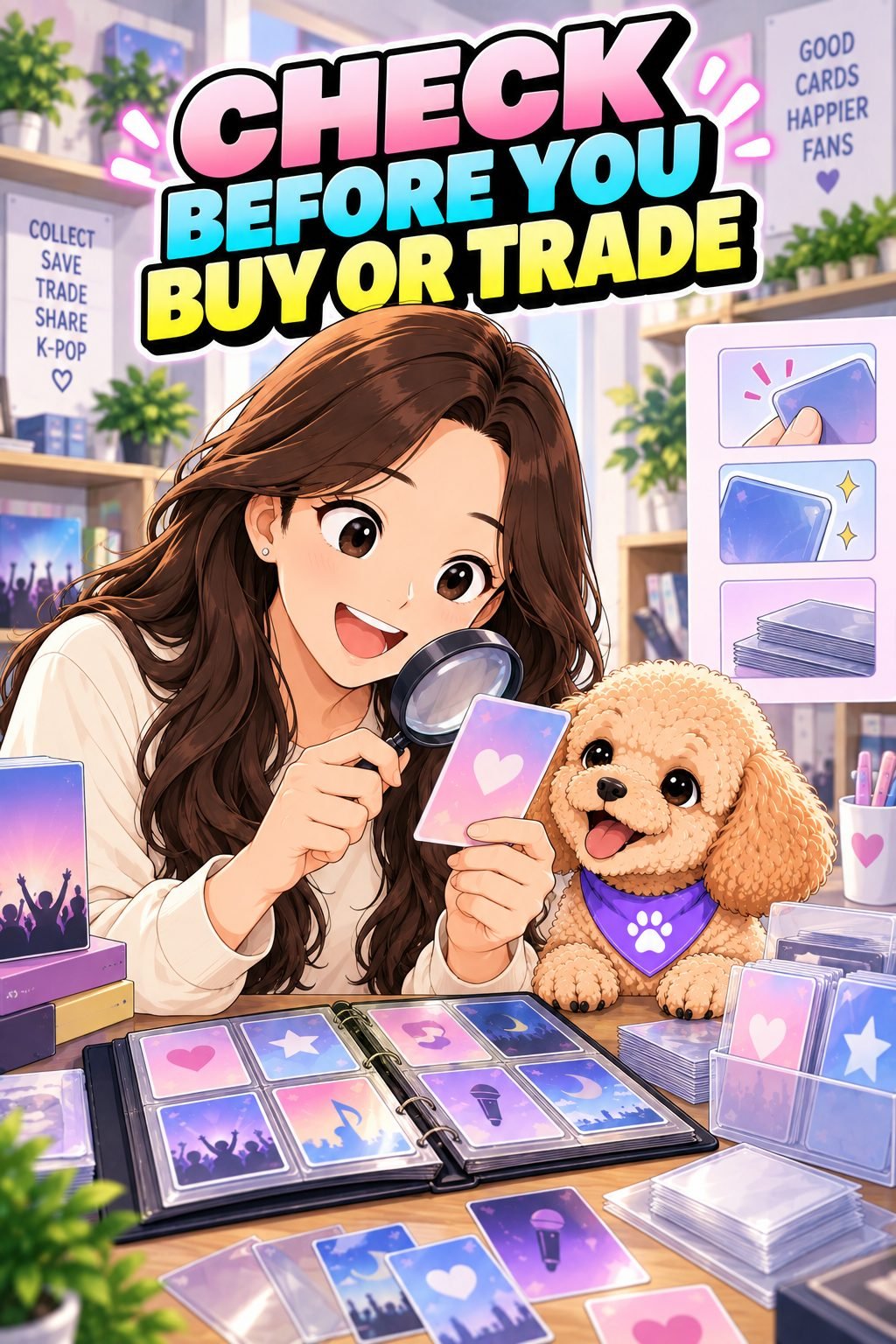
K-Pop Photocards family visual with Dad, Mom, K-Nana daughter, and Nana discovering photocard collecting culture together — K-Nana Studio original visual.
K-Pop photocard beginner visual with Dad and Nana discovering why small collectible cards have become a recognizable part of fan culture — K-Nana Studio original visual.
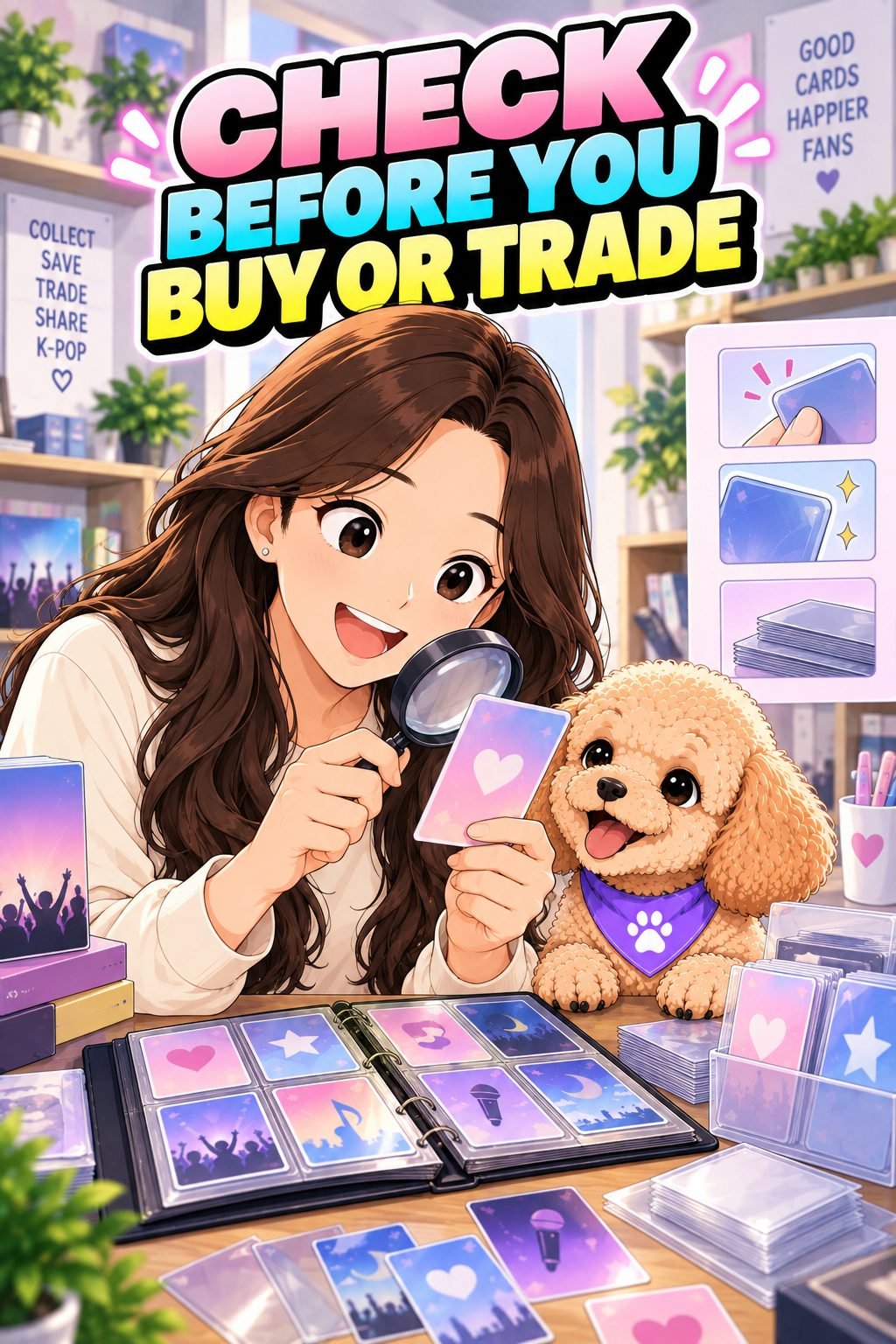
K-Pop photocard buying and trading visual with Mom and Nana checking card condition and practical details before a transaction — K-Nana Studio original visual.
K-Pop collecting visual with K-Nana daughter and Nana organizing cards and exploring photocard collecting and trading culture — K-Nana Studio original visual.
Nana as the K-Nana Studio K-Pop mascot reminding beginners to collect only what they genuinely enjoy and can comfortably afford — K-Nana Studio original visual.
Disclaimer
This article is provided for general cultural and educational information. K-Pop album inclusions, photocards, merchandise, promotional benefits, event products, prices, resale values, seller policies, shipping options, and collecting practices can vary and may change over time.
K-Nana Studio is not affiliated with or endorsed by any K-Pop artist, entertainment company, album retailer, merchandise seller, trading platform, fandom, event organizer, or collector discussed in this guide.
Before purchasing an official photocard, album, promotional benefit, or other collectible, check the relevant artist’s, entertainment company’s, authorized retailer’s, or event organizer’s current information when authenticity or eligibility matters.
Transactions between individual buyers, sellers, and traders can involve financial, authenticity, shipping, privacy, and fraud risks. Readers should evaluate sellers and transaction terms independently and use appropriate caution before sending money, personal information, or valuable items.
Photocard collecting and merchandise purchasing are optional. Readers should make their own purchasing and collecting decisions based on their interests, budget, and circumstances.
All K-Nana family and Nana illustrations used in this article are K-Nana Studio original visuals created for educational and editorial use. They are not intended to depict or reproduce any specific real K-Pop artist, group, entertainment company, official logo, album artwork, official photocard, merchandise design, or other protected official design.