
Bibigo Mandu is a globally distributed line of Korean-style dumpling products from Bibigo, a Korean food brand operated by CJ Foods. Mandu itself has a much longer history in Korean cuisine, while Bibigo represents a modern example of how Korean dumplings have entered international frozen-food markets.
Bibigo offers Mandu in multiple markets, but the products sold in one country should not be assumed to be identical to those sold in another. Product names, fillings, wrapper ingredients, package sizes, nutrition information, allergens, and cooking instructions can vary by market and product.
For international consumers, Bibigo Mandu therefore provides a useful case study in how a traditional Korean food category can be adapted for convenient preparation and large-scale global distribution.
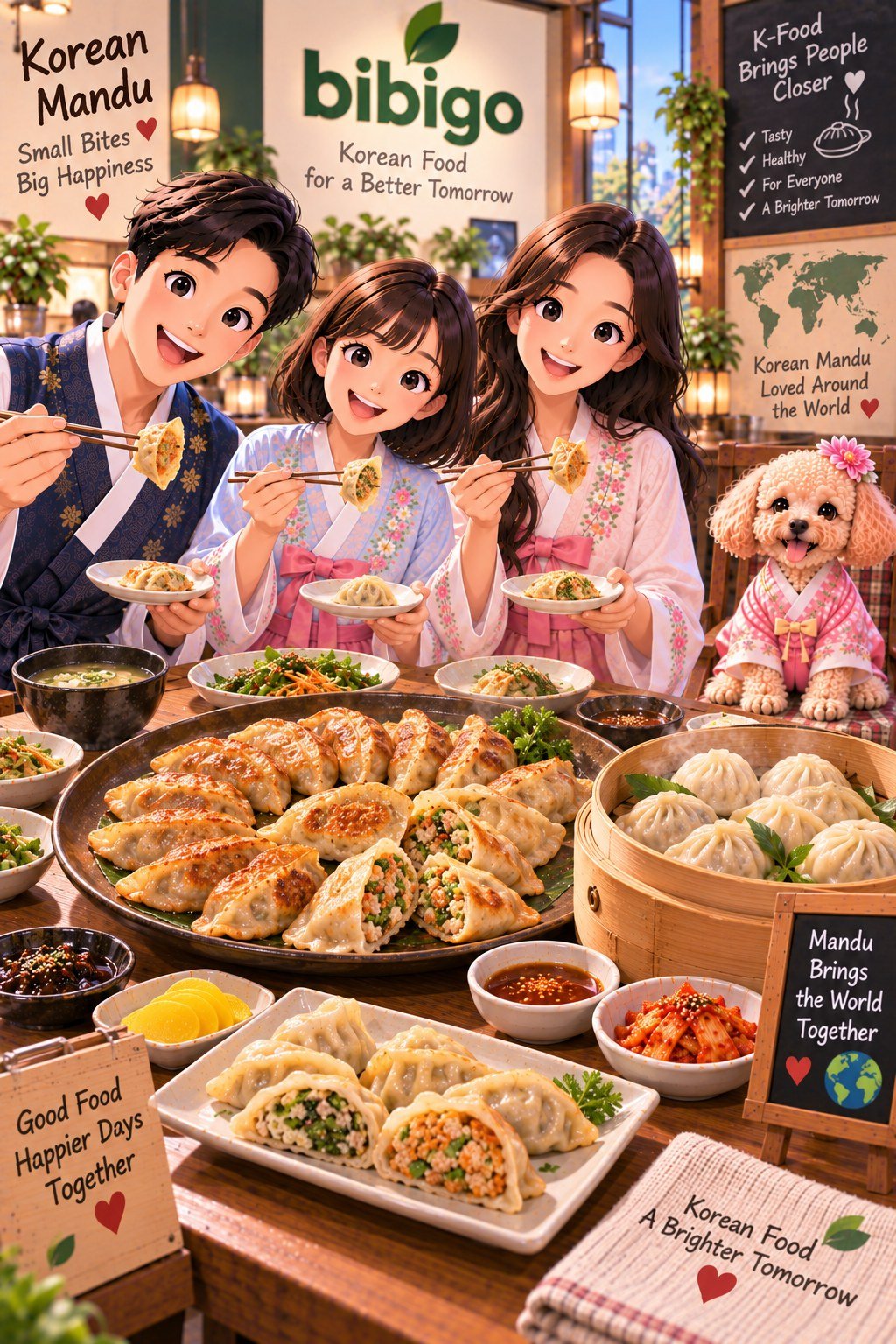
Bibigo Mandu connects Korea’s traditional dumpling culture with the modern global frozen-food market.
Quick Guide
| Brand | Bibigo |
| Food category | Korean-style Mandu |
| Common English category | Korean dumplings |
| Product format | Primarily convenient packaged or frozen products, depending on market |
| Basic structure | Wrapper with filling |
| Fillings | Product- and market-dependent |
| Cooking methods | Product-dependent; can include pan-frying, steaming or other package-directed methods |
| Global presence | Bibigo products are sold across international markets |
| Important consumer check | Ingredients, allergens, nutrition and cooking directions on the specific package |
What Is Bibigo Mandu?
Bibigo Mandu refers to Korean-style dumpling products sold under the Bibigo brand.
The category takes the familiar Korean Mandu structure of a wrapper surrounding a filling and adapts it to packaged food products designed for convenient storage, preparation, and international distribution.
It should not be treated as a separate traditional Korean dish from Mandu itself. Instead, it is a branded modern expression of the broader Korean Mandu category.
What Is Bibigo?
Bibigo is a Korean food brand associated with CJ Foods and a range of Korean food products distributed internationally.
The brand includes more than Mandu and has expanded Korean foods into retail markets in multiple countries.
Its global presence makes Bibigo useful for examining how Korean foods move from domestic food culture into international supermarkets, frozen-food sections, and home kitchens.
What Does Bibigo Mean?
Bibigo explains its brand name through the Korean concept of bibim, meaning the mixing or harmonious combination of different ingredients.
The name connects the modern brand with a familiar idea in Korean food culture: different ingredients coming together to create a balanced whole.
This brand meaning should be distinguished from Mandu itself, which is the Korean food category represented by the dumpling products.
Bibigo Mandu vs. Korean Mandu
Korean Mandu is the broader traditional food category and can include many homemade, restaurant, market, regional, and commercial forms.
Bibigo Mandu is one branded commercial expression within that much larger category.
This distinction is important because the history of Korean Mandu did not begin with Bibigo, and characteristics of one Bibigo product should not be applied to every Korean dumpling.
Mandu vs. Dumpling
“Dumpling” is a broad English-language food category used for many foods from different culinary traditions.
Mandu is the Korean term for Korea’s dumpling tradition and can include different wrappers, fillings, shapes, sizes, and cooking methods.
Calling Bibigo Mandu “Korean dumplings” can help international consumers understand the general food type while the word Mandu preserves its Korean identity.
How Bibigo Mandu Became a Global K-Food Product
Frozen and packaged Mandu allows Korean-style dumplings to reach consumers who may not have access to a Korean restaurant or traditional market.
Instead of requiring diners to make dough, prepare filling, shape each dumpling, and cook everything from the beginning, packaged Mandu provides a convenient format for home preparation.
Retail distribution also places Korean Mandu alongside other internationally familiar frozen foods, increasing opportunities for consumers to encounter the category.
Bibigo Mandu Sales Scale
Bibigo’s official Korean product information identifies Mandu as one of the brand’s best-selling categories.
The company reports cumulative Korean sales, including exports, of more than 600 million bags from August 2012 through June 2026.
This is a company-reported cumulative sales figure for the stated period and should not be interpreted as an independent estimate of the entire global Mandu market.
Bibigo Beyond Mandu
Bibigo has developed a wider portfolio of Korean food products rather than operating only as a dumpling brand.
According to the brand’s official information, Bibigo products are distributed across more than 80 countries and include more than 100 Korean food products.
Mandu is therefore part of a larger strategy of presenting multiple Korean food categories to international consumers.
Why Frozen Mandu Matters
Frozen food can extend storage life and make preparation more convenient compared with making fresh Mandu from scratch.
For global consumers, this lowers some practical barriers to trying Korean-style dumplings at home.
Freezing does not make all Mandu products identical, however, and storage requirements should always follow the specific package instructions.
What Is Inside Mandu?
Mandu has two basic structural components: the wrapper and the filling.
The wrapper encloses the filling so the dumpling can be steamed, pan-fried, boiled, or otherwise cooked according to the specific product or recipe.
The ingredients inside Bibigo Mandu vary by product and country, so no single filling should be treated as universal across the brand.
The Mandu Wrapper
A Mandu wrapper needs enough flexibility to surround the filling while remaining intact during cooking.
Bibigo describes thin and chewy wrappers as a characteristic of its Mandu, but exact wrapper formulations can vary by product.
Consumers with wheat, gluten, egg, soy, or other dietary concerns should check the ingredient and allergen information on the specific package.
The Mandu Filling
The filling creates much of the flavor and texture inside the dumpling.
Depending on the specific product, fillings can combine meat, vegetables, tofu, noodles, seasonings, or other ingredients.
Products sold under the same brand should not be assumed to use the same filling simply because their outer shape appears similar.
Why Product Labels Matter
Commercial frozen Mandu is sold as a specific packaged product rather than as a universal recipe.
The ingredient list, allergen statement, nutrition information, net weight, storage directions, and cooking instructions apply to that particular product and market.
Consumers should therefore use the current package as the primary reference for the product they actually purchase.
Understanding Mandu Structure
A useful way to understand Mandu is to separate the wrapper from the filling.
The wrapper provides the outer structure, while the filling provides most of the internal flavor, moisture, and texture.
Different combinations of these two components allow Mandu products to vary substantially even when they share a similar dumpling shape.
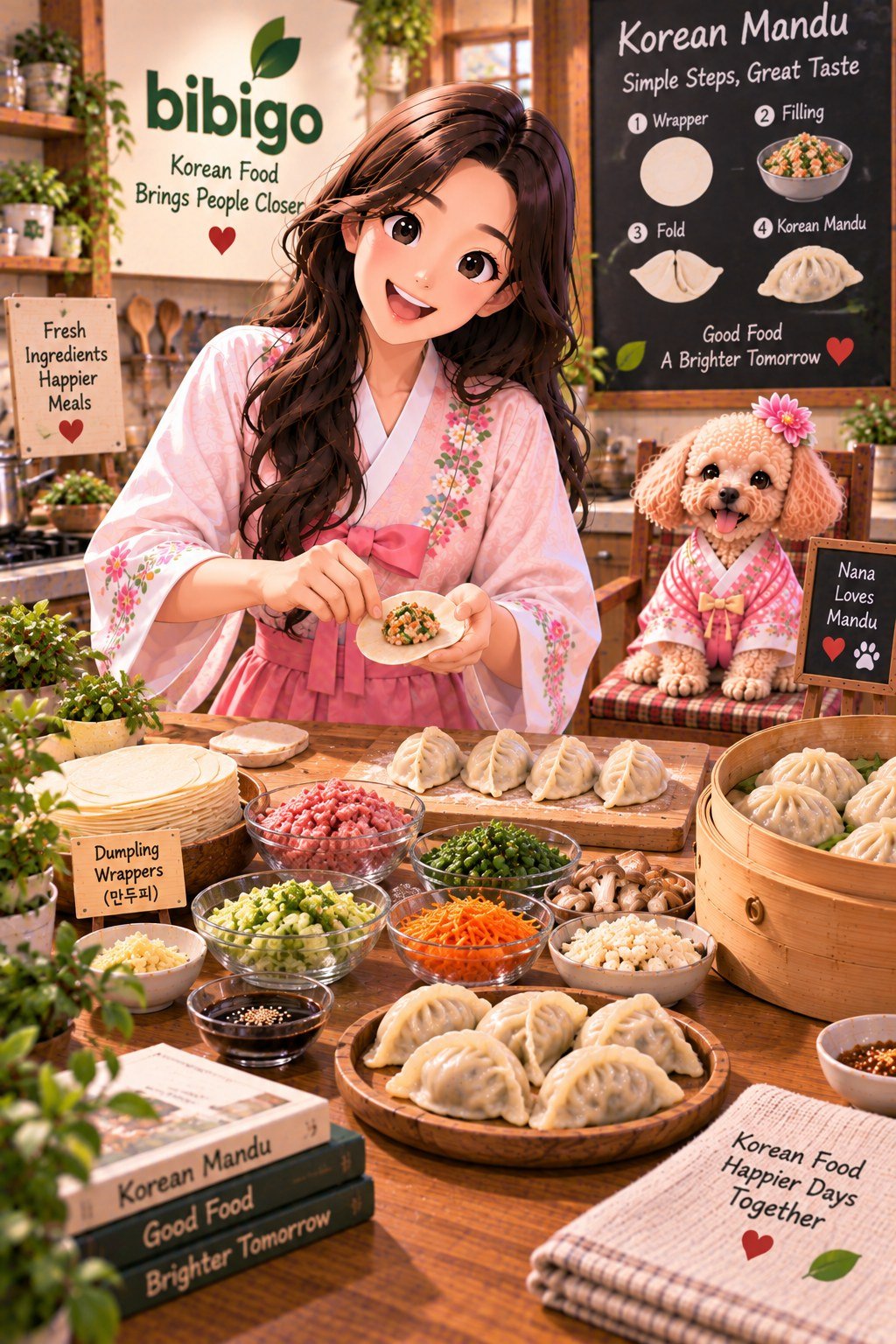
A wrapper surrounding a filling is the basic Mandu structure, while the exact ingredients vary by recipe, product, and market.
Traditional Mandu Making vs. Packaged Mandu
Traditional or homemade Mandu preparation can involve preparing filling, handling wrappers or dough, shaping individual dumplings, and cooking them soon afterward.
Commercial packaged Mandu moves much of that preparation into food manufacturing so consumers receive shaped dumplings ready for storage and later cooking.
The convenience is different, but both remain connected through the fundamental wrapper-and-filling structure of Mandu.
Does Bibigo Use One Mandu Recipe Worldwide?
No single product specification should be assumed to apply to every country.
Food regulations, ingredient availability, consumer preferences, package sizes, product portfolios, and manufacturing locations can differ between markets.
A product sold in Korea can therefore differ from a similarly branded product sold in the United States, Europe, or another region.
Product Names Can Differ by Market
Bibigo can use market-specific product names and descriptions to communicate with local consumers.
The word Mandu can appear alongside English descriptions such as dumplings, while individual filling names and product formats can also differ.
Consumers comparing products across countries should compare the actual package information rather than relying only on a similar product name.
Bibigo Mandu & the U.S. Market
The United States has become an important international market for Bibigo and Korean food products.
Frozen dumplings provide a format that can be distributed through mainstream retail channels and prepared at home without requiring specialized restaurant access.
The specific Bibigo Mandu products available in the United States can change over time, so current U.S. product information should be checked through official market-specific sources and packaging.
Bibigo Mandu & Europe
Bibigo has also continued expanding its food business across European markets.
As Korean food distribution grows, Mandu can reach consumers through retail channels beyond specialist Korean grocery stores.
Products, manufacturing arrangements, recipes, labeling, and availability can vary by country and over time.
How Frozen Mandu Is Cooked
Frozen Mandu can support several cooking methods depending on the specific product.
Pan-frying and steaming are two familiar approaches, while some products can provide additional preparation methods on their packaging.
The package instructions for the actual product should take priority over a generic cooking time or temperature.
Pan-Fried Mandu
Pan-frying can create a browned and crisp exterior on the part of the dumpling that contacts the cooking surface.
The interior should still be appropriately heated according to the product instructions.
Oil, hot cookware, steam, and moisture from frozen food require careful handling during cooking.
Steamed Mandu
Steaming creates a softer wrapper without relying on the same browned pan-contact surface as pan-frying.
Hot steam surrounds the dumplings as they cook, allowing the wrapper and filling to heat together.
Steam can cause burns, so lids and steamers should be opened and handled carefully.
Pan-Fried vs. Steamed Mandu
The same general dumpling category can provide noticeably different textures depending on cooking method.
Pan-fried Mandu can develop crisp browned areas, while steamed Mandu emphasizes a softer wrapper.
The appropriate method and required cooking conditions depend on the specific product.
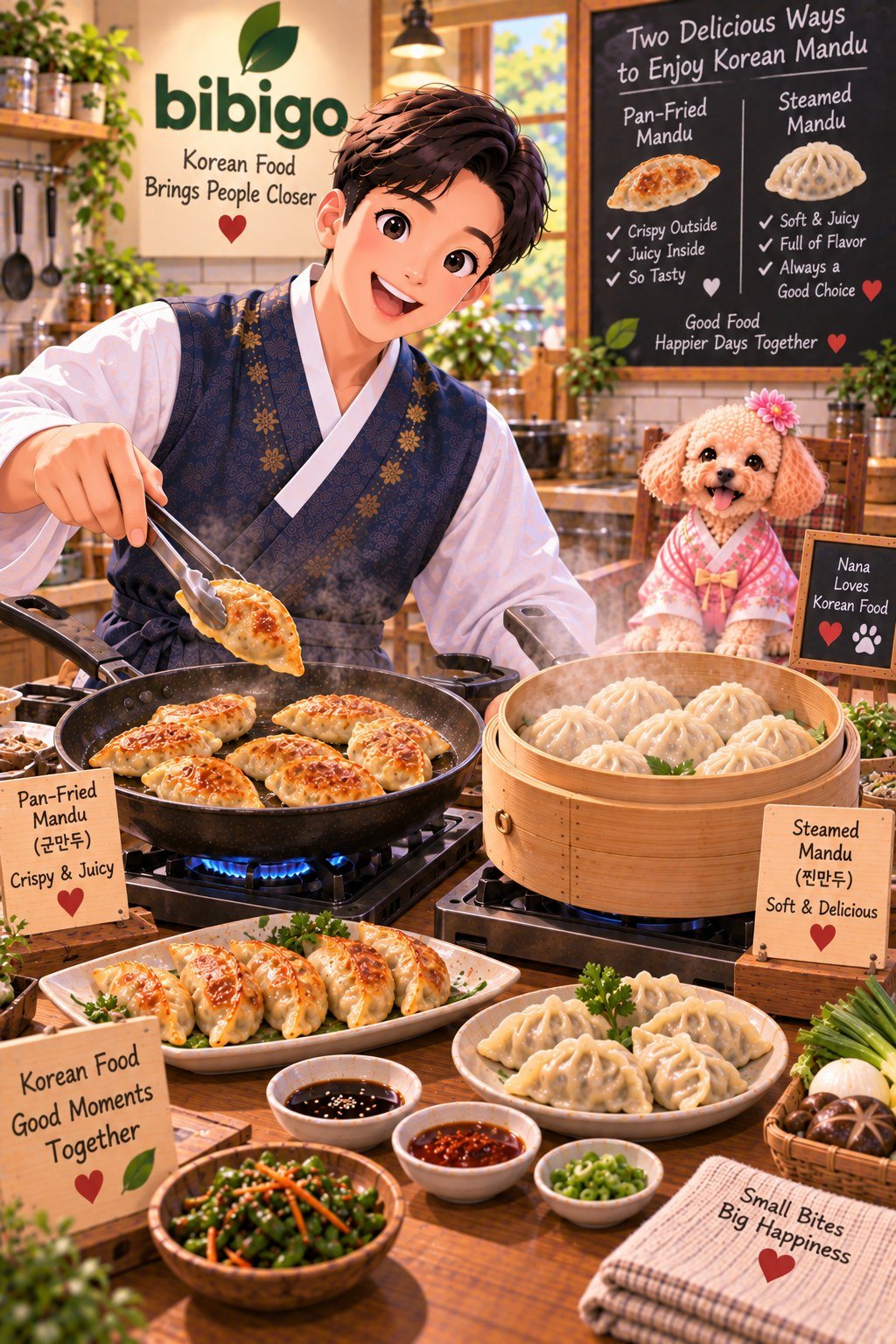
Pan-frying and steaming can create very different wrapper textures, while the specific package directions determine how an individual frozen Mandu product should be cooked.
Why Cooking Instructions Can Differ
Dumpling size, wrapper thickness, filling, frozen state, manufacturing process, and cooking appliance can all affect preparation requirements.
This is why a cooking time for one Bibigo Mandu product should not automatically be used for another.
Following the current package instructions is more reliable than assuming one universal Mandu cooking method.
Heating the Filling Properly
A browned wrapper does not necessarily prove that the filling has reached the appropriate condition throughout.
Frozen dumplings contain enclosed fillings that can heat differently from the exterior.
Consumers should follow the specific product’s cooking directions and any applicable food-safety instructions before eating.
Why Mandu Filling Stays Hot
The wrapper encloses moisture and filling inside the dumpling.
Even after the exterior feels comfortable to touch, the center can remain significantly hotter.
Allowing a cooked Mandu to cool briefly before taking a large bite can reduce the risk of burning the mouth.
How to Taste Bibigo Mandu for the First Time
Start with the Mandu cooked according to the specific package directions and allow it to cool to a comfortable temperature.
Try a bite without a large amount of sauce first so the wrapper texture and filling are easier to distinguish.
If comparing cooking methods, try pan-fried and steamed Mandu separately to notice how the same general dumpling structure changes with preparation.
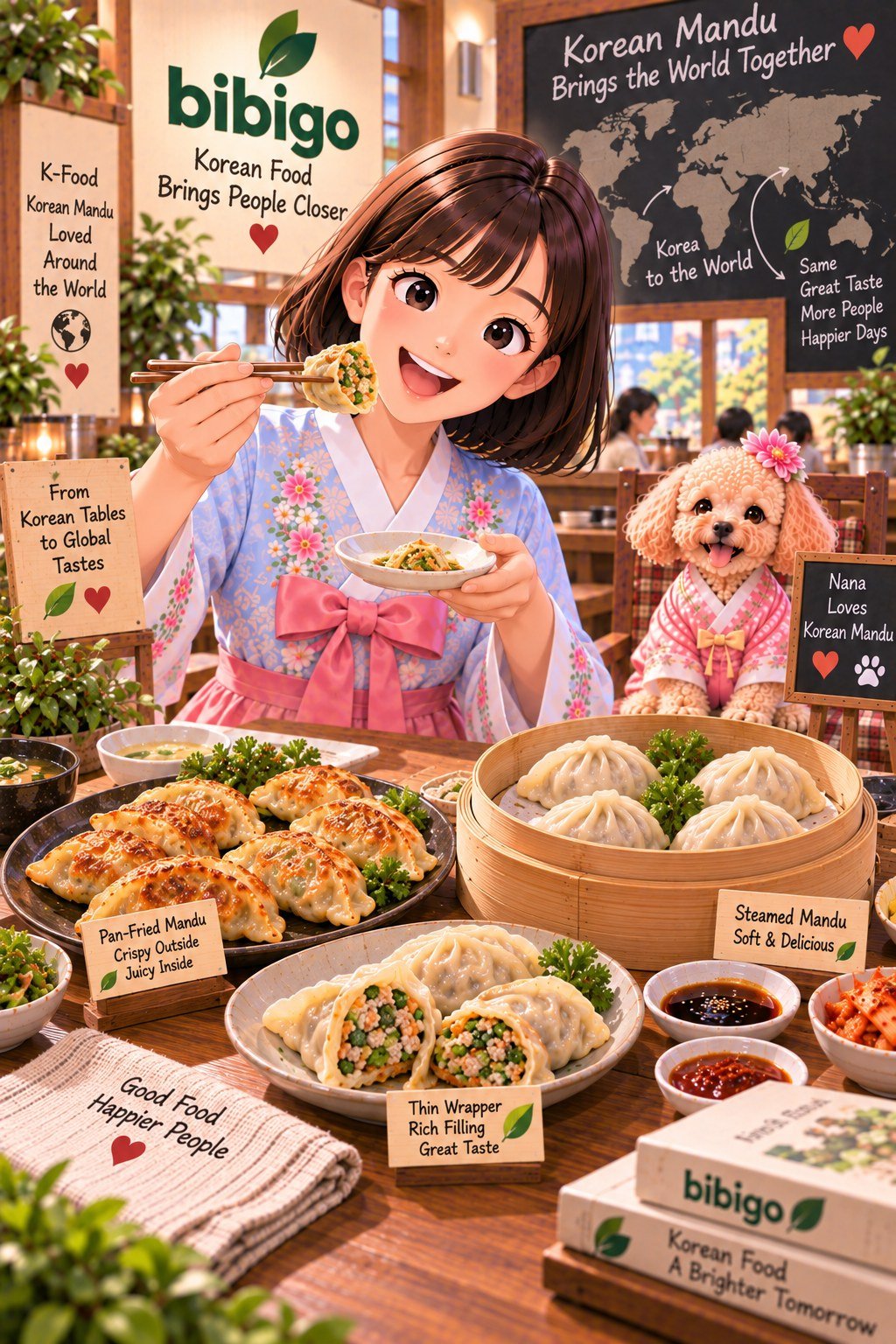
Comparing pan-fried and steamed Mandu highlights how cooking method changes the wrapper while the filling remains at the center of the experience.
Bibigo Mandu as a Global K-Food Case Study
Bibigo Mandu shows how a traditional Korean food category can move into modern international retail without replacing the broader culture from which it came.
Frozen distribution and convenient home preparation make Mandu accessible to consumers who may encounter Korean food first through a supermarket rather than a restaurant in Korea.
The most useful distinction is therefore simple: Mandu is the Korean food tradition, while Bibigo Mandu is one modern branded route through which that tradition reaches global consumers.
What to Expect When Buying Bibigo Mandu
Bibigo Mandu can appear in different product formats depending on the country, retailer, and current product lineup.
Consumers should check the exact product name, filling description, package size, ingredient list, allergen statement, nutrition information, storage directions, and cooking instructions on the package they are purchasing.
A Bibigo Mandu product seen online or in another country should not automatically be assumed to match the product available in a local store.
How to Choose a Bibigo Mandu Product
Start with the filling description because different products can contain substantially different ingredients.
Then check the wrapper, allergens, nutrition label, package size, storage requirements, and available cooking methods.
Consumers with dietary restrictions should use the current product label rather than relying only on the front-of-package name or photographs.
Why Bibigo Mandu Products Vary by Country
International food products can be adapted for different markets.
Local regulations, ingredient sourcing, manufacturing arrangements, retailer requirements, consumer preferences, and product portfolios can all influence what is sold in a particular country.
This means the Bibigo Mandu category should be understood as a family of products rather than one identical dumpling sold everywhere.
Global Mandu & Local Markets
A Korean food brand entering multiple countries must communicate with consumers who can have very different levels of familiarity with the word Mandu.
Using terms such as Korean dumplings can make the food category easier to understand while retaining Mandu as the Korean food name.
This combination of Korean identity and locally understandable labeling is one way K-Food can move into mainstream retail environments.
Bibigo Mandu & Frozen-Food Convenience
Frozen Mandu shifts much of the preparation work away from the consumer.
The dumplings arrive shaped and filled, allowing home cooking to focus primarily on storage, cooking method, and safe preparation.
This convenience can make Korean-style dumplings accessible for everyday meals, snacks, or shared dishes without requiring consumers to make Mandu from scratch.
Bibigo Mandu as a Snack
A smaller portion of cooked Mandu can function as a snack or side dish depending on the product, serving size, and meal.
Pan-fried Mandu can emphasize crisp texture, while steamed Mandu can provide a softer eating experience.
Serving size should be considered according to the actual product label and the rest of the meal rather than assuming one universal portion.
Bibigo Mandu as Part of a Meal
Mandu can also be combined with rice, noodles, soup, vegetables, kimchi, or other foods as part of a larger meal.
The filling and cooking method influence which combinations feel most natural.
Because individual Bibigo products differ, the role of Mandu in a meal can range from a small side dish to a more substantial component.
Bibigo Mandu & Korean Mandu Culture
Korean Mandu provides the cultural foundation needed to understand Bibigo Mandu.
Traditional Korean Mandu includes many shapes, fillings, regional forms, cooking methods, and serving contexts that extend far beyond one commercial brand.
Bibigo Mandu should therefore be understood as part of the modern global expansion of Korean Mandu rather than as a replacement for the wider tradition.
Bibigo Mandu vs. Homemade Mandu
Homemade Mandu allows the cook to choose and prepare the wrapper, filling, seasoning, shape, and cooking method directly.
Bibigo Mandu is manufactured, packaged, stored, and distributed as a commercial food product, so those decisions are made according to the specification of each product.
The difference is primarily one of production and convenience rather than evidence that only one form represents Korean Mandu.
Bibigo Mandu vs. Restaurant Mandu
Restaurant Mandu can be made in-house or sourced commercially depending on the business.
Restaurants can also serve Mandu steamed, pan-fried, boiled, in soup, or through other menu-specific preparations.
Bibigo Mandu is designed for packaged retail distribution, making its consumer experience different from ordering freshly prepared Mandu at a restaurant.
Bibigo Mandu vs. Gyoza
Mandu and Japanese gyoza belong to broader East Asian dumpling traditions but should not be treated as interchangeable names for one identical food.
Wrappers, fillings, seasoning, shapes, cooking methods, and cultural contexts can differ between Korean Mandu and Japanese gyoza.
Bibigo Mandu is marketed as Korean-style Mandu and should be understood within that Korean food context.
Bibigo Mandu & Kimchi
Kimchi provides an important connection between Mandu and one of Korea’s best-known fermented food traditions.
Kimchi can be eaten alongside Mandu, and some dumpling products can also use kimchi-related fillings depending on the specific product and market.
Consumers should check the package rather than assuming every Bibigo Mandu contains kimchi or that every kimchi-containing product uses the same ingredients.
Bibigo Mandu & Korean Ramyeon
Korean Ramyeon and frozen Mandu are both convenient ways international consumers can encounter Korean food at home.
Mandu can be served separately with noodles or added to certain soup and stew preparations when appropriate for the specific product.
The cooking instructions for the dumplings should still be followed rather than assuming that placing frozen Mandu into any noodle dish will cook it appropriately.
Bibigo Mandu & Budae Jjigae
Budae Jjigae provides another connection because mandu can appear as an optional sari in some versions of the stew.
The dumpling wrapper and filling add another texture and make an already substantial shared pot even more filling.
The specific dumpling used in a restaurant Budae Jjigae should not automatically be assumed to be a Bibigo product unless the restaurant identifies it as such.
Bibigo Mandu & Tteokbokki
Tteokbokki represents another Korean food category that has expanded internationally through restaurants, packaged products, and home cooking.
Cooked Mandu can also be paired with spicy Korean foods, creating a contrast between dumpling wrapper, filling, and chili-based sauce.
Specific combinations depend on personal preference and the cooking requirements of the Mandu product.
Bibigo Mandu & Gimbap
Gimbap provides another example of Korean food built around a filled structure, although its ingredients and construction are completely different from Mandu.
Gimbap wraps rice and fillings in seaweed, while Mandu encloses filling inside a dumpling wrapper.
Both demonstrate how Korean foods can combine several ingredients into convenient individual portions.
Bibigo Mandu & Korean Fried Chicken
Korean Fried Chicken provides another example of a Korean food category that has achieved broad international recognition.
The two foods expanded globally through different restaurant, retail, and packaged-food channels.
Together they illustrate that global K-Food growth is not limited to one cooking method or one type of dining experience.
Bibigo Mandu & Global Retail
Retail distribution changes how consumers first encounter Korean food.
A shopper can discover Mandu in a supermarket freezer without previously visiting Korea or eating at a Korean restaurant.
Packaging, cooking instructions, ingredient labels, and local availability therefore become important parts of the international K-Food experience.
Bibigo Mandu & the Growth of K-Food
Bibigo Mandu demonstrates how a familiar Korean food format can be adapted for international retail while retaining the Mandu name and Korean identity.
The scale of distribution also allows consumers in different countries to encounter Korean-style dumplings through ordinary grocery shopping.
At the same time, regional product differences mean that global reach should not be confused with complete product uniformity.
Bibigo Mandu in Europe
Bibigo has continued expanding its food business across European markets, including distribution of Korean food products in multiple countries.
European production and distribution expansion can reduce the distance between manufacturing and consumers while supporting a wider regional product presence.
The actual Bibigo Mandu assortment, recipes, package information, and availability still need to be checked in each country and at the time of purchase.
Why Brand Information Can Change
Commercial food portfolios change over time.
Products can be introduced, reformulated, renamed, resized, discontinued, or moved between manufacturing locations and markets.
For this reason, current official product information and the physical package should take priority over older online articles, videos, or social-media posts when checking a specific Bibigo Mandu.
Reading a Bibigo Mandu Package
Start with the exact product name and filling description.
Then check the ingredient list, allergen statement, nutrition information, net weight, storage requirements, cooking directions, and any market-specific labeling.
These details provide more reliable information about the purchased product than assumptions based on another Bibigo Mandu variety.
Ingredients & Product Formulation
Ingredients can differ substantially between Bibigo Mandu products.
Depending on the product, a filling can include meat, vegetables, tofu, noodles, seasonings, or other ingredients, while the wrapper has its own formulation.
The current ingredient list on the package should be used when a particular ingredient matters.
Nutrition Labels
Nutrition values depend on the specific product, serving size, recipe, and market labeling requirements.
Calories, sodium, protein, fat, carbohydrates, and other values should therefore not be generalized across all Bibigo Mandu.
Consumers comparing products should use equivalent serving sizes and the current nutrition panels for the exact products involved.
Sodium in Packaged Mandu
Sodium can come from the filling, seasoning, wrapper, sauces, or other components of a packaged Mandu product.
The amount varies by product and serving size.
People who monitor sodium intake for medical or dietary reasons should use the current nutrition label and follow guidance appropriate to their individual needs.
The Complete Bibigo Mandu Experience
Bibigo Mandu combines the familiar Korean wrapper-and-filling concept with frozen-food convenience and international retail distribution.
Different fillings, market-specific products, and cooking methods show how Korean Mandu can be adapted for a wide range of global consumers without becoming one completely standardized product.
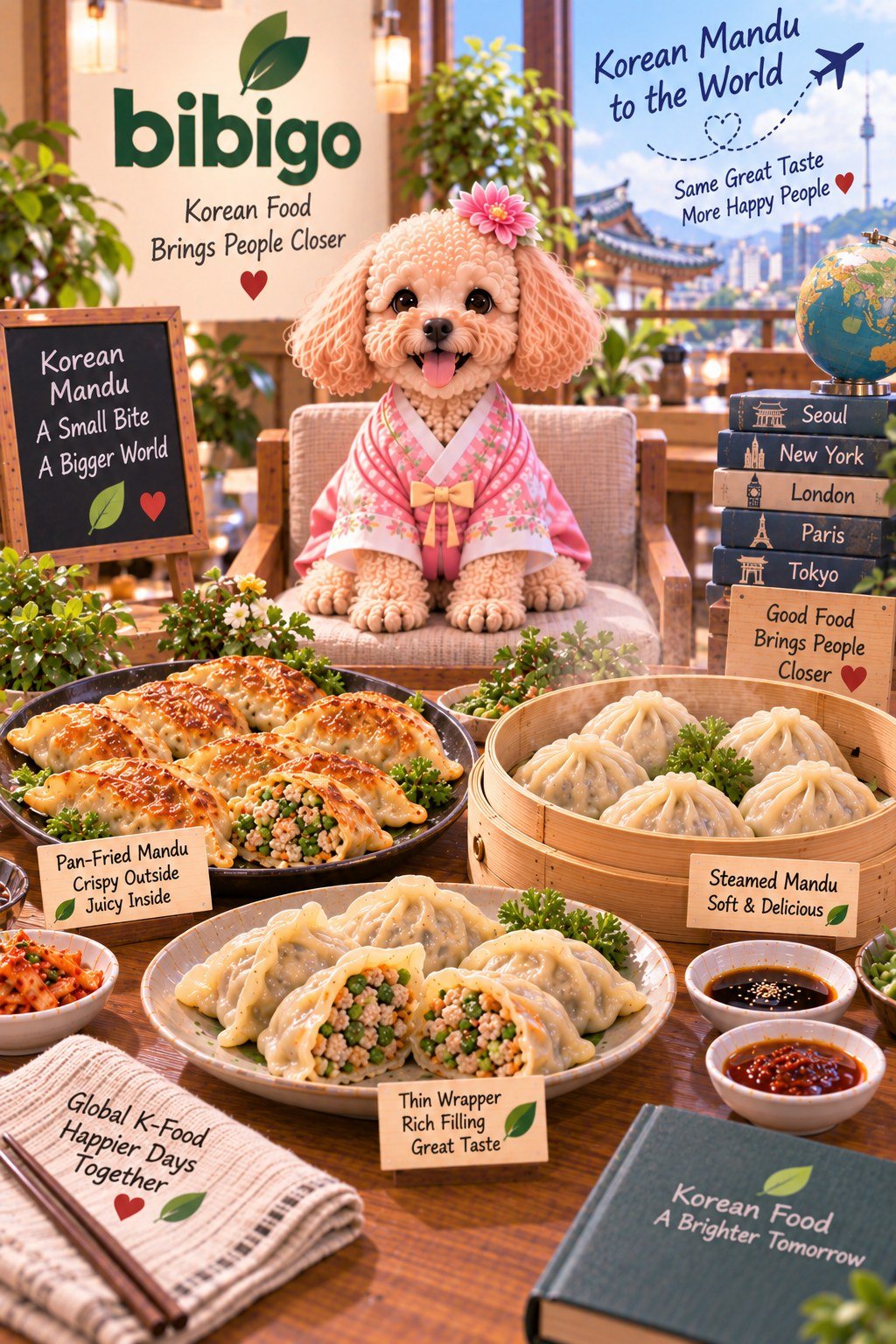
Bibigo Mandu illustrates how Korea’s Mandu tradition has entered modern frozen-food aisles and home kitchens around the world.
How Bibigo Mandu Connects with Other K-Food
Korean Mandu provides the essential cultural foundation and explains the broader dumpling tradition beyond one commercial brand.
Kimchi connects Mandu with Korean fermentation culture and can appear as an accompaniment or in product-dependent fillings.
Korean Ramyeon provides another globally accessible packaged K-Food category, while Budae Jjigae shows how mandu can function as sari in a shared Korean stew.
Tteokbokki, Gimbap, and Korean Fried Chicken expand the comparison into other internationally recognizable Korean food categories.
Bibigo Mandu & Korean Food Accessibility
Global retail allows consumers to encounter Korean food without beginning with an international trip or restaurant visit.
Frozen Mandu can be stored at home and prepared when needed according to the product instructions, making the category accessible in a different way from freshly made restaurant food.
This convenience is one reason packaged Mandu has become an important part of the international K-Food landscape.
Bibigo Mandu & the Wider Mandu Tradition
Bibigo’s international distribution can introduce new consumers to the word Mandu, but the broader Korean dumpling tradition remains much larger than the brand.
Regional recipes, homemade Mandu, market dumplings, restaurant preparations, soups, steamed versions, fried versions, and other forms continue to represent different parts of Korean Mandu culture.
Using the commercial product as an entry point and the wider Korean Mandu guide for cultural context provides a more complete understanding of the food.
FAQ
What is Bibigo Mandu?
Bibigo Mandu refers to Korean-style dumpling products sold under the Bibigo brand. They are a modern commercial expression of the broader Korean Mandu tradition and are distributed as convenient packaged products in international markets.
Is Bibigo Mandu the same as traditional Korean Mandu?
Bibigo Mandu belongs to the broader Korean Mandu category, but it should not be treated as representing every traditional Mandu recipe. Korean Mandu includes homemade, restaurant, market, regional, and commercial forms with many different fillings, wrappers, shapes, and cooking methods.
Are all Bibigo Mandu products the same worldwide?
No. Product names, fillings, wrapper formulations, package sizes, ingredients, allergens, nutrition information, manufacturing arrangements, and cooking directions can vary by product and market. Consumers should check the package for the specific product they purchase.
How do you cook Bibigo Mandu?
Cooking methods depend on the specific product. Some Mandu can be pan-fried, steamed, or prepared using other package-directed methods. The current cooking instructions on the actual product package should take priority over generic Mandu directions.
Can Bibigo Mandu contain meat?
Some products can contain meat, while other formulations can use different fillings. Meat type and other filling ingredients should not be assumed from the Bibigo or Mandu name alone. Check the ingredient list and product description on the specific package.
Does Bibigo Mandu contain wheat or soy?
Some Mandu products can contain wheat, soy, or other allergens in the wrapper, filling, seasoning, or other components. Formulations vary, so the allergen statement and ingredient list on the specific product should be checked.
What is the difference between Mandu and gyoza?
Mandu is part of the Korean dumpling tradition, while gyoza is associated with Japanese cuisine. Both belong to broader East Asian dumpling traditions, but wrappers, fillings, seasoning, shapes, cooking methods, and cultural contexts can differ.
What to Check Before Buying Bibigo Mandu
Start with the exact product name and filling description rather than relying only on the Bibigo brand name.
Check the ingredient list, allergen statement, nutrition panel, serving size, net weight, storage instructions, cooking directions, and any market-specific labeling.
If a product has been reformulated or differs from one sold in another country, the current physical package should take priority over older online information.
What to Check Before Cooking
Confirm whether the product should remain frozen until cooking and whether the package directs consumers to cook it from frozen or use another preparation method.
Check the recommended cooking appliance, time, temperature, and any instructions involving water, oil, steam, or resting time.
Do not automatically transfer cooking directions from one Bibigo Mandu product to another simply because the dumplings look similar.
Wheat & Gluten
Dumpling wrappers commonly use wheat-based ingredients, but formulations vary between products.
Wheat or gluten can also appear in filling ingredients, sauces, seasonings, or other components.
People who must strictly avoid wheat or gluten should check the current ingredient list, allergen statement, and relevant cross-contact information on the specific package.
Soy
Soy can appear in tofu, soy sauce, seasonings, filling ingredients, or other components of a Mandu product.
Its presence may not be visually obvious once the filling is enclosed inside the wrapper.
People with soy allergies should use the allergen statement and ingredient list for the exact product being prepared.
Sesame
Sesame seeds, sesame oil, or sesame-containing seasonings can appear in Korean dumpling products depending on the formulation.
Sesame oil can be mixed into a filling or seasoning and may not be visible in the cooked Mandu.
People with sesame allergies should confirm the specific product rather than assuming all Mandu have the same allergen profile.
Meat & Animal-Derived Ingredients
Bibigo Mandu fillings vary, and some products can contain pork, beef, chicken, or other animal-derived ingredients.
Broths, seasonings, sauces, or other components can also contain animal-derived ingredients even when they are not visually obvious.
People with religious, ethical, allergy-related, or other dietary requirements should check the complete ingredient information for the specific product.
Kimchi & Product-Dependent Ingredients
Kimchi can appear in some Mandu fillings, but it should not be assumed to be present in every Bibigo Mandu product.
Kimchi itself can contain fish sauce, fermented seafood, shrimp products, or other recipe-dependent seasonings.
Consumers who avoid particular ingredients should check both the Mandu ingredient list and allergen information rather than relying only on a filling name.
Vegetarian & Vegan Considerations
A filling that visibly contains vegetables should not automatically be assumed to be vegetarian or vegan.
Seasonings, sauces, broths, kimchi, flavoring ingredients, or other components can contain animal-derived ingredients.
Consumers following vegetarian or vegan diets should use the specific product labeling and relevant certification where available.
Sodium
Sodium levels vary according to the wrapper, filling, seasoning, sauces, serving size, and individual product formulation.
One Bibigo Mandu nutrition panel should not be used as the nutrition information for the entire product range.
People who monitor sodium intake for medical or dietary reasons should use the current nutrition label for the exact product and follow guidance appropriate to their individual needs.
Nutrition Information
Calories, protein, fat, carbohydrates, sodium, and other nutrition values vary between Bibigo Mandu products and serving sizes.
Market-specific labeling rules can also affect how nutrition information is presented.
When comparing products, use the current nutrition panels and equivalent serving quantities rather than comparing unrelated serving sizes.
Frozen Storage
Frozen Mandu should be stored according to the directions provided for the specific product.
Storage requirements, shelf life, handling after opening, and instructions concerning thawing can differ between products and markets.
The package and manufacturer guidance should therefore be followed rather than assuming one storage rule applies to every frozen dumpling.
Cooking Mandu Thoroughly
Frozen Mandu should be prepared according to the cooking directions and food-safety information provided for the specific product.
The wrapper can brown or soften before the enclosed filling reaches the appropriate condition throughout.
Exterior appearance alone should therefore not replace the cooking instructions provided for the product.
Hot Filling & Steam
Freshly cooked Mandu can remain extremely hot inside even when the exterior appears ready to eat.
Moisture and steam can remain trapped inside the wrapper around the filling.
Allow cooked Mandu to cool to a comfortable temperature before taking a large bite.
Pan-Frying Safety
Pan-frying can involve hot cookware, oil, water, and steam.
Adding frozen food to a hot pan can create splashing or steam depending on the cooking method.
Follow the specific product directions and use appropriate care around hot pans, oil, handles, and cooking surfaces.
Steaming Safety
Steam can cause burns even when the dumplings themselves are not touching an exposed flame.
Open steamer lids carefully and avoid placing hands or the face directly above escaping steam.
Children and pets should remain appropriately separated from active steaming equipment and hot food.
Cross-Contact & Shared Equipment
Commercial manufacturing and home preparation can involve equipment or surfaces used with multiple ingredients.
People with serious food allergies should review the product’s allergen and cross-contact information and consider shared cookware, utensils, sauces, and preparation surfaces at home.
Ingredient and facility information can change if a product is reformulated or manufacturing arrangements change.
Sauces & Additional Allergens
Dipping sauces can add soy, wheat, sesame, sodium, chili, or other ingredients that are separate from the Mandu itself.
A Mandu product that meets a particular dietary requirement does not automatically mean every sauce served with it meets the same requirement.
Check sauces and condiments separately when allergens or other dietary restrictions matter.
Leftovers
Cooked Mandu that will be kept for later requires appropriate food handling.
Storage time, refrigeration, reheating, and other requirements depend on the product and applicable food-safety guidance.
Follow relevant package or manufacturer instructions where available and avoid treating previously cooked Mandu as shelf-stable food.
Reheating Bibigo Mandu
Reheating can change the wrapper texture, particularly when comparing originally pan-fried and steamed Mandu.
Previously cooked Mandu should be handled and reheated appropriately when reheating is required under applicable food-safety guidance.
The filling can again become much hotter than the exterior, so allow reheated Mandu to cool sufficiently before eating.
Image Credits
Bibigo Mandu global K-Food family visual with Dad, Mom, K-Nana daughter, and Nana in hanbok enjoying pan-fried and steamed Korean-style Mandu — K-Nana Studio original visual.
Korean Mandu structure visual with Mom in hanbok demonstrating dumpling wrappers and filling ingredients as a general educational representation while Nana watches from a separate safe seat — K-Nana Studio original visual.
Korean Mandu cooking visual with Dad in hanbok safely preparing pan-fried and steamed dumplings while Nana remains separated from the hot pan, steamer, oil, and cooking area — K-Nana Studio original visual.
Bibigo Mandu tasting visual with K-Nana daughter in hanbok comparing fully cooked pan-fried and steamed Korean-style Mandu while Nana sits separately without touching the food — K-Nana Studio original visual.
Nana in pink floral hanbok seated separately as a K-Food mascot beside pan-fried and steamed Korean-style Mandu with visible wrappers and fillings in a global K-Food setting — K-Nana Studio original visual.
Disclaimer
This article is provided for general food, cultural, brand, and product information and is not an advertisement or product endorsement. Bibigo Mandu product names, availability, fillings, wrappers, ingredients, allergens, nutrition information, serving sizes, package sizes, manufacturing locations, storage requirements, and cooking instructions can vary by product, country, retailer, and time and can change through reformulation or product updates. References to Bibigo describe the brand and product category for informational purposes. Consumers should use the current official product information and physical package for the exact product they purchase. Mandu products can contain wheat, gluten, soy, sesame, meat, seafood-derived ingredients, dairy, or other product-dependent allergens, and shared manufacturing or preparation environments can create cross-contact risks. Frozen Mandu should be stored and cooked according to the specific product directions. Hot filling, steam, oil, pans, and cooking equipment can cause burns. People with allergies, medical conditions, religious dietary restrictions, or other individual requirements should confirm the current ingredients and preparation information for the specific product and follow appropriate professional guidance when necessary.