
Seopjikoji is a scenic coastal headland on the eastern side of Jeju Island, where open grasslands meet black volcanic cliffs and the blue sea. Walking paths follow the coastline through green fields, seasonal flowers, rocky viewpoints, and exposed coastal scenery, creating a landscape that feels very different from Jeju’s beaches and mountain trails.
For international visitors, Seopjikoji offers an accessible way to experience several of Jeju’s most recognizable natural elements in one place. Volcanic rock, ocean views, grasslands, coastal wind, walking trails, and views toward the wider Seongsan area come together along a relatively compact stretch of coastline.
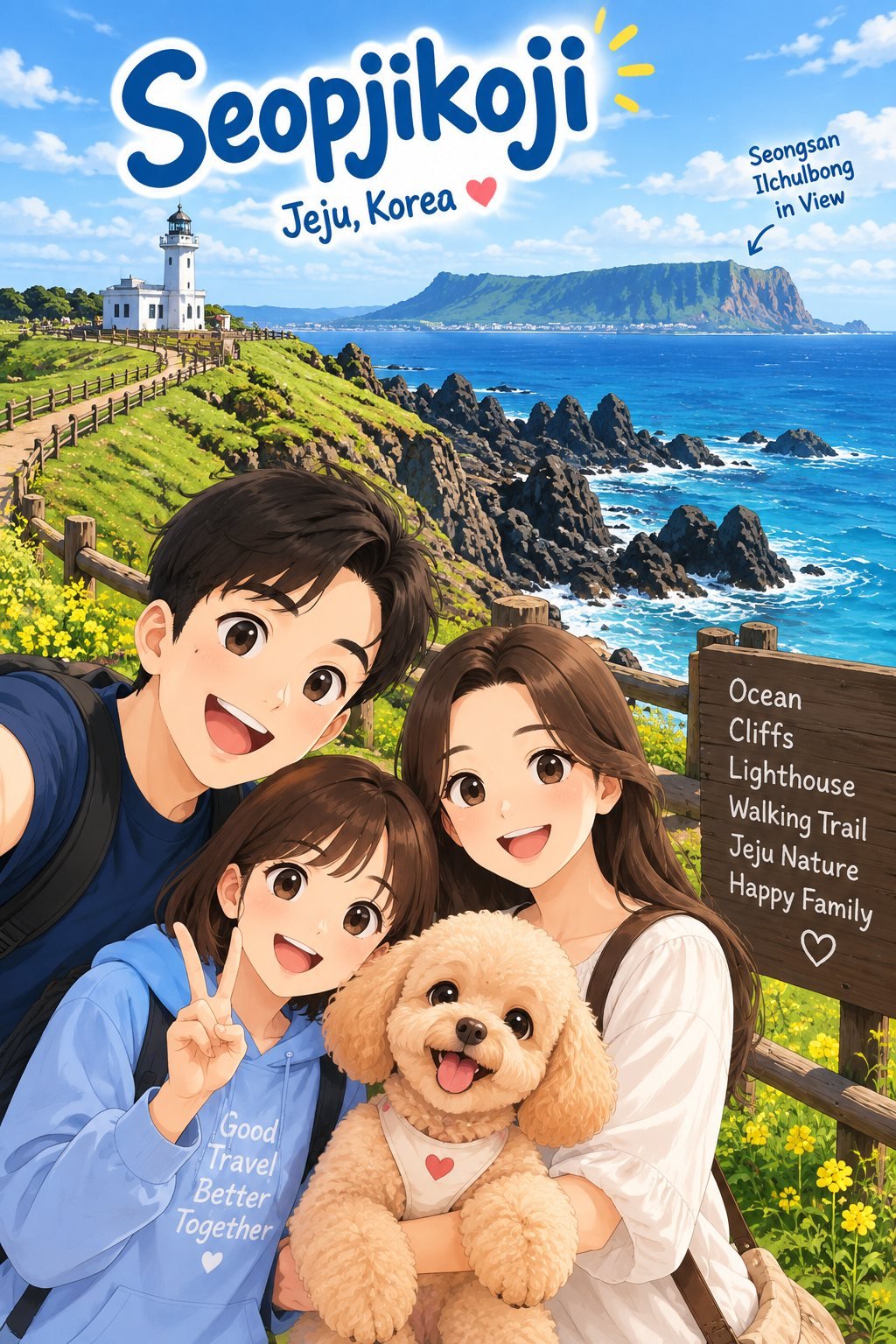
Green fields, volcanic cliffs, walking paths, and the blue sea come together in Seopjikoji’s distinctive coastal landscape.
Quick Guide
| Location | Eastern Jeju Island |
| Best for | Coastal walks, volcanic scenery, ocean views, photography, grasslands, seasonal landscapes |
| Recommended time | About 1.5–3 hours |
| Main experience | Walking through open grasslands and volcanic coastal scenery |
| Terrain | Walking paths, gentle slopes, grassland areas, and coastal viewpoints |
| Good to combine with | Seongsan Ilchulbong, Udo Island, and other eastern Jeju destinations |
What Is Seopjikoji?
Seopjikoji is a coastal headland characterized by open grasslands, volcanic rock formations, cliffs, walking paths, and expansive ocean views. Its exposed position beside the sea gives the landscape a strong sense of openness, and its appearance changes noticeably with weather, season, vegetation, and light.
Unlike a destination centered on a single monument or observation deck, Seopjikoji is best experienced by walking through the landscape. Visitors encounter different combinations of grassland, flowers, volcanic rocks, cliffs, ocean views, and elevated viewpoints as they move along the coast.
Its location also creates a natural connection with the wider Seongsan area. On clear days, Seongsan Ilchulbong can become part of the distant coastal panorama, giving visitors another perspective on one of eastern Jeju’s best-known volcanic landscapes.
Coastal Landscape
One of Seopjikoji’s strongest visual features is the contrast between land and sea. Green grasslands extend toward sections of dark volcanic coastline, while waves break against irregular rock formations below the cliffs.
The open terrain feels very different from the forested environment of Hallasan National Park or the beach-centered atmosphere of Hamdeok Beach. Here, the main attraction is the uninterrupted relationship between grassland, volcanic rock, cliffs, sky, and ocean.
Wind is also an important part of the experience. Conditions can become noticeably stronger along exposed sections of the coast, and rain or strong wind can make walking less comfortable.
Why Visit?
- Walk through one of eastern Jeju’s most distinctive coastal landscapes.
- See green grasslands beside black volcanic cliffs and blue ocean.
- Enjoy wide coastal views without completing a demanding mountain hike.
- Experience seasonal flowers and changing vegetation along the walking route.
- Photograph volcanic rocks, cliffs, grasslands, walking paths, and ocean scenery.
- See Seongsan Ilchulbong from another perspective when visibility is favorable.
- Combine Seopjikoji naturally with Udo Island and other eastern Jeju destinations.
Coastal Walking Trail
Walking is the best way to experience Seopjikoji because the scenery changes continuously along the coast. The route moves through open terrain where visitors can alternate between views of grasslands, volcanic cliffs, flowers, ocean, and distant landmarks.
The experience is more about enjoying the landscape than moving quickly between individual attractions. Stopping at viewpoints and looking back along the route often reveals new perspectives across the cliffs and sea.
Comfortable shoes are useful because walking surfaces and slopes can vary. Strong wind, rain, summer heat, and wet paths can also affect conditions, so visitors should adjust their route and walking time according to the weather.

Seopjikoji’s coastal trail connects open grasslands, volcanic cliffs, ocean views, and changing seasonal scenery.
Grasslands & Wildflowers
Seopjikoji’s open grasslands soften the dramatic volcanic coastline and create some of the area’s most peaceful scenery. Depending on the season, green fields and flowering plants can add bright colors between the walking paths, dark rocks, and blue sea.
The landscape is especially attractive because the vegetation does not feel separated from the coastline. Grasslands extend toward the cliffs, while the ocean remains visible from many parts of the walking route.
Seasonal conditions can change the appearance of the fields considerably. Visitors should enjoy flowers and vegetation from designated paths and avoid entering protected areas simply for photographs.
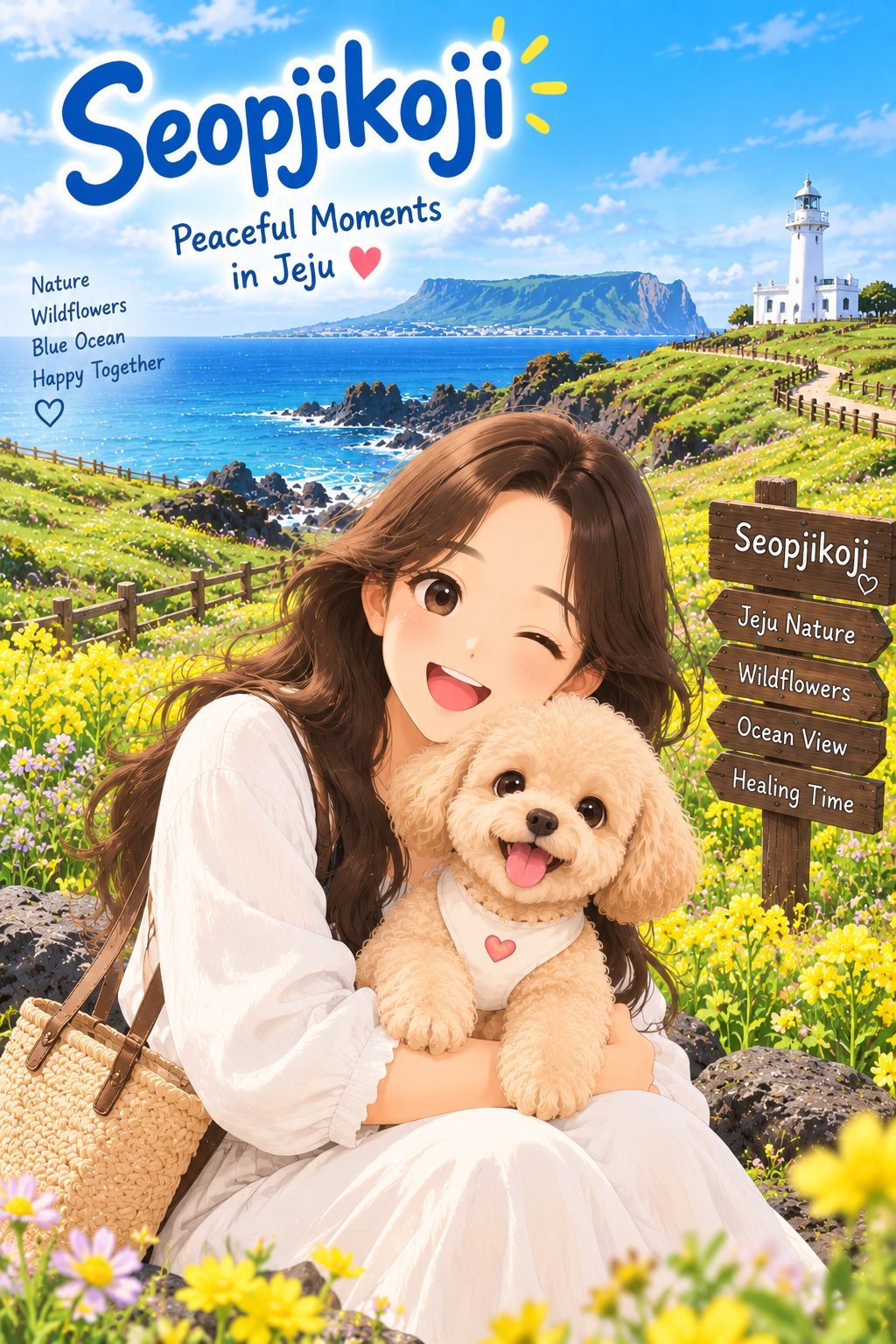
Grasslands, seasonal flowers, volcanic rock, and the open sea create a peaceful side of Seopjikoji’s coastal landscape.
Volcanic Coast
Dark volcanic rocks along the shoreline provide a strong reminder of Jeju’s geological origins. Waves breaking against the irregular formations create a dramatic contrast with the green slopes above and the blue water beyond.
These coastal formations also connect Seopjikoji visually with other volcanic landscapes across the island. However, unlike the summit experience at Seongsan Ilchulbong or the mountain environment of Hallasan National Park, Seopjikoji allows visitors to experience volcanic scenery directly beside the sea.
Visitors should remain behind barriers and use designated viewpoints. Wet rocks, strong waves, wind, and uneven coastal surfaces can create hazards close to the shoreline.
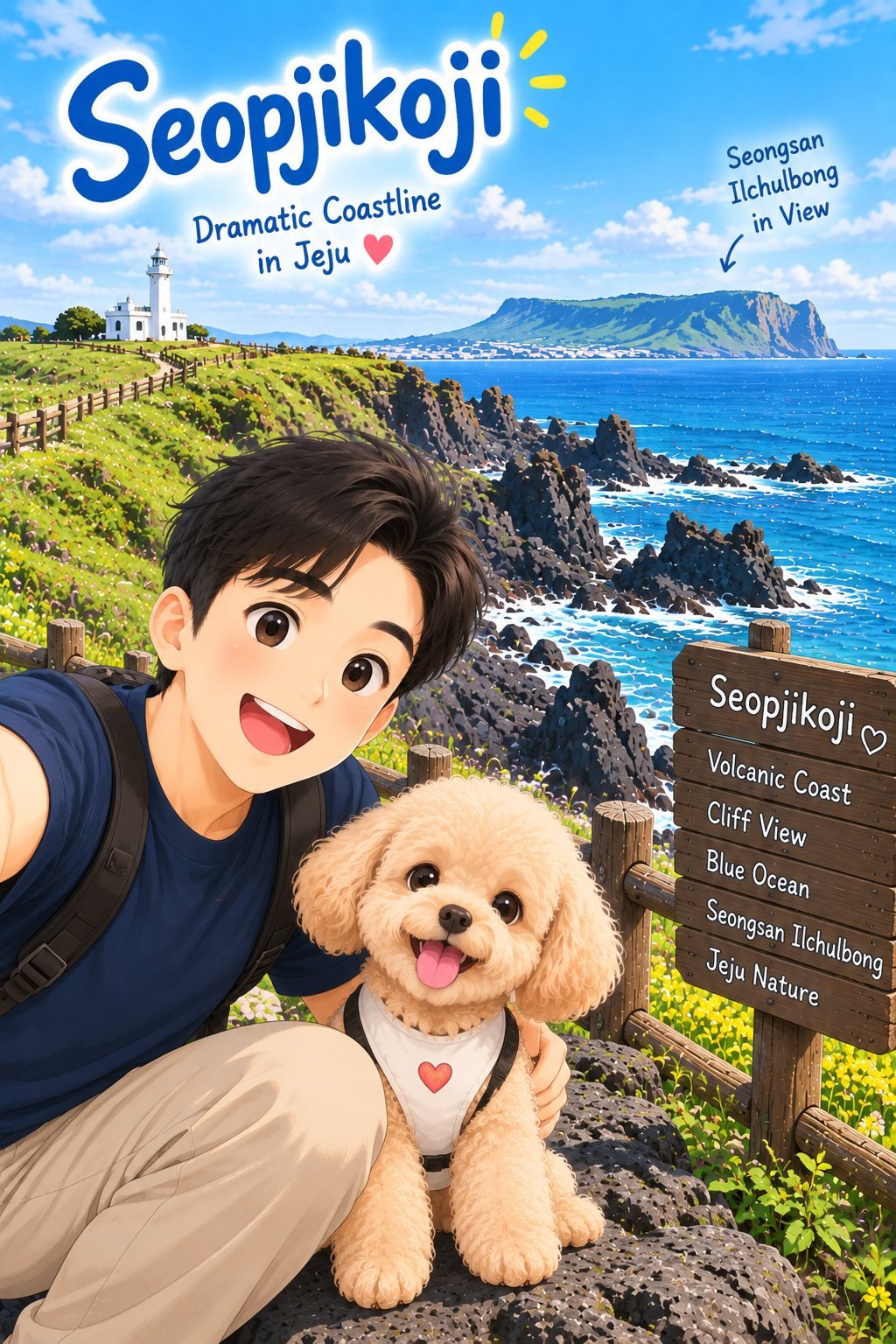
Black volcanic cliffs, blue water, and distant Seongsan Ilchulbong create one of Seopjikoji’s most dramatic coastal views.
Views toward Seongsan Ilchulbong
One of the most interesting visual connections at Seopjikoji is the view toward Seongsan Ilchulbong when weather and visibility are favorable.
From Seopjikoji, visitors see the famous volcanic landmark as part of a much wider coastal panorama rather than from its own summit or base. The foreground of grasslands, volcanic cliffs, and ocean gives Seongsan Ilchulbong a completely different context.
This makes the two destinations complementary rather than repetitive. Seongsan Ilchulbong provides the experience of climbing and exploring the volcanic formation itself, while Seopjikoji provides a coastal walking experience with the landmark appearing in the surrounding landscape.
Photography at Seopjikoji
Seopjikoji is especially well suited to landscape photography because several different visual elements can appear within the same frame. Green fields, seasonal flowers, wooden paths, black volcanic cliffs, blue water, open sky, and distant landmarks create many possible compositions.
Wide-angle views work well along the coastline, while closer photographs can focus on flowers, volcanic textures, waves, fences, and details along the walking route.
Clear weather can produce vivid blue ocean views, but clouds and changing light can also create a more dramatic atmosphere. Morning and late afternoon often provide softer light than the middle of a bright day.
Strong coastal wind can affect cameras, phones, hats, and other belongings. Visitors should remain on designated paths and behind safety barriers rather than moving toward exposed cliffs or unstable rocks for a photograph.
Seopjikoji at Sunset
Late afternoon brings warmer colors to Seopjikoji as the strong daytime light gradually softens across the grasslands, volcanic cliffs, and sea. The changing light can create a very different atmosphere from the bright blue coastal scenery seen earlier in the day.
Depending on season, weather, clouds, and viewing position, sunset colors may spread across the sky and reflect on the water while the coastline and distant landmarks become darker silhouettes.
Visitors remaining into the evening should consider coastal wind, falling temperatures, transportation, and reduced visibility along walking paths. Sunset conditions are never guaranteed, so check the weather and sunset time before planning a visit specifically for evening scenery.

Warm evening light transforms Seopjikoji’s lighthouse, grasslands, volcanic cliffs, and ocean into a different coastal landscape.
Best Time to Visit
Seopjikoji can be visited throughout the year, but its open coastal landscape changes significantly with season and weather. Spring can bring fresh vegetation and seasonal flowers, summer provides vivid green fields and bright ocean colors, while autumn and winter create a quieter and more exposed coastal atmosphere.
Spring and autumn are comfortable periods for many visitors who want to focus on walking. Summer can be hot and sunny, while winter may bring colder temperatures and stronger coastal wind.
Morning and late afternoon are useful for photography because the light can be softer. However, clear visibility is especially valuable if seeing Seongsan Ilchulbong across the surrounding coastline is important to your visit.
How Long to Spend
About 1.5–3 hours works well for many first-time visitors who want to follow the main walking areas, stop at coastal viewpoints, enjoy the grasslands, and take photographs without rushing.
A shorter visit can focus on a few major viewpoints, while visitors interested in photography, seasonal flowers, slower walking, or sunset may want additional time.
Walking time can also vary according to wind, heat, rain, crowd levels, and how frequently you stop along the coast.
Getting to Seopjikoji
Seopjikoji is located on the eastern side of Jeju Island and fits naturally into an itinerary focused on the wider Seongsan area.
Visitors may travel by rental vehicle, taxi, public transportation, or another suitable option depending on their starting point and wider itinerary. Travel time can vary considerably because Jeju is larger than many first-time visitors expect.
Bus routes, schedules, parking arrangements, road access, and transportation conditions can change. Check a current navigation or transit service on the day of your visit rather than relying only on an older route description.
First-Time Visitor Tips
- Wear comfortable shoes suitable for walking paths and gentle slopes.
- Check the weather because Seopjikoji is exposed to coastal wind.
- Bring sun protection and water during warmer months.
- Allow extra time if photography or seasonal flowers are important to your visit.
- Stay on designated walking routes and respect conservation barriers.
- Keep away from unsafe cliff edges and slippery volcanic rocks.
- Check visibility if views toward Seongsan Ilchulbong are a priority.
- Check sunset time and transportation options before remaining into the evening.
What to Do Nearby
- Seongsan Ilchulbong — explore a famous volcanic crater, summit viewpoints, UNESCO natural heritage, and sunrise scenery.
- Udo Island — experience beaches, turquoise water, volcanic shoreline, coastal roads, fields, and small island villages.
- Seongsan coastal area — combine harbor scenery, cafés, restaurants, local streets, and ocean views with an eastern Jeju itinerary.
- Hamdeok Beach — enjoy turquoise water, beach walks, coastal cafés, and views from Seoubong.
- Hallasan National Park — experience Jeju’s mountainous interior through forests, volcanic terrain, hiking trails, and seasonal scenery.
Jeju K-Culture Connection
Seopjikoji shows how strongly Jeju’s identity is connected with volcanic land and the sea. Grasslands, dark volcanic rock, coastal wind, walking paths, and open ocean views create a landscape that feels distinctly different from Korea’s major urban destinations.
For international visitors, the experience also demonstrates that Jeju does not need a large attraction or entertainment complex to create a memorable journey. Simply walking through the landscape allows travelers to experience the island’s geology, seasonal nature, coastline, and slower outdoor rhythm.
Seopjikoji now forms part of a wider K-Nana Studio Jeju journey. Travelers can connect it with Seongsan Ilchulbong for volcanic heritage, Udo Island for island landscapes, Hallasan National Park for mountain scenery, Hamdeok Beach for turquoise water and beach culture, Jeongbang Waterfall for waterfall-and-ocean scenery, and Seogwipo Maeil Olle Market for local food and everyday market culture.
FAQ
What is Seopjikoji known for?
Seopjikoji is known for its open grasslands, black volcanic cliffs, coastal walking paths, ocean views, seasonal flowers, and dramatic eastern Jeju scenery. On clear days, visitors can also enjoy views toward Seongsan Ilchulbong from parts of the coastline.
How long should I spend at Seopjikoji?
About 1.5–3 hours works well for many first-time visitors. This allows time to walk through the main coastal areas, stop at viewpoints, enjoy the grasslands, and take photographs without rushing.
Is Seopjikoji difficult to walk around?
Seopjikoji is primarily a coastal walking destination rather than a demanding mountain hike. However, walking surfaces, slopes, wind, rain, heat, and other weather conditions can affect the difficulty, so comfortable shoes are recommended.
Can I see Seongsan Ilchulbong from Seopjikoji?
Yes. Seongsan Ilchulbong can become part of the wider coastal panorama when weather and visibility are favorable. This provides a different perspective from visiting the volcanic landmark itself.
When is the best time to visit Seopjikoji?
Seopjikoji can be visited throughout the year. Spring and autumn are comfortable for walking, while summer brings vivid green landscapes and bright coastal colors. Morning and late afternoon can provide softer light for photography, but weather and visibility can significantly affect the experience.
Can I visit Seopjikoji and Seongsan Ilchulbong on the same day?
Yes. Seopjikoji and Seongsan Ilchulbong fit naturally into the same eastern Jeju itinerary. Visitors can also consider Udo Island, although ferry schedules and travel time should be considered when combining several destinations.
Related K-Nana Guides
Continue exploring Jeju with Seongsan Ilchulbong for volcanic scenery and sunrise, Udo Island for turquoise water and island landscapes, Hallasan National Park for mountain hiking and Baengnokdam, Hamdeok Beach for turquoise water and coastal cafés, Jeongbang Waterfall for waterfall and ocean scenery, and Seogwipo Maeil Olle Market for street food, seafood, local products, and everyday Jeju market culture.
Official Information
Seopjikoji is an outdoor coastal destination where walking conditions, access, parking, transportation, facilities, individual businesses, and visitor services can change. Strong wind, rain, heat, seasonal weather, maintenance, safety restrictions, and local management may also affect particular walking areas or viewpoints. Check current official information when a specific route, facility, transportation option, or seasonal experience is important to your visit, and always follow posted signs, designated walking paths, conservation barriers, and coastal safety guidance.
Image Credits
Seopjikoji grasslands, volcanic cliffs, blue ocean, and Jeju family travel visual — K-Nana Studio original visual.
Seopjikoji coastal walking trail and lighthouse scenery with K-Nana daughter and Nana visual — K-Nana Studio original visual.
Seopjikoji grasslands, wildflowers, and coastal nature with Mom and Nana visual — K-Nana Studio original visual.
Seopjikoji volcanic coastline and views toward Seongsan Ilchulbong with Dad and Nana visual — K-Nana Studio original visual.
Nana enjoying Seopjikoji sunset, lighthouse, volcanic cliffs, and ocean scenery visual — K-Nana Studio original visual.