
Introduction to Korean Facial Cleansers
A Korean facial cleanser is often the water-based cleansing step in a skincare routine. This guide focuses on foam, gel, and cream formats, including how their textures and labels differ without assuming that one format is automatically better.
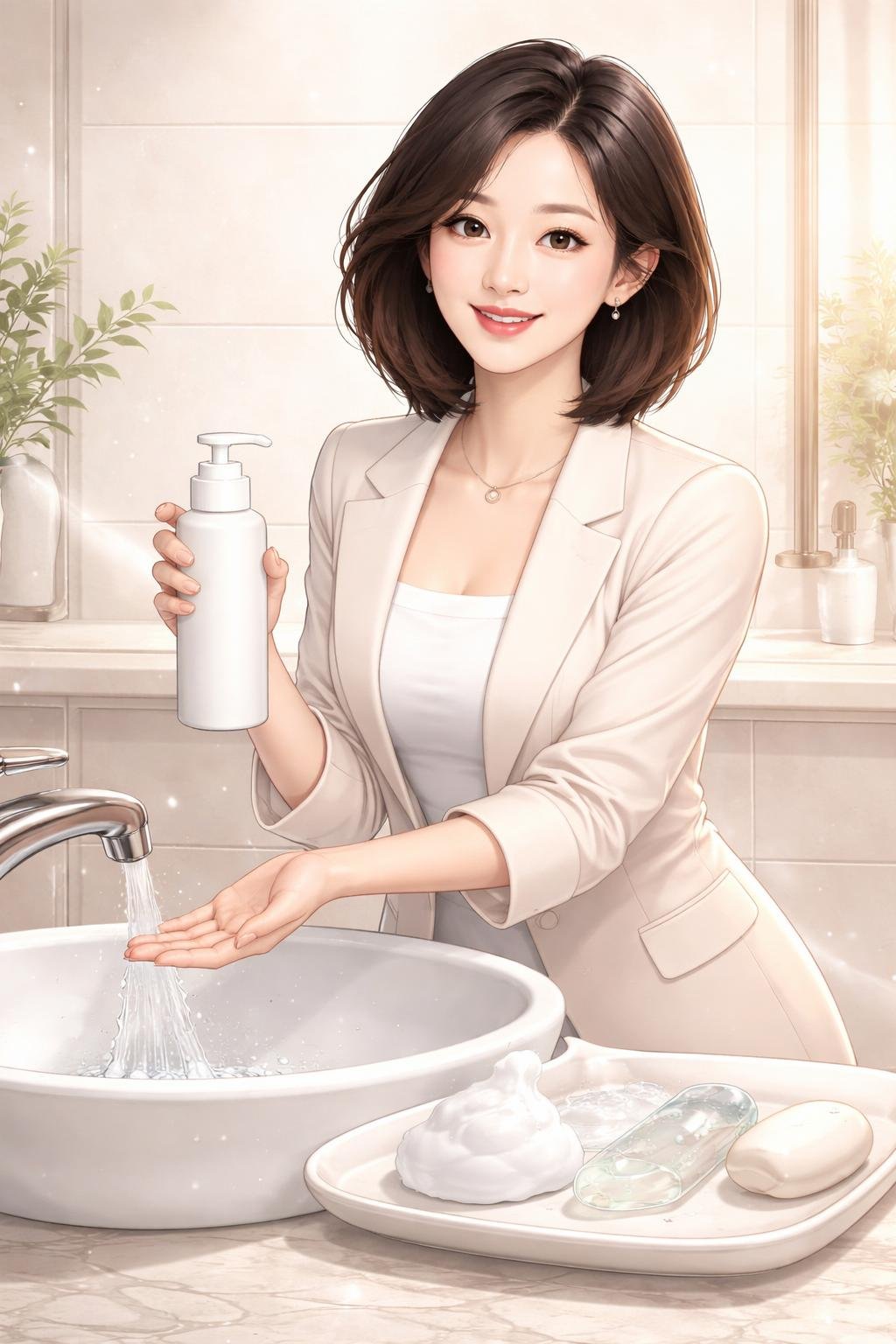
You will learn what cleanser pH means, how to compare formulas, how to use a cleanser safely, and where water-based cleansing may fit into a routine. Educational visual 01 introduces the core concept by showing water-based cleanser formats alongside water, a product label, and a simple cleansing sequence.
Quick Guide
- Product category: A water-based facial cleanser is designed to be used with water according to its directions and then rinsed from the skin.
- Formats: Foam, gel, and cream describe aspects of a cleanser’s texture, dispensing method, or presentation. They do not prove how gentle or effective the complete formula will be.
- pH: A labeled pH provides information about a particular formula. It should be considered together with the full ingredient list, directions, warnings, and personal response.
- Selection: Compare current labels, fragrance preferences, packaging, directions, and how your skin responds rather than choosing by format alone.
- Use: Begin with clean hands, follow the label, apply gently, rinse thoroughly, and stop using the product if an unexpected reaction occurs.
What Is a Korean Water-Based Facial Cleanser?
A water-based facial cleanser is a rinse-off cosmetic used to remove material such as everyday surface residue from the face. Water is commonly a major part of the formula, and the product contains cleansing agents that help the cleanser mix with material that can then be rinsed away.
“Water-based cleanser” identifies a broad product category. “Foam,” “gel,” and “cream” are format or texture descriptions within that category. A cleanser may dispense as ready-made foam, begin as a gel that lathers during use, or have an opaque, cream-like consistency.
Korean origin does not by itself establish that a cleanser is gentle, suitable, or high-performing. Products from Korea vary in formulation and directions just as products from other markets do. International shoppers should assess the current formula, label, warnings, and official manufacturer information for the specific product under consideration.
Foam, Gel, and Cream Cleansers: Formulas and Ingredients

| Format label | What it may describe | What it does not prove |
|---|---|---|
| Foam | A formula that dispenses as foam or produces noticeable bubbles during use. | It does not automatically prove stronger cleansing, dryness, or gentleness. |
| Gel | A clear, translucent, or gel-textured product that may produce little or substantial lather. | It does not guarantee suitability for oily, dry, or sensitive skin. |
| Cream | An opaque or cream-like rinse-off texture. | It does not guarantee moisturization or freedom from irritation. |
The complete formula matters more than texture alone. Water can act as the formula’s main base. Humectants, such as glycerin, are ingredients used to attract and hold water within a cosmetic formula. Cleansing agents help water interact with material that otherwise does not rinse away easily. Other ingredients may support texture, formula stability, preservation, pH adjustment, or the intended sensory experience.
Verified product example: The official ETUDE page describes Soonjung pH 6.5 Whip Cleanser as a water-based face wash with a whipped-cream texture and weakly acidic bubbles. Its listed ingredients include water; glycerin, sorbitol, and propanediol; the cleansing agents lauryl glucoside and disodium cocoyl glutamate; and ingredients including panthenol, citric acid, madecassoside, tocopherol, and green tea leaf extract.
This ETUDE cleanser is an example of how one manufacturer presents a foam cleanser and its ingredients. It is not a universal model for Korean cleansers, and its ingredient list should not be applied to other foam, gel, or cream products. Educational visual 02 compares the three formats and groups example ingredients by formulation role without presenting a fictional package as a real product.
What Cleanser pH Means
pH is a measurement used to describe how acidic or alkaline a water-containing solution is. A pH of 7 is neutral; values below 7 are acidic, while values above 7 are alkaline. On a cleanser label, a stated pH refers to that particular formulation or the manufacturer’s stated specification.
The official product name Soonjung pH 6.5 Whip Cleanser provides a verified example of a manufacturer using pH in a cleanser label. ETUDE also describes the product’s bubbles as weakly acidic.
A pH number should not be interpreted as a stand-alone guarantee. A lower-pH label does not prove that a cleanser will be gentle, moisturizing, or suitable for every person. Cleansing agents, fragrance components, other ingredients, amount used, frequency, contact time, and individual response also matter.
How to Use a Water-Based Facial Cleanser

- Wash your hands. Clean hands reduce the chance of transferring unwanted material to the face or product container.
- Read the directions. Check whether the manufacturer instructs you to wet the face first, how much product to use, and whether any special precautions apply.
- Use the cleanser with water as directed. Dispense an appropriate amount and add water if the label calls for it.
- Apply gently. Spread the cleanser without aggressive rubbing. Keep it away from areas excluded by the product directions, such as direct eye contact.
- Rinse thoroughly. Remove the cleanser with water and avoid leaving unintended residue.
- Continue the routine as needed. After cleansing, use any leave-on skincare in the order appropriate for those products and their directions.
A water-based cleanser can be the only cleansing step. In routines that use an oil-based first cleanser to remove makeup or other oil-soluble material, the water-based cleanser may be used afterward. This sequence is commonly called double cleansing, but it is optional rather than a requirement.
Frequency depends on the product directions, personal routine, environment, other products, and skin response. Using a cleanser more often is not automatically better. Common avoidable mistakes include scrubbing aggressively, using water at an uncomfortable temperature, applying more product than directed, and ignoring warnings or signs of an unexpected reaction.
Educational visual 03 illustrates clean hands, label reading, gentle application, thorough rinsing, and optional routine placement without promising a particular result.
How to Choose a Cleanser and Use It Safely

Begin by choosing a format you can use comfortably, but do not stop at the words foam, gel, or cream. Read the full ingredient list, directions, warnings, and manufacturer description. Check whether fragrance or other personally relevant ingredients are listed, especially if you already know that you prefer to avoid them.
Consider practical details such as how the container dispenses the formula and how the product should be stored. The FDA advises cosmetic users to read the full label, including ingredients, directions, and warnings; wash their hands before use; keep containers clean and tightly closed; and protect cosmetics from extreme temperatures. A product whose color or smell has changed should be discarded.
Marketing terms require context. According to the FDA guidance, “hypoallergenic” does not guarantee that a product will not cause an allergic reaction. “Natural” and “organic” do not necessarily mean safer. These terms should not replace careful label reading or attention to individual response.
Stop using a cleanser if it causes redness, burning, rash, or another unexpected reaction. The FDA advises contacting a healthcare provider after such a reaction. Significant, persistent, or worsening concerns also require guidance from an appropriate healthcare professional rather than self-diagnosis based on a product label.
Educational visual 04 presents a label-check checklist covering the ingredient list, directions, warnings, storage, container condition, and changes in color or smell.
Water-Based Cleansers in Korean Beauty Routines
Water-based cleansers often appear in Korean beauty discussions as a basic cleansing step or as the second part of double cleansing. However, double cleansing and extended multi-step routines are not mandatory or universal. A routine can be simpler when that better suits the user’s products, preferences, and skin response.
Korean beauty shopping language may emphasize texture, foam quality, pH, or particular featured ingredients. These details can help narrow the options, but broad claims about all Korean products are unreliable. Formulas vary among products and can change over time.
International shoppers should check the current packaging and official manufacturer information available for their market. A retailer summary, older ingredient list, or social media description may not reflect the current formula or directions.
K-Nana Beauty Guide
Fictional guide: Nana is a fictional female beauty guide used only to demonstrate a careful comparison process. She is not providing a personal review, test result, or effectiveness claim.
Scenario 1: Comparing format labels
Nana places a foam, gel, and cream cleanser on a comparison list. Instead of assuming that foam is strongest or cream is mildest, she checks each product’s complete ingredient list, directions, warnings, and fragrance information.
Scenario 2: Checking a pH statement
One label states a particular pH. Nana records that number as information about that formula, but she does not treat it as a guarantee of gentleness or suitability. She compares it with the rest of the label and the manufacturer’s directions.
Scenario 3: Planning use
Nana reads whether the face should be wet before application and how the cleanser should be rinsed. If she has used an oil-based first cleanser, she checks whether adding a water-based step fits her routine rather than assuming double cleansing is always necessary.
Scenario 4: Monitoring tolerance
Nana pays attention to her individual response and avoids increasing frequency simply because a product feels pleasant to use. If redness, burning, rash, or another unexpected reaction appears, the educational scenario directs her to stop use and seek appropriate healthcare advice.
Frequently Asked Questions
1. Is foam, gel, or cream inherently the best cleanser format?
No. Format describes texture or presentation, not guaranteed performance. The better choice depends on the complete current formula, directions, preferences, and individual skin response.
2. Does low-pH labeling guarantee that a cleanser is gentle?
No. A pH statement provides useful information about a particular formula, but it does not guarantee gentleness, moisture, safety, or suitability. The full formulation and personal response remain important.
3. Can a water-based cleanser be used alone?
Yes, it can be the only cleansing step when that fits the user’s needs and the product directions. An oil-based first cleanser may be used beforehand when relevant, but double cleansing is optional.
4. How often should a facial cleanser be used?
Follow the product label and adjust with consideration for your routine and individual response. There is no single frequency that is appropriate for every cleanser and every person.
5. What should I do if a cleanser causes redness, burning, rash, or another unexpected reaction?
Stop using the product. FDA cosmetic safety guidance advises contacting a healthcare provider after an unexpected reaction. Seek appropriate professional advice for significant, persistent, or worsening concerns.
References
- Soonjung pH 6.5 Whip Cleanser 150ml – ETUDE GLOBAL OFFICIAL WEBSITE — https://int.etude.com/shop/category/cleanser/cleanser-all/soonjung-ph-6-5-whip-cleanser-150ml/
- Using Cosmetics Safely | FDA — https://www.fda.gov/cosmetics/resources-consumers-cosmetics/using-cosmetics-safely
Final Takeaway
Foam, gel, and cream labels can help describe a Korean facial cleanser, while a stated pH provides another useful detail about a particular formulation. Neither format nor pH should be used alone to predict how a product will perform for an individual. Compare the complete current formula, label directions, warnings, personal preferences, and skin response, then use the cleanser gently and as directed.
Image Credits
- Visual 01 — Water-based cleanser concept: An original AI-generated educational visual showing foam, gel, and cream formats with water and a simple rinse-off concept. Credit: K-Nana Studio.
- Visual 02 — Formats and ingredient roles: An original AI-generated educational chart comparing cleanser textures with example roles for water, humectants, and cleansing agents. Credit: K-Nana Studio.
- Visual 03 — Application sequence: An original AI-generated educational visual showing clean hands, label reading, gentle application, rinsing, and routine placement. Credit: K-Nana Studio.
- Visual 04 — Label and safety checks: An original AI-generated checklist illustrating ingredients, directions, warnings, storage, container hygiene, and changes in color or smell. Credit: K-Nana Studio.
- Visual 05 — Final practical reminder: An original AI-generated educational visual placed after the FAQ to reinforce checking the full formula, following directions, and monitoring individual response. Credit: K-Nana Studio.
All five visuals are illustrative. They do not depict verified products, packaging, ingredients, application results, or clinical outcomes.
Disclaimer
This article provides general educational information and is not medical advice, diagnosis, or treatment. Cosmetic formulations, ingredients, labels, availability, and prices can change, and individual skin responses vary. Verify current product information with the official manufacturer. Consult an appropriate healthcare professional about significant, persistent, or worsening skin concerns or unexpected reactions. AI-generated images are illustrative and may not accurately represent actual products, packaging, ingredients, application results, or clinical outcomes.