
Dongdaemun Design Plaza is one of Seoul’s most recognizable modern landmarks, known for its sweeping curves, futuristic architecture, exhibitions, design events, public spaces, and dramatic evening atmosphere. Commonly called DDP, the complex provides a striking contrast to Seoul’s royal palaces, traditional markets, and hanok neighborhoods.
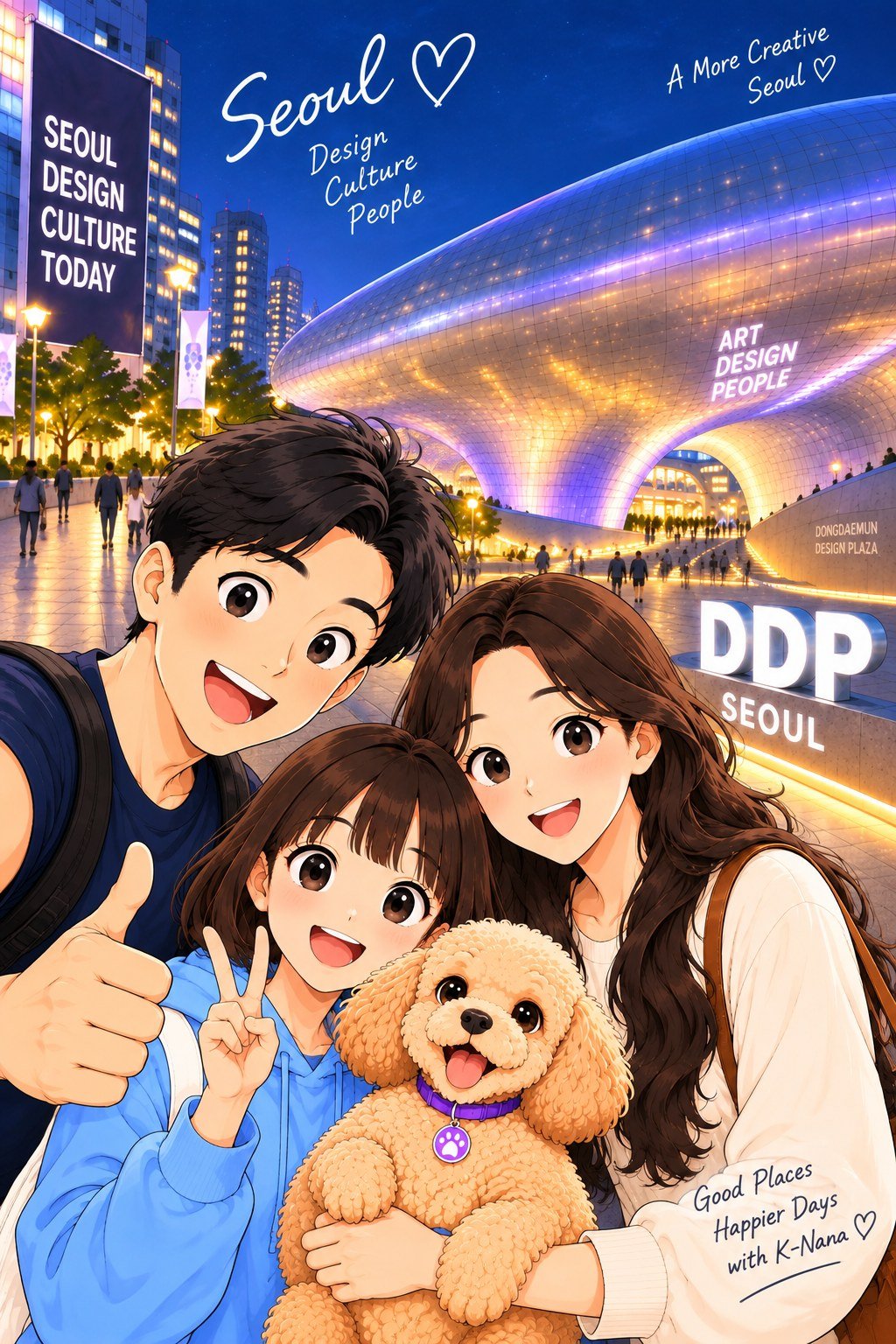
Discover futuristic architecture, design, and modern Seoul at Dongdaemun Design Plaza with the K-Nana family.
Quick Guide
| Location | Jung-gu, Seoul |
| Best for | Architecture, design, exhibitions, photography, fashion, evening walks |
| Recommended time | About 2–3 hours |
| Nearest subway | Dongdaemun History & Culture Park Station |
| Admission | Outdoor public areas are generally free; individual exhibitions and events may charge admission |
| Good to combine with | Dongdaemun, Gwangjang Market, and central Seoul |
What Is Dongdaemun Design Plaza?
Dongdaemun Design Plaza, usually abbreviated as DDP, is a major cultural and design complex in Seoul’s Dongdaemun district. The building was designed by architect Zaha Hadid with Samoo Architects & Engineers and opened in 2014.
Its flowing metallic exterior, large exhibition spaces, public plazas, design facilities, and surrounding urban landscape have made DDP one of the most visually distinctive contemporary buildings in Seoul.
Unlike a conventional attraction with a single viewing route, DDP can be experienced in several ways. Visitors can explore the exterior architecture, attend an exhibition or event, walk through public spaces, shop, or simply return after sunset to see the complex illuminated.
Why Visit?
DDP offers a very different side of Seoul from the traditional neighborhoods and heritage sites found elsewhere in the city.
- See one of Seoul’s most distinctive contemporary buildings.
- Explore architecture built around sweeping curves and open public spaces.
- Visit design, art, fashion, and cultural exhibitions.
- Enjoy photography during both daylight and evening.
- Experience the wider Dongdaemun shopping and fashion district.
- Combine DDP with nearby traditional markets and central Seoul attractions.
The Architecture of DDP
Architecture is one of the main reasons to visit Dongdaemun Design Plaza. Instead of relying on conventional straight façades and rectangular forms, the complex uses broad curves and interconnected spaces that create a continuous sense of movement.
The exterior changes depending on where you stand. Walkways rise and descend, large openings reveal other parts of the complex, and metallic surfaces respond differently to daylight, sunset, and artificial illumination.
For first-time visitors, walking around the outside before entering can be just as interesting as exploring the interior.

DDP’s flowing architecture creates a different view from almost every angle.
Walk Around the Exterior
There is no need to rush directly inside. The surrounding plaza, ramps, pathways, entrances, and curved façades are an important part of the DDP experience.
Walking around the building allows visitors to see how the structure interacts with the surrounding Dongdaemun cityscape. Depending on the route, the view can shift from a large futuristic landmark to smaller architectural details within only a few minutes.
Design, Art & Exhibitions
DDP functions as more than an architectural landmark. Exhibition halls and cultural spaces host changing programs connected with design, art, fashion, technology, media, and other creative fields.
Because exhibitions and events change throughout the year, the experience inside DDP can be different from one visit to another.
If a particular exhibition is important to your trip, check its current dates, opening hours, admission conditions, and ticket information before visiting.
A Place to Slow Down
Despite its futuristic appearance and busy urban location, parts of DDP can also provide a place to pause between sightseeing stops.
Seating areas, cafés, public spaces, landscaped sections, and views across the complex allow visitors to experience the architecture without constantly moving from one attraction to another.

DDP can also be enjoyed slowly from cafés and public spaces around the complex.
DDP & Seoul Fashion
Dongdaemun has long been associated with clothing, wholesale markets, shopping, and fashion. DDP adds a contemporary design and cultural landmark to that broader district.
Fashion-related exhibitions, events, photography, and the surrounding commercial area help connect the architecture of DDP with Dongdaemun’s wider identity.
Visitors interested in Korean fashion can therefore treat DDP as a starting point rather than the only destination in the neighborhood.
Photography at DDP
DDP is especially suitable for photography because the building changes dramatically with perspective and light.
Wide shots can emphasize the scale of the curved architecture, while closer angles reveal metallic surfaces, openings, ramps, reflections, and geometric details.
Late afternoon can be useful for experiencing the transition from daylight to illuminated evening scenery during one visit.

Changing light and modern architecture make DDP a popular place for photography.
DDP After Dark
Evening is one of the most visually memorable times to experience Dongdaemun Design Plaza. As daylight fades, lighting around the building, walkways, entrances, and surrounding city becomes more prominent.
The illuminated curves can create a completely different impression from the daytime exterior. Visitors arriving in late afternoon can experience both versions without making two separate trips.
Best Time to Visit
There is no single best time because DDP offers different experiences throughout the day.
Daytime is useful for seeing architectural details clearly and exploring surrounding areas. Late afternoon provides softer light and a gradual transition toward evening. Evening emphasizes illumination, city lights, and the futuristic character of the complex.
For a first visit, late afternoon into early evening is a practical choice if your schedule allows it.

Sunset and evening lights reveal another side of Dongdaemun Design Plaza.
How Long to Spend
About 2–3 hours is a useful starting point for a first visit.
Visitors who mainly want to see the architecture and take photographs may need less time. An exhibition, café stop, shopping, or exploration of the wider Dongdaemun area can easily extend the visit.
How to Get There
Dongdaemun History & Culture Park Station is the most convenient subway stop for DDP.
The station is served by Seoul Subway Lines 2, 4, and 5, providing convenient connections from many parts of the city.
Once you arrive, signs toward Dongdaemun Design Plaza make the complex straightforward to reach.
First-Time Visitor Tips
- Walk around the exterior before deciding where to enter.
- Consider arriving in late afternoon if you want both daylight and evening photographs.
- Wear comfortable shoes because the complex and surrounding district involve considerable walking.
- Check exhibition schedules before visiting if you want to see a specific program.
- Allow extra time if you plan to explore Dongdaemun shopping areas.
- Do not assume every exhibition or event is free.
- Look at the building from several angles rather than staying near one entrance.
From Gwangjang Market to DDP
DDP connects naturally with Gwangjang Market. Visiting the two during the same part of your Seoul itinerary creates a strong contrast between traditional market culture and contemporary architecture.
At Gwangjang Market, visitors encounter food stalls, textiles, vendors, and busy commercial passages. At DDP, the experience shifts toward modern design, architecture, exhibitions, fashion, and illuminated public spaces.
Continue Through Central Seoul
Travelers exploring central Seoul can also connect DDP with Ikseon-dong and Insadong.
Together, these places provide several very different views of the city: contemporary design at DDP, traditional market culture at Gwangjang Market, renovated hanok streets in Ikseon-dong, and crafts and cultural shopping in Insadong.
What to Do Nearby
- Gwangjang Market — Korean market food, textiles, shopping, and local atmosphere.
- Ikseon-dong — hanok cafés, restaurants, small shops, and narrow alleys.
- Dongdaemun shopping district — fashion malls, shopping, and commercial streets.
- Heunginjimun Gate — one of Seoul’s historic city gates.
- Cheonggyecheon Stream — an urban stream and walking route through central Seoul.
DDP vs Seoul’s Traditional Attractions
Visitors who have already explored Gyeongbokgung Palace or Bukchon Hanok Village will find DDP especially interesting because of the contrast.
Royal palaces and hanok neighborhoods introduce architectural traditions shaped by Korea’s history, while Dongdaemun Design Plaza represents a highly contemporary side of Seoul’s urban identity.
Experiencing both helps show why Seoul cannot be understood only as either an old or a modern city.
K-Culture Connection
Dongdaemun Design Plaza sits at the intersection of architecture, fashion, design, exhibitions, technology, photography, and contemporary urban culture.
For international visitors, DDP provides a useful introduction to the modern creative side of Korea while remaining close to traditional markets and historic areas.
FAQ
What does DDP stand for?
DDP stands for Dongdaemun Design Plaza.
Is Dongdaemun Design Plaza worth visiting?
It is particularly suitable for visitors interested in contemporary architecture, design, exhibitions, fashion, photography, and modern Seoul.
Is DDP free to visit?
Outdoor public areas can generally be explored without a general admission ticket. Individual exhibitions, events, and programs may require tickets or separate fees.
Is DDP better during the day or at night?
Both offer different experiences. Daylight reveals architectural details clearly, while evening illumination emphasizes the building’s futuristic appearance.
How long should I spend at DDP?
About 2–3 hours works well for many first-time visitors. Allow additional time for exhibitions, cafés, shopping, or the wider Dongdaemun district.
Which subway station is closest to DDP?
Dongdaemun History & Culture Park Station is the most convenient choice and is served by Lines 2, 4, and 5.
Related K-Nana Guides
Continue exploring Seoul with the K-Nana Studio guides to Gwangjang Market, Ikseon-dong, Insadong, Gyeongbokgung Palace, and Bukchon Hanok Village.
Official Information
Exhibition schedules, events, operating hours, admission fees, facility access, and individual programs at Dongdaemun Design Plaza can change. Check the latest official DDP and Seoul tourism information before visiting when a particular exhibition or event is important to your itinerary.
Image Credits
Dongdaemun Design Plaza family visual — K-Nana Studio original visual.
DDP architecture with Dad and Nana visual — K-Nana Studio original visual.
DDP café and city-view with Mom and Nana visual — K-Nana Studio original visual.
DDP design and evening with K-Nana daughter and Nana visual — K-Nana Studio original visual.
Nana at Dongdaemun Design Plaza visual — K-Nana Studio original visual.