
What Are K-Pop Generations?
K-Pop generations are informal labels used to divide K-Pop history into different eras.
You may hear fans, journalists, entertainment-industry observers, and other commentators describe artists as first-generation, second-generation, third-generation, fourth-generation, or part of a newer generation.
These labels can help explain how K-Pop changed over time, but they are not an official classification system with universally fixed start and end dates.
The most useful way to understand generations is as a map of K-Pop history rather than a set of strict rules.
If you are completely new to K-Pop, start with What Is K-Pop? for the broader definition of Korean popular music and its surrounding culture.
Why Do People Divide K-Pop Into Generations?
K-Pop has changed significantly across more than three decades.
The music industry, idol system, television environment, physical album market, digital distribution, social media, international promotion, fandom communication, concerts, and global audience have all developed over time.
Generation labels give people a convenient way to discuss groups that emerged under broadly similar industry conditions.
Instead of treating every year as a completely separate period, generations provide a rough historical framework.
Are K-Pop Generations Official?
No single industry-wide authority determines the official beginning and ending date of every K-Pop generation.
Generation labels are widely used, but their boundaries are conventions rather than formal regulations.
This is why two otherwise reliable sources can place the beginning of a generation in slightly different years or classify a group near a transition differently.
That disagreement does not necessarily mean that one source is completely wrong. It can reflect different ways of defining the historical transition.
Who Decides When a New Generation Begins?
No single person or organization decides for the entire K-Pop industry.
Generation language develops through repeated use by entertainment companies, media, fans, commentators, and the wider industry.
A company or media organization may describe a new artist as part of a new generation, but broader acceptance of that label develops through continued use.
This is one reason generational boundaries often become clearer in hindsight than they are at the exact moment a transition begins.
Why Are the Generation Boundaries Debated?
K-Pop does not transform completely on January 1 of a particular year.
Changes in music, technology, promotion, fandom, international expansion, and the idol system happen gradually.
A group debuting near a transition may begin under conditions associated with one era while becoming successful during changes associated with another.
As a result, the boundary between two generations can overlap.
This is why it is safer to use approximate periods rather than presenting one exact date as an unquestionable rule.
What About “2.5 Gen,” “3.5 Gen,” or Other Half Generations?
You may encounter expressions such as 2.5 generation, 3.5 generation, or other transitional labels.
These are informal ways of describing artists or periods that do not fit neatly into a simple generation boundary.
They are not official subdivisions recognized by one universal K-Pop authority.
Different communities may use these labels differently, and some people may not use them at all.
What Is First-Generation K-Pop?
First-generation K-Pop generally refers to the formative era in which the modern Korean idol-group system and organized idol fandom became established.
Discussions of this period often focus on the 1990s and early 2000s, although the exact starting point depends on how a source defines modern K-Pop and the idol system.
Some historical discussions emphasize the early-1990s transformation of Korean popular music, while others place greater emphasis on the agency-built idol-group system that became prominent later in the decade.
For beginners, the important point is not memorizing one disputed starting year. It is understanding that this period helped establish many structures later associated with K-Pop idols and fandom.
What Changed During the First Generation?
The early idol era helped establish practices that would become familiar in later K-Pop.
These included organized idol groups, agency management, coordinated performances, dedicated fan clubs, television promotion, and recognizable fan identities.
The technology surrounding fandom was very different from today’s environment.
Television, physical media, magazines, radio, and offline fan communities played much larger roles because today’s global social-media and streaming infrastructure did not yet exist.
What Is Second-Generation K-Pop?
Second-generation K-Pop is commonly associated with the period when the idol system became more established and Korean pop artists expanded their audiences more strongly across Asia and beyond.
Online video and digital media became increasingly important, helping performances and music reach listeners who were not watching Korean television directly.
This period is closely connected with the wider growth of the Korean Wave, or Hallyu.
Again, exact year boundaries vary depending on the source.
What Changed During the Second Generation?
K-Pop’s international reach became increasingly visible.
Artists promoted in overseas markets, international fan communities expanded, and online video made Korean music easier to discover outside Korea.
At the same time, physical albums, television music shows, official fan clubs, fan chants, concerts, and other established parts of idol culture remained important.
This combination of traditional Korean promotion and expanding digital access helped prepare the industry for much larger global growth.
What Is Third-Generation K-Pop?
Third-generation K-Pop is commonly associated with an era in which global fandom and digital communication became much more central to K-Pop’s international expansion.
Social media, online video, streaming, international touring, global fan communities, and increasingly visible worldwide chart activity changed how international audiences encountered K-Pop.
Artists could communicate with fans across national borders much more directly than in earlier periods.
The international audience was no longer simply an additional market at the edge of K-Pop activity. It increasingly became part of the everyday structure of fandom.
What Changed During the Third Generation?
The connection between K-Pop artists and global fans became faster and more continuous.
Music videos could reach worldwide audiences immediately, social platforms supported international fandom communities, and global touring became increasingly important.
K-Pop albums, merchandise, fan content, performances, and news also became easier for international audiences to discover and discuss.
This broader digital environment strengthened many of the global fandom practices associated with contemporary K-Pop.

What Is Fourth-Generation K-Pop?
Fourth-generation K-Pop is commonly used for a later digital-native period in which global online audiences, social platforms, performance content, streaming, and direct fan communication were deeply integrated into how new groups developed.
Many artists associated with this era entered an industry where international fandom was already an expected part of K-Pop rather than a distant future goal.
Short-form content, performance videos, online fan platforms, livestreaming, digital communities, and rapid international discovery became increasingly important.
However, the exact beginning of the fourth generation remains one of the boundaries that can vary by source.
What About Fifth-Generation K-Pop?
Fifth generation is now widely used in current K-Pop discussion for a newer wave of artists that emerged after the fourth-generation period.
The label has been used by entertainment and media organizations as well as fans, but this still does not create one official industry-wide calendar that fixes every group into an undisputed category.
Because this is a more recent period, its defining characteristics are still being discussed and interpreted as the industry develops.
It is better to describe fifth generation as an evolving contemporary label than to pretend that its complete historical meaning is already settled.
What About a Sixth Generation?
You may encounter claims that an even newer generation is beginning or has already begun.
Because generation labels are informal and partly shaped by marketing, media, fandom, and industry usage, new-generation claims can appear before a broad consensus exists.
For a beginner guide, it is safer not to declare a new generation as an established historical fact simply because one company, article, or fan community uses the term.
As K-Pop continues to change, future usage will determine whether newer generation labels become broadly accepted.
What Actually Changes Between Generations?
Generation discussions become more useful when you look beyond dates.
Changes can involve:
- Music and production trends
- The idol training and promotion system
- Television and music-show culture
- Physical albums and distribution
- Music videos and online video
- Streaming
- Social media
- Short-form content
- Artist-to-fan communication
- International touring
- Global marketing strategies
- Fan platforms and fandom organization
No single factor automatically creates a new generation.
Generation labels usually make the most sense when several changes begin to define a broader period together.
Are K-Pop Generations Based Only on Debut Year?
Debut year is one of the easiest reference points, but it does not explain everything.
When people discuss generations, they may also consider which artists debuted together, the media environment in which they grew, how fandom worked at the time, and which industry changes shaped their careers.
This is why groups near a generational boundary can sometimes be classified differently even when everyone agrees on their exact K-Pop Debut date.
The disagreement is often about the definition of the generation, not about the factual debut date.
Are Generations a Ranking of K-Pop Quality?
No.
First, second, third, fourth, fifth, and other generation labels are not rankings of musical quality, talent, popularity, cultural importance, or artistic value.
A later generation is not automatically “better” because it is newer, and an earlier generation is not automatically more important simply because it came first.
Each period developed under different technology, media, industry, and fandom conditions.
Generation labels are most useful when they help explain those historical differences rather than create competitions between artists from different eras.
Do Generations Have Different Music Styles?
Music trends can change across generations, but there is no single sound shared by every artist within one generation.
K-Pop itself includes many genres, production styles, concepts, and performance approaches.
Artists active during the same period can sound completely different from one another.
It is therefore safer to discuss musical trends associated with an era rather than saying that one generation has one fixed musical style.
How Did Technology Change K-Pop Generations?
Technology is one of the clearest ways to understand how the K-Pop environment changed over time.
Earlier idol fandom developed in an environment dominated more heavily by television, radio, physical media, magazines, and offline fan activity.
Later periods increasingly incorporated online video, social media, streaming, livestreaming, mobile platforms, short-form video, and dedicated fan platforms.
These changes affected not only how fans listened to music but also how quickly international audiences could discover artists and participate in fandom.
How Did Music Videos Change?
Music videos became increasingly important as digital video platforms made K-Pop easier to discover internationally.
A viewer no longer needed direct access to Korean television to encounter a new performance or release.
Music videos could circulate globally and become an important entry point for new fans.
K-Pop Music Videos explains concepts, choreography, teasers, performance versions, storytelling, views, and how music videos fit into a release cycle.
How Did Social Media Change K-Pop?
Social media reduced the distance between artists and international audiences.
Announcements, photos, videos, livestreams, short-form content, and fan discussions can now move internationally almost immediately.
This also changed how fandom communities organize themselves and how quickly information about a K-Pop Comeback, concert, album, or other activity can spread.
However, social media did not replace every older part of K-Pop culture. Television music shows, physical albums, concerts, merchandise, and offline fan activities remain important.
How Did Global Fandom Change?
International K-Pop fandom existed before today’s social platforms, but the scale and speed of global participation changed dramatically as digital access expanded.
Fans in different countries can now discover releases at nearly the same time, participate in online communities, buy albums internationally, follow translated information, watch performances, and communicate across borders.
The K-Pop Fandom Culture guide explains many of the practices that developed around these communities.
Global fandom is therefore one useful factor when discussing generational change, but it should not be treated as the only factor.
How Did Physical Albums Change?
Physical albums remained important even as music consumption became increasingly digital.
K-Pop albums developed into packages that can include photobooks, photocards, posters, multiple versions, and other collectible elements.
This means digital listening and physical collecting can exist together rather than one simply replacing the other.
The K-Pop Albums guide explains versions, inclusions, photocards, and physical album culture in more detail.
How Did Fan Participation Change?
Fan participation has existed across K-Pop generations, but the tools and platforms used by fans have changed.
Offline fan clubs, organized cheering, physical fan goods, and concerts developed alongside newer practices involving social platforms, digital communities, livestreams, global purchasing, short-form content, and dedicated fan services.
Practices such as K-Pop Fan Chants demonstrate how older forms of coordinated fan participation can continue alongside newer technology.
Generational change often adds new layers rather than completely erasing older ones.
How Should You Classify a Group Near a Generation Boundary?
Start by accepting that there may not be one universally agreed answer.
If a group debuted during a transition period, check how multiple credible sources describe it.
Pay attention to the context of the discussion. One article may emphasize debut year, another may emphasize industry change, and another may focus on how the group is commonly discussed within K-Pop media.
When the classification is genuinely disputed, describing the group as being near a generational transition can be more accurate than presenting one label as unquestionable fact.
Can One Group Be Called Different Generations by Different Sources?
Yes.
This happens most often with artists near generational boundaries.
The disagreement can result from different definitions rather than different knowledge of the group’s history.
When writing about a real artist, avoid presenting a contested generation label as though it were an official designation unless the context clearly supports that description.
Do Artists Change Generation as Their Careers Continue?
Usually, generation labels are associated with the period in which an artist emerged rather than changing every time the wider industry enters another era.
A group that continues performing for many years can therefore remain associated with its original generation while being active alongside much newer artists.
This is another reason generation and current activity status should not be confused.
An earlier-generation artist can still release new music, hold concerts, and participate in contemporary K-Pop.
Can Different Generations Be Active at the Same Time?
Yes.
K-Pop generations are not replacement cycles in which every artist from an earlier period disappears when a new generation begins.
Artists from several generations can release music, tour, appear on television, and maintain active fandoms during the same year.
The labels refer primarily to historical context, not to a rule about who is currently allowed to be active.
Why Does Understanding Generations Help Beginners?
Generation terminology appears frequently in K-Pop articles, videos, fan discussions, and artist introductions.
Understanding the basic idea helps you place an artist within a broader historical context without needing to memorize every group or debut date.
It can also help explain why artists from different eras experienced different media environments, fandom systems, international markets, and promotional tools.
The important skill is understanding the historical pattern rather than arguing over every boundary.
K-Nana Family Guide
Dad: Initially assumes there must be an official calendar showing the exact day one K-Pop generation ends and the next begins.
Mom: Notices that different sources can use slightly different boundaries and checks the context before treating a generation label as fact.
K-Nana Daughter: Explains that changes in music, media, technology, promotion, and global fandom help people describe different periods of K-Pop history.
Nana: Keeps the lesson simple: generations are a guide to K-Pop history, not an absolute rule.
Practical Tips for K-Pop Beginners
- Use generation labels as historical shorthand rather than official categories.
- Do not expect one universally accepted start and end year for every generation.
- Remember that boundaries can overlap.
- Expect groups near transition periods to be classified differently by different sources.
- Do not treat later generations as automatically better than earlier ones.
- Do not assume every artist within one generation has the same musical style.
- Look at media, technology, fandom, promotion, and global expansion as well as debut year.
- Treat half-generation labels such as 2.5 or 3.5 as informal terminology.
- Be cautious with claims that a brand-new generation has definitively begun.
- Remember that artists from several generations can be active at the same time.
- Use current and credible sources when a specific artist’s generation classification matters.
- When credible sources disagree, acknowledge the disagreement instead of inventing a precise boundary.
FAQ
What are K-Pop generations?
K-Pop generations are informal labels used to divide K-Pop history into broad eras based on changes in artists, industry conditions, media, technology, promotion, and fandom.
Are K-Pop generations official?
No. There is no single industry-wide authority that establishes universally fixed generation boundaries.
How many K-Pop generations are there?
First through fifth generation are commonly discussed today, while newer-generation claims can also appear. Because the system is informal, terminology continues to evolve.
What years are first-generation K-Pop?
It is generally associated with the formative idol era of the 1990s and early 2000s, but exact boundaries vary depending on the source and definition.
What years are second-generation K-Pop?
There is no universally fixed range. It is generally associated with the period following the first-generation idol era and the expansion of K-Pop and Hallyu across international markets.
What years are third-generation K-Pop?
Exact boundaries vary, but the label is commonly associated with an era of rapidly expanding global digital fandom, social media, streaming, and international touring.
What years are fourth-generation K-Pop?
There is no single official range. The term is commonly used for a later digital-native era in which global online fandom and social platforms were already central to new-group promotion.
Is fifth-generation K-Pop real?
Fifth generation is now widely used in contemporary K-Pop discussion, but its exact boundaries and defining historical characteristics remain open to interpretation.
Has sixth-generation K-Pop started?
Claims about newer generations can appear before broad agreement develops. It is safer to distinguish emerging terminology from an established historical consensus.
What does 2.5 generation or 3.5 generation mean?
These are informal transitional labels sometimes used for artists or periods that do not fit neatly into a simple generation boundary.
Can a K-Pop group belong to two generations?
A group near a transition can be classified differently by different sources. Rather than literally belonging to two official categories, it may be more accurate to say that its generational placement is debated.
Does a K-Pop group change generation as it gets older?
Usually not. Groups are generally associated with the historical period in which they emerged even if they remain active during later generations.
Is one K-Pop generation better than another?
Generation labels do not measure quality. Different eras developed under different musical, technological, promotional, and fandom conditions.
Why do K-Pop generations matter?
They provide a convenient framework for understanding how K-Pop’s industry, media, technology, international reach, and fandom changed over time.
Final Takeaway
K-Pop generations are useful historical labels, but they are not an official calendar with universally agreed boundaries.
First, second, third, fourth, fifth, and transitional generation terms help people discuss changes in the idol system, music, media, technology, promotion, international expansion, and fandom.
The boundaries can overlap, and artists near transition periods may be classified differently by different sources.
The most useful rule is simple: use generations to understand K-Pop history, not to turn history into a rigid ranking system.
Continue Exploring K-Pop
For the broader definition and development of the genre and culture, start with What Is K-Pop?.
To understand two systems that developed across different eras, explore the K-Pop Idol System and K-Pop Trainee System.
For how fan communities changed alongside media and technology, continue with K-Pop Fandom Names.
Continue With K-Pop Media
Next, K-Pop Music Videos explains concepts, choreography, teasers, performance versions, storytelling, views, and the role of music videos in a release cycle.
For television performance culture, Korean Music Shows explains prerecordings, broadcasts, rankings, encore stages, and audience participation.
For unfamiliar terminology across different K-Pop eras, use the K-Pop Glossary for Beginners.
References
- Korea.net — Korean Culture and K-Pop Information
- Korea.net — K-Pop Artists and the Idol System
- K-Culture Log — K-Pop Generations and Changing Era Boundaries
Image Credits
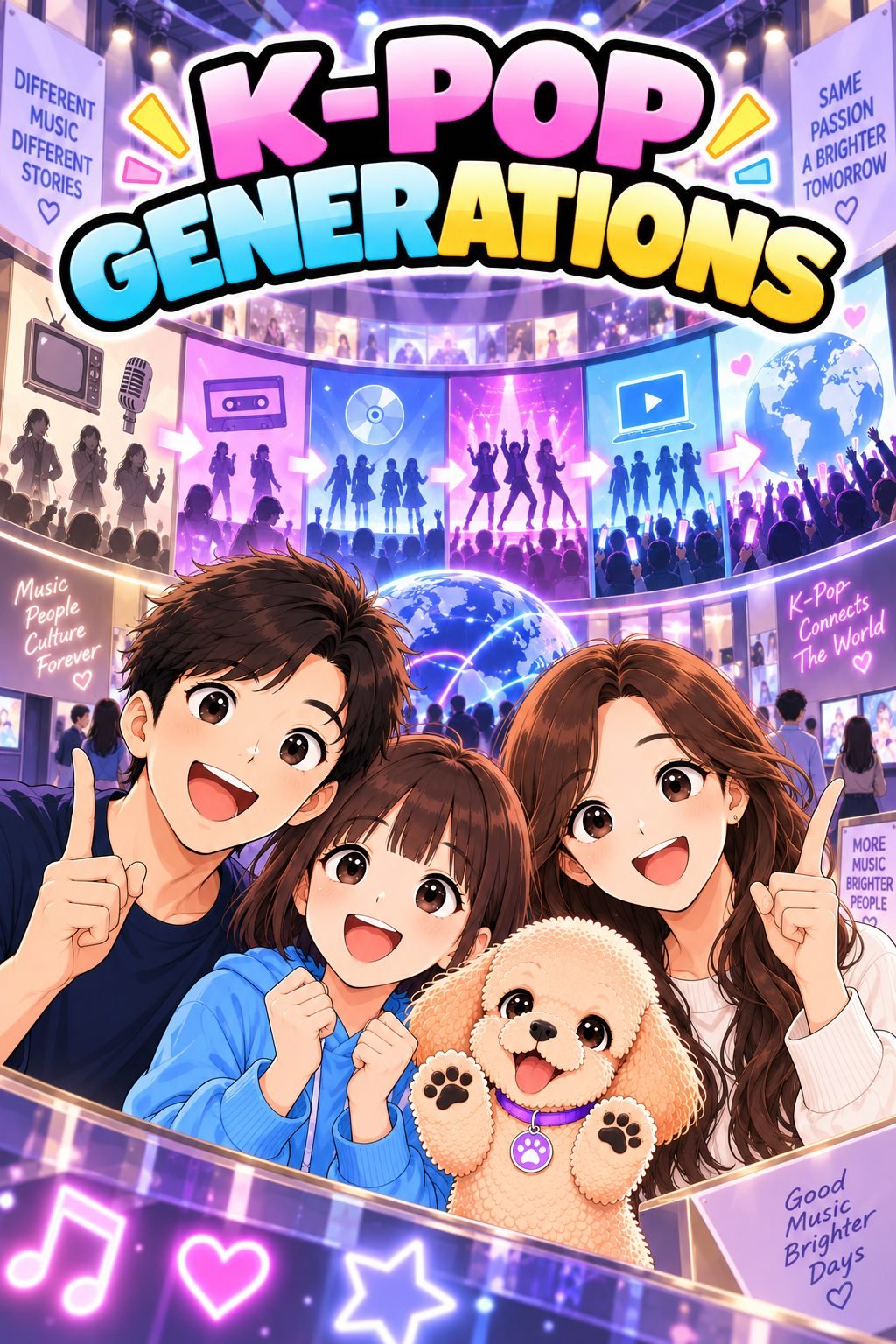
K-Pop generations family visual with Dad, Mom, K-Nana daughter, and Nana exploring a fictional timeline representing changes across K-Pop history — K-Nana Studio original visual.
K-Pop generations beginner visual with Dad and Nana learning that generation labels help explain historical periods rather than fixed official dates — K-Nana Studio original visual.
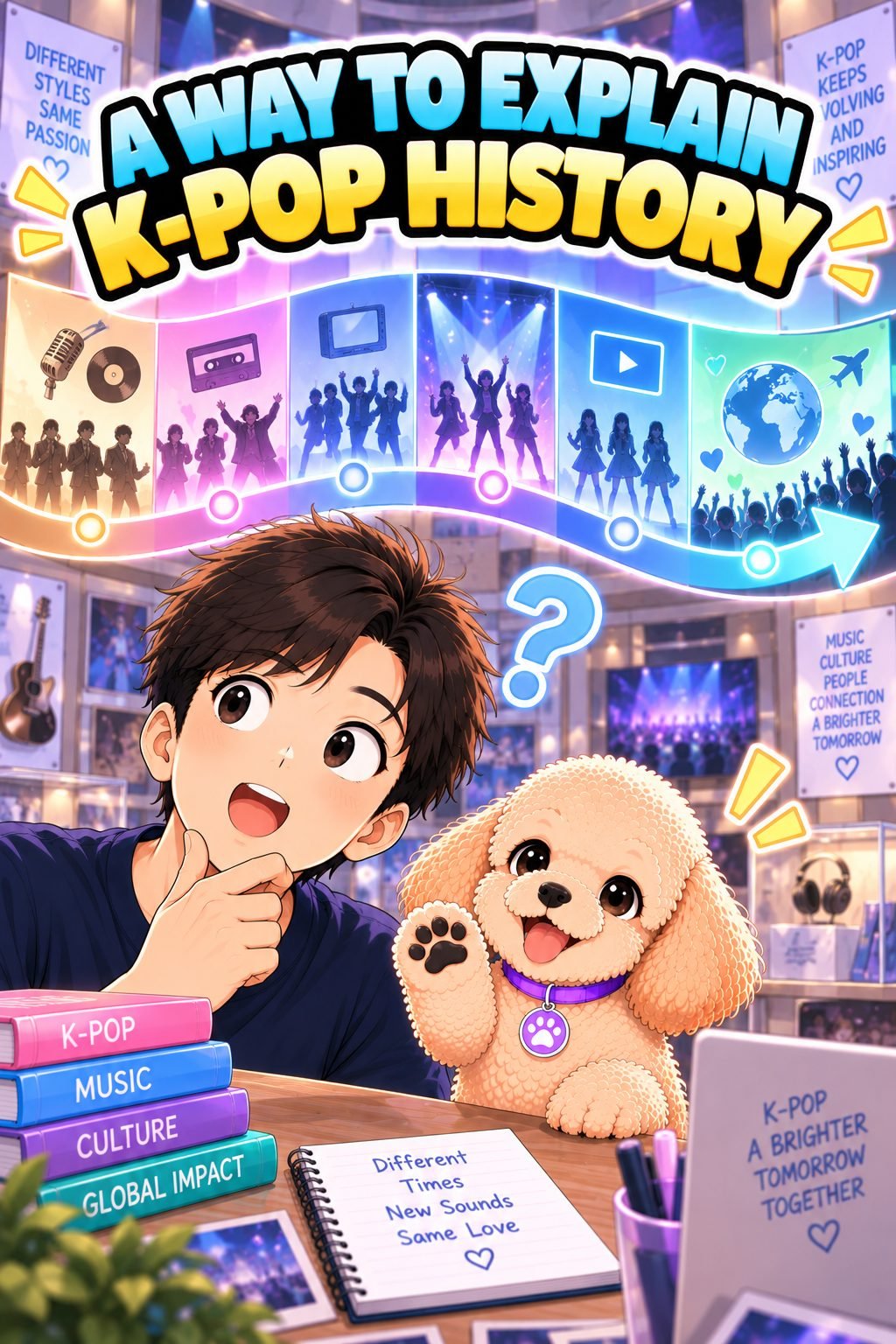
K-Pop generation-boundary visual with Mom and Nana exploring overlapping fictional eras to illustrate why generation boundaries can be debated — K-Nana Studio original visual.
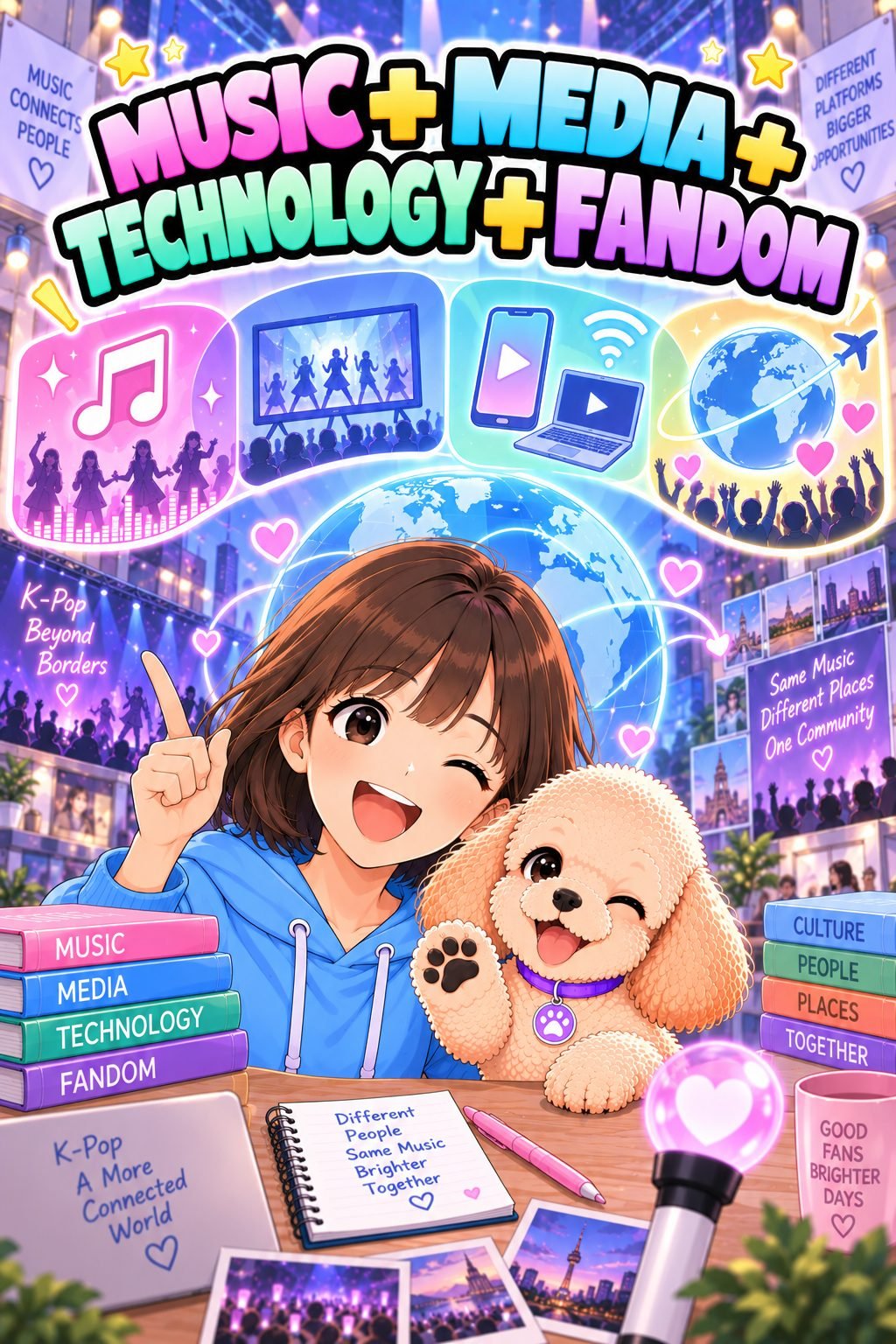
K-Pop historical-change visual with K-Nana daughter and Nana explaining how music, media, technology, and global fandom contribute to discussions of K-Pop generations — K-Nana Studio original visual.
Nana as the K-Nana Studio K-Pop mascot explaining that generation labels are useful guides to K-Pop history rather than absolute rules — K-Nana Studio original visual.
Disclaimer
This article is provided for general cultural, historical, and educational information about K-Pop generation terminology. K-Pop generations are informal historical labels rather than universally standardized industry classifications, and generation boundaries can vary between media, researchers, fans, entertainment companies, and other sources.
K-Nana Studio is not affiliated with or endorsed by any K-Pop artist, group, entertainment company, record label, broadcaster, fandom, media organization, or other entertainment-industry organization discussed in this guide.
Approximate generation periods and terms such as first generation, second generation, third generation, fourth generation, fifth generation, 2.5 generation, 3.5 generation, and newer-generation labels should not be interpreted as universally fixed official categories. When a specific real artist’s generational classification matters, consult multiple current and reliable sources and acknowledge meaningful disagreements where they exist.
Generation labels in this guide are not rankings of artists, groups, music, talent, popularity, commercial success, cultural importance, or fandoms. They are used only as a framework for discussing historical change.
All K-Nana family and Nana illustrations used in this article are K-Nana Studio original editorial visuals. They are not intended to depict or reproduce any specific real K-Pop artist, group, entertainment company, fandom, official logo, album artwork, stage, music video, costume, promotional image, or other protected official design.