
Korean Hot Bar is a convenient ready-to-eat snack commonly found in Korean convenience stores and other food retail settings. The name can refer to several types of individually portioned hot snacks rather than one single standardized recipe.
Depending on the product, a Hot Bar can be based on fish cake, sausage, processed meat, or a combination of ingredients and seasonings. Many products are designed to be heated and eaten quickly as a snack or small addition to a convenience-store meal.
For visitors to Korea, Hot Bar provides another look at everyday K-Food beyond restaurant dishes, packaged sweets, and instant noodles.

Korean Hot Bar represents a broad convenience-store snack category that can include fish-cake, sausage, and other ready-to-eat styles.
Quick Guide
| Korean name | 핫바 |
| Romanization | Hot Bar |
| Category | Korean convenience-store hot snack |
| Common forms | Fish-cake, sausage, processed-meat or mixed styles |
| Serving style | Product-dependent; commonly heated and eaten individually |
| Common setting | Convenience stores and food retailers |
| Important distinction | Hot Bar is a broad product category, not one fixed recipe |
| Consumer check | Ingredients, allergens, nutrition, storage and heating instructions |
What Is Korean Hot Bar?
Korean Hot Bar is a general convenience-food term used for individually portioned savory snacks that are easy to heat, hold, and eat.
The category can include products made primarily from fish cake, sausage, processed meat, or mixtures containing additional ingredients.
Because the term covers different products, appearance alone does not reliably identify the ingredients inside a particular Hot Bar.
Why Is It Called a Hot Bar?
The name is associated with a compact savory snack designed to be eaten warm and conveniently handled as an individual portion.
Some products are long and bar-like, while shapes, sizes, wrappers, sticks, and serving formats can differ.
The word therefore describes a convenience-food style more than one traditional Korean recipe.
Fish-Cake Hot Bar vs. Sausage-Style Hot Bar
Fish-cake-based Hot Bar can use processed fish paste with seasonings and other ingredients, while sausage-style products can use pork, chicken, beef, or product-dependent meat combinations.
Other products can combine cheese, vegetables, seafood, sauces, or additional ingredients.
Consumers should check the actual product label instead of assuming that every Hot Bar is fish cake or every Hot Bar is sausage.
Checking a Korean Hot Bar Package
The package is important because similar-looking products can have very different ingredient lists.
Check the exact product name, ingredients, allergen statement, nutrition panel, date labeling, refrigerated or frozen storage requirements, and heating instructions.
Meat type, fish or seafood ingredients, cheese, wheat, soy, egg, and other components can differ by product.

Checking the package helps distinguish fish-cake, sausage, meat, cheese, and other Hot Bar varieties before heating or eating.
Hot Bar & Korean Convenience Stores
Hot Bar fits naturally into Korean convenience-store culture because it provides a compact savory food that requires little preparation.
Depending on the store and product, Hot Bar can be sold refrigerated, frozen, or in another ready-to-heat format.
Product selection, price, heating method, and availability can differ between retailers and locations.
How Korean Hot Bar Is Heated
Heating instructions vary according to the product and packaging.
Some packaged products can provide microwave directions, while other formats can require different preparation or can be sold already heated.
Consumers should follow the exact package or retailer instructions and should not assume that every wrapper, stick, or container is suitable for microwave heating.

Heating methods differ by product, making the package instructions the safest guide for preparing a Korean Hot Bar.
What Does Korean Hot Bar Taste Like?
There is no single Hot Bar flavor because the category includes different base ingredients and seasonings.
Fish-cake varieties can emphasize savory seafood flavor, while sausage or meat-based products can have a different texture and seasoning profile.
Cheese, spicy seasoning, vegetables, sauces, and other additions can create further variations.
How to Try Korean Hot Bar for the First Time
Start by checking whether the product is fish-cake-based, meat-based, or another variety and review its heating instructions.
After heating, allow the Hot Bar to cool enough to handle and eat comfortably because the exterior and filling can retain significant heat.
Try a small bite first to understand the texture and seasoning before adding any optional sauce or pairing it with another convenience-store food.
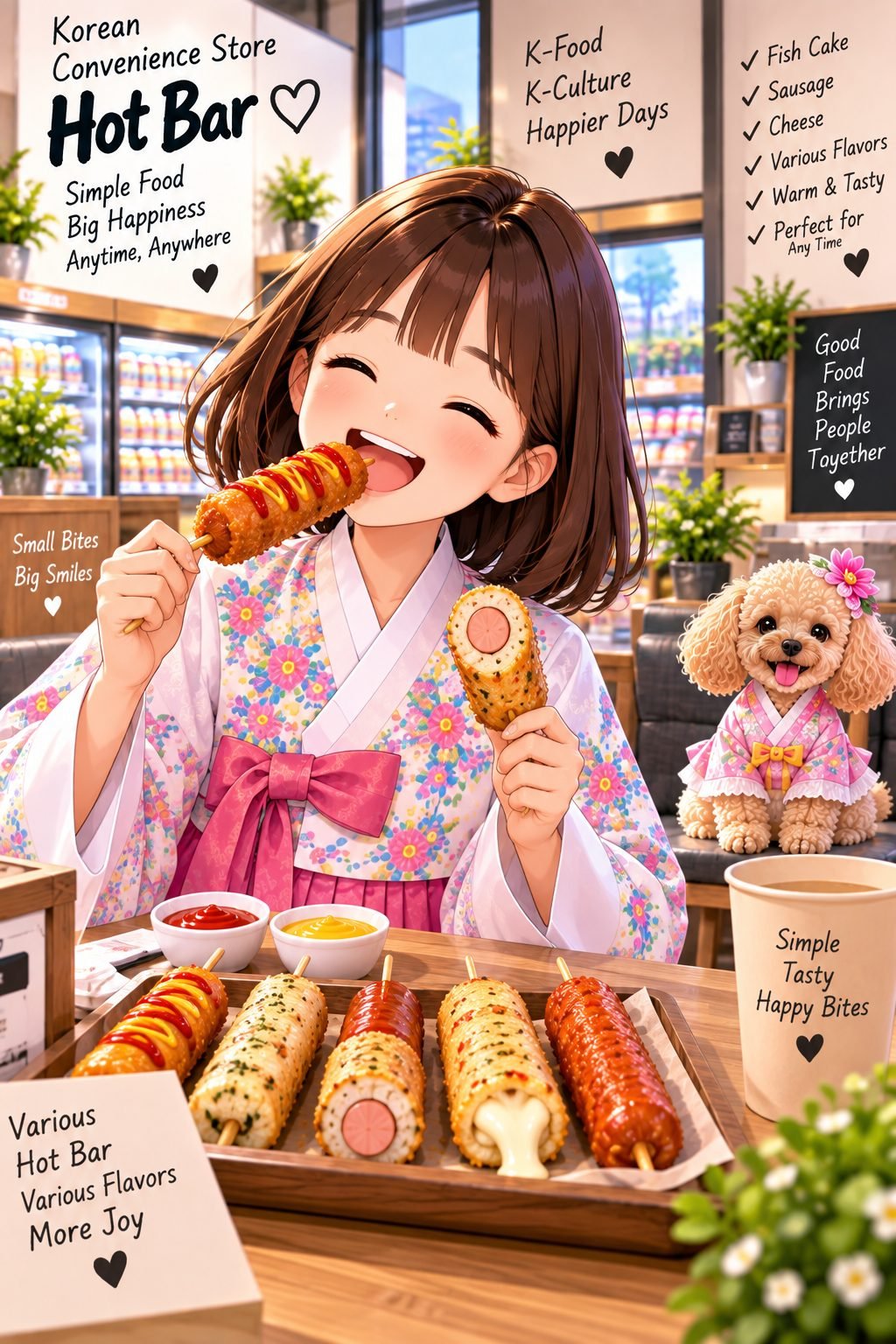
Fish-cake, sausage, cheese, and spicy varieties can create very different Korean Hot Bar experiences.
Korean Hot Bar as Everyday Convenience K-Food
Korean Hot Bar expands convenience-store K-Food beyond noodles, rice meals, drinks, and packaged sweets.
Its defining feature is flexibility: different products can provide different proteins, flavors, textures, and heating methods while remaining compact and convenient.
For K-Nana Studio, Hot Bar adds the ready-to-heat savory snack category to the growing guide to everyday Korean convenience-store food.
Different Korean Hot Bar Products
Korean Hot Bar is a broad convenience-food category, so products can differ significantly in their main ingredients and texture.
Fish-cake, sausage, processed-meat, cheese-filled, spicy, vegetable-mixed, and other styles can appear depending on the manufacturer and retailer.
The current package should be checked because similar shapes do not guarantee similar ingredients or allergens.
Korean Hot Bar vs. Eomuk
Eomuk is the broader Korean fish-cake food category and can be served in broth, on skewers, in side dishes, or in other preparations.
Some Hot Bar products can be fish-cake-based, but the term Hot Bar can also include sausage, meat, cheese, or mixed convenience products.
This means Hot Bar and Eomuk can overlap, but they should not be treated as identical categories.
Hot Bar & Samgak Gimbap
Samgak Gimbap provides a compact rice-based convenience food, while Hot Bar adds a warm savory snack with a different texture.
Combining the two can create a more substantial convenience-store meal, although ingredients, portions, allergens, and nutrition information depend on the individual products.
Hot Bar & Korean Cup Ramyeon
Korean Cup Ramyeon adds hot noodles and, depending on the product, broth or sauce to a convenience-store meal.
A Hot Bar can provide another savory component, but sodium, portion size, spice level, and other nutrition information should be checked when combining packaged foods.
Hot Bar as a Quick Korean Snack
Hot Bar can be useful when a full meal is unnecessary but a warm savory snack is preferred over sweets or cold packaged food.
Its compact format also makes it practical for work breaks, travel, or other situations where quick preparation and easy handling are useful.
The Complete Korean Hot Bar Experience
The Korean Hot Bar experience depends on the product: one version can emphasize fish cake, another sausage or meat, and another cheese, vegetables, or spicy seasoning.
What connects them is the convenient individual format and the ability to enjoy a warm savory snack with relatively little preparation.
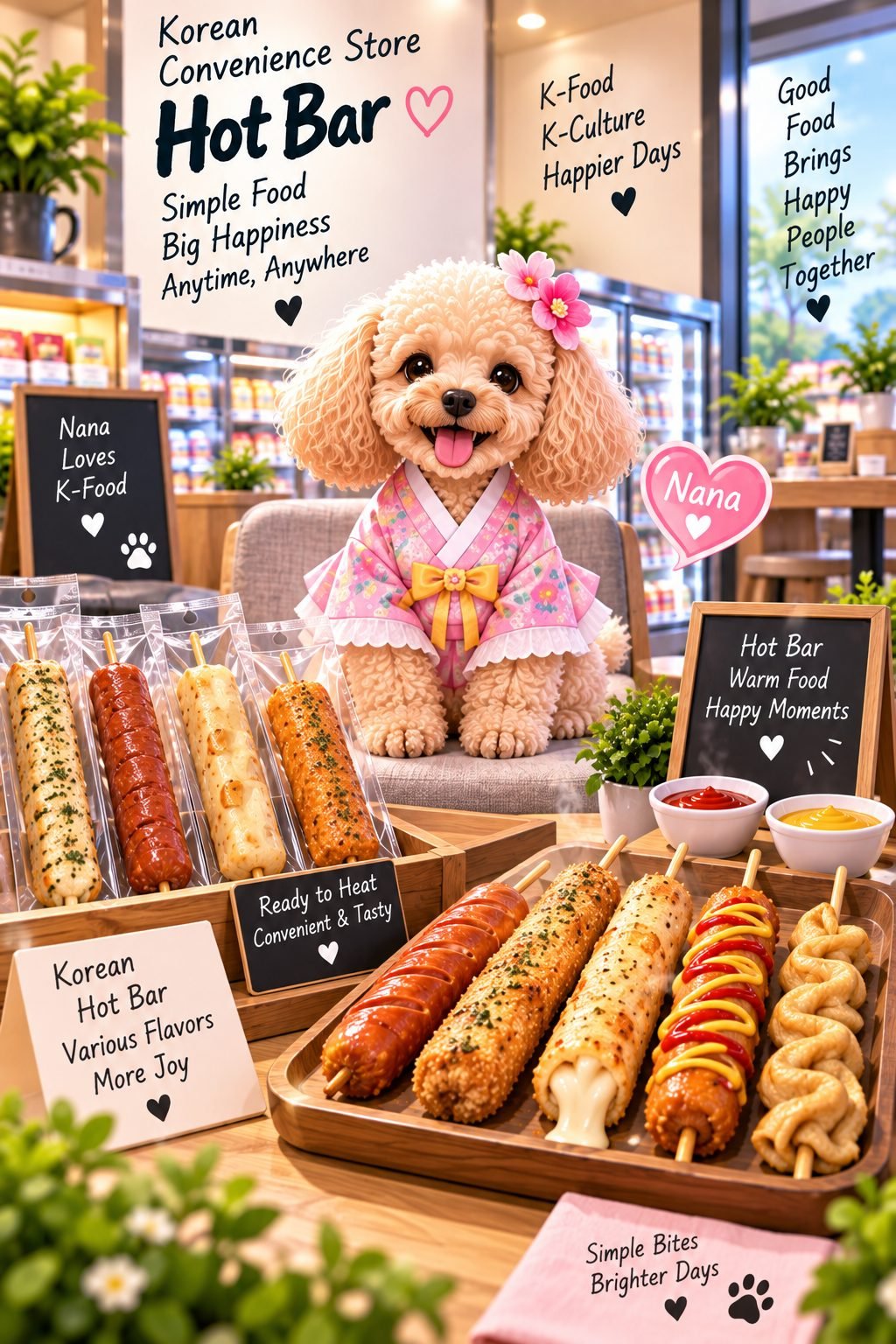
Korean Hot Bar brings fish-cake, sausage, cheese, and other savory styles into one convenient ready-to-heat snack category.
How Korean Hot Bar Connects with Other K-Food
Eomuk provides the closest connection for understanding fish-cake-based Hot Bar products.
Samgak Gimbap and Korean Cup Ramyeon expand the collection into Korean convenience-store rice and noodle meals.
Binggrae Banana Flavored Milk provides a ready-to-drink K-Drink connection, while Lotte Pepero represents packaged Korean snack culture.
Hot Bar in the Growing Convenience K-Food Collection
Korean Hot Bar adds a warm savory snack category to the K-Nana Studio convenience-food collection.
Together with Samgak Gimbap, Cup Ramyeon, packaged drinks, and K-Snacks, it helps show how varied an everyday Korean convenience-store meal can be without returning to restaurant-centered food content.
FAQ
What is Korean Hot Bar?
Korean Hot Bar is a broad convenience-food category for individually portioned savory snacks that are commonly heated and eaten warm. Products can include fish-cake, sausage, processed-meat, cheese, vegetable, or mixed styles.
Is every Korean Hot Bar made from fish cake?
No. Some Hot Bar products are fish-cake-based, while others can use sausage, pork, chicken, beef, cheese, vegetables, or other product-dependent ingredients. Check the specific package to identify the product.
Is Korean Hot Bar the same as Eomuk?
No. Eomuk is the broader Korean fish-cake category. Some Hot Bar products can be made from fish cake, but Hot Bar can also include other types of savory convenience snacks.
How do you heat a Korean Hot Bar?
Heating methods vary by product. Some packaged Hot Bars provide microwave instructions, while other products can use different preparation methods or may already be served warm. Follow the directions for the specific product.
Where can you find Korean Hot Bar?
Hot Bar products can be found in Korean convenience stores and other food retail settings. Product selection, ingredients, preparation methods, and availability vary by retailer and location.
Ingredients & Allergens
Korean Hot Bar products can contain fish, seafood, meat, wheat, soy, egg, milk, sesame, cheese, sauces, or other product-dependent ingredients and allergens.
Consumers with food allergies or dietary restrictions should check the current ingredient list and allergen statement on the exact product they purchase.
Fish, Meat & Product Differences
The appearance of a Hot Bar does not reliably identify whether it is made primarily from fish cake, pork, chicken, beef, another meat, or a mixture of ingredients.
People who avoid particular fish, seafood, meats, or animal-derived ingredients should confirm the specific product rather than relying on appearance or the general Hot Bar name.
Sodium & Nutrition Label
Sodium, calories, fat, protein, carbohydrates, serving size, and other nutrition values can differ substantially between Hot Bar products.
Use the current nutrition panel for the specific product rather than applying information from one Hot Bar variety to the entire category.
Heating & Eating Safety
Hot Bar can become very hot after heating, and cheese, sauces, or other fillings can retain heat inside even when the exterior appears ready to eat.
Follow the product’s heating directions, handle hot packaging carefully, and allow the food to cool to a comfortable temperature before taking a large bite.
Storage & Product Condition
Hot Bar products can have different refrigerated, frozen, or other storage requirements depending on the product.
Follow the storage directions on the package and check package integrity and date labeling before heating or eating.
Image Credits
Korean Hot Bar family convenience-food visual with Dad, Mom, K-Nana daughter, and Nana in hanbok enjoying different fish-cake and sausage-style savory Hot Bar snacks — K-Nana Studio original visual.
Korean Hot Bar package-check visual with Mom in hanbok reviewing ingredients, allergens, nutrition, storage, and heating information among different Hot Bar products while Nana watches from a separate safe seat — K-Nana Studio original visual.
Korean Hot Bar heating visual with Dad in hanbok safely preparing a convenience-store Hot Bar according to product instructions while Nana remains separated from the hot food and heating area — K-Nana Studio original visual.
Korean Hot Bar tasting visual with K-Nana daughter in hanbok enjoying a heated savory Hot Bar while different fish-cake and sausage-style varieties are shown and Nana sits separately — K-Nana Studio original visual.
Nana in pink floral hanbok seated separately as a K-Food mascot beside different Korean Hot Bar convenience snacks including fish-cake and sausage-style varieties — K-Nana Studio original visual.
Disclaimer
This article is provided for general food, cultural, and product information. Korean Hot Bar products, ingredients, allergens, meat or seafood content, nutrition information, heating instructions, storage requirements, package designs, and availability can vary by product, manufacturer, retailer, country, and time. Products can contain fish, seafood, pork, beef, chicken, wheat, soy, egg, milk, sesame, or other product-dependent ingredients and allergens, and shared manufacturing or preparation environments can present cross-contact risks. Consumers should check the current physical package for the exact product they purchase and follow its storage and heating instructions. Heated products and fillings can become very hot. People with food allergies, medical conditions, religious dietary restrictions, or other individual requirements should confirm current product information before consumption and follow appropriate professional guidance when necessary.