
What Is a K-Pop Subunit?
A K-Pop subunit is generally a smaller combination of members from an existing K-Pop group who carry out activities together as a unit.
For example, a group with several members may create a subunit featuring only two, three, or another selection of those members.
The subunit can release music, perform, create promotional content, or explore a concept that is different from the full group’s usual activities.
Most importantly, forming a subunit does not automatically mean that the members have left the original group.
If you are still learning how K-Pop groups are structured, start with K-Pop Group Roles.

Is a Subunit a New K-Pop Group?
Not necessarily.
A subunit usually exists in relation to a larger group. Its members are already associated with the full group and participate in a smaller combination for particular activities.
The subunit may have its own name, music, concept, visual identity, promotions, or performances, but that does not automatically make it completely separate from the original group.
The exact relationship depends on the artist and project.
Does Joining a Subunit Mean Leaving the Original Group?
No.
Subunit activities generally allow selected members to promote together while remaining members of the larger group.
After unit promotions, those members can participate in future full-group releases and activities.
This is one of the most important distinctions for beginners: subunit activity and group departure are different concepts.

Why Do K-Pop Groups Create Subunits?
There is no single reason.
A subunit can give artists and producers another way to use the members, music, and identity of a larger group.
Depending on the project, a subunit may be used to:
- Explore a different musical style
- Try a different concept
- Highlight a particular combination of members
- Focus on certain vocal, rap, or performance characteristics
- Create additional music between full-group activities
- Experiment with a different performance format
- Develop a separate unit identity within the larger group
These are examples rather than rules.
Different entertainment companies and artists can use subunits in very different ways.
How Are Subunit Members Chosen?
There is no universal selection method.
A unit may bring together members because of their voices, performance styles, chemistry, concept, age, language, market, creative direction, or another project-specific reason.
In some cases, the member combination itself may be the main creative idea behind the unit.
In other cases, the music or concept may come first and the lineup may be developed around it.
Do not assume that members are placed into a subunit because they are more or less important than other members.
Can a Group Have More Than One Subunit?
Yes.
A larger group can have several different subunits with different combinations of members.
Those units may explore different sounds, concepts, performance styles, or promotional goals.
Not every K-Pop group uses subunits, and there is no required number of units for groups that do.
Can the Same Member Be in Multiple Subunits?
Yes, depending on the group’s structure.
A member may participate in more than one unit if the artist’s overall system is designed that way.
Another member may participate only in full-group activities or in a different unit.
Subunit membership therefore should not automatically be treated as a permanent division of the full group into separate teams.

Can a Subunit Have a Different Music Style?
Yes.
One advantage of a smaller unit is the opportunity to explore music that may feel different from the full group’s usual releases.
A subunit might emphasize vocals, rap, performance, a particular genre, a different mood, or another creative direction.
However, a subunit does not have to sound completely different from the original group.
The degree of musical separation depends on the project.
Can a Subunit Have a Different Concept?
Yes.
Subunits can use concepts, styling, visual presentation, or storytelling that differ from the full group’s current image.
This can help show another side of the participating members without requiring the entire group to use the same concept.
Some units may have a very distinctive identity, while others remain closely connected to the full group’s overall style.
Does a Subunit Release Its Own Music?
It can.
Depending on the project, a subunit may release a single, digital track, EP, physical album, soundtrack contribution, or another form of music.
Some units promote their releases through performances, music shows, videos, or other content, while others may have more limited activities.
If you want to understand physical K-Pop releases and album formats, see K-Pop Albums.
What Is a Subunit Debut?
A subunit debut generally refers to the beginning of official activities by a newly introduced unit.
The members may already be established K-Pop artists because they previously debuted as part of the full group.
In this context, the word debut refers to the start of the unit’s official activities rather than the first professional debut of every individual member.
This is similar to the distinction explained in What Is a K-Pop Debut?, where an already debuted artist can later have a solo or unit debut.
Subunit Debut vs. Full-Group Debut
A full-group debut introduces the larger group as an official act.
A later subunit debut introduces a smaller member combination as its own activity within the broader group structure.
The members therefore do not erase or restart their previous career history when the subunit begins.
The two debut terms refer to different levels of the artist’s activities.
Subunit vs. Solo Activity
A subunit involves multiple members from a larger group carrying out activities together.
A solo activity centers on one individual artist.
A group member can potentially participate in full-group activities, a subunit, and solo activities at different points in their career.
Starting a solo career also does not automatically mean that the artist has left the group.
Full Group vs. Subunit vs. Solo
The simplest way to separate the three is:
- Full Group: the larger group lineup carrying out activities together.
- Subunit: selected members from the group carrying out activities as a smaller combination.
- Solo: one member carrying out individual artist activities.
These formats can exist alongside one another.
They should not automatically be interpreted as stages in which one replaces another.

Is a Subunit Permanent?
Not always.
Some subunits may release music repeatedly over several years, while others may be created for a particular project, period, concept, or limited set of activities.
A unit can become an important long-term part of a group’s identity, but temporary unit combinations can also exist.
Do not assume that every subunit follows the same activity schedule or lifespan.
Does the Full Group Stop While a Subunit Promotes?
Not necessarily.
Scheduling depends on the group, members, company, and project.
A subunit may promote between full-group releases, alongside other member activities, or during a period when the full group is less active.
The existence of a subunit alone does not prove that the full group has ended or permanently stopped activities.
Subunits and K-Pop Comebacks
A subunit that has already debuted can later release new music again.
Fans may describe that later release cycle as the unit’s K-Pop Comeback.
This means a larger K-Pop group can potentially have full-group comebacks, subunit releases, and solo releases within the broader careers of its members.
Understanding these layers makes K-Pop release schedules much easier to follow.
Do Subunits Have Their Own Names?
They can.
Some K-Pop subunits use a distinct unit name that separates their activities from the full group’s name, while others use a variation of the original group name or another project-specific label.
A separate name can make it easier for fans to identify the unit’s releases, performances, albums, and promotional activities.
However, there is no universal naming system for K-Pop subunits.
Do Subunits Have Their Own Fandoms?
Usually, the relationship between a subunit and fandom depends on the structure of the larger group and the way the project is presented.
Fans of the full group may naturally support its subunits as part of the same broader fandom.
Some units can also develop particularly active communities of listeners who enjoy that specific member combination or musical style.
That does not automatically mean every subunit has a completely separate official fandom name.
When an official fandom name or membership structure matters, check information from the relevant artist or entertainment company.
Do Subunits Have Their Own Albums?
They can.
A subunit may release music under the unit’s own name, including physical albums or other release formats depending on the project.
The album can have its own concept, packaging, photographs, tracks, and collectible inclusions while remaining connected to the wider group’s activities.
If you are new to physical releases, K-Pop Albums explains versions, photobooks, random inclusions, and other common album concepts.
Do Subunits Appear on Korean Music Shows?
They can.
When a subunit promotes a new release, it may perform through Korean television music programs in a similar way to other active K-Pop artists.
Whether a particular unit appears on music shows depends on its promotional strategy and schedule.
Music-show promotion is therefore possible but should not be treated as mandatory for every subunit release.
For the wider system, read Korean Music Shows.
Can Subunits Perform at Concerts?
Yes.
A full-group concert can include stages performed by smaller combinations of members, including established subunits or special unit stages.
Some subunits may also have other performances or events connected specifically with their own activities.
However, a special concert stage featuring only some members is not automatically an officially established subunit.
The context and official presentation of the project matter.
Subunit vs. Special Unit Stage
This distinction can be confusing for beginners.
An established subunit generally has an identifiable unit project or activity connected with selected members of the larger group.
A special unit stage may simply bring certain members together for one performance, concert, television appearance, collaboration, or temporary event.
Seeing two or three group members perform together once does not automatically mean a permanent or officially named subunit has been created.
Are Subunits Based on K-Pop Group Roles?
Sometimes member roles can influence a unit concept, but they do not have to.
For example, a project could highlight strong vocalists, rappers, dancers, or another member combination.
But a subunit can also be created around musical chemistry, concept, age, language, personality, creative direction, or another idea unrelated to traditional positions.
The K-Pop Group Roles guide explains why roles themselves should not be treated as rigid rankings or boundaries.
Does Being in a Subunit Make a Member More Important?
No.
Subunit participation should not automatically be interpreted as a ranking of members within the full group.
A particular project may require only certain members because of its music, concept, schedule, creative direction, or another practical reason.
Members who are not part of that unit can continue contributing through full-group, solo, acting, variety, songwriting, production, performance, or other activities depending on their careers.
Can Subunit Members Have Different Roles From the Full Group?
Yes.
A smaller lineup can change how responsibilities are distributed.
A member who has fewer vocal parts in the full group might sing more in a particular unit, while another member could take different performance responsibilities.
This does not necessarily mean the member’s official full-group position has changed.
The smaller combination simply creates a different performance structure.
Why Are Subunits Useful for Understanding K-Pop?
Subunits show that a K-Pop group does not always need to operate as one fixed combination for every activity.
The same group can support several creative formats: full-group releases, smaller units, solo projects, collaborations, and other activities.
This flexibility can give members opportunities to explore different music and performances while maintaining their connection to the larger group.
Once you understand this idea, K-Pop release schedules and artist discographies become much easier to follow.
K-Nana Family Guide
Dad: Initially thinks that members appearing in a subunit must have left the original group to form a new one.
Mom: Notices that subunits can have their own music, concepts, albums, and schedules while remaining connected to the full group.
K-Nana Daughter: Explains the difference between full-group activities, subunits, solo activities, and temporary special unit stages.
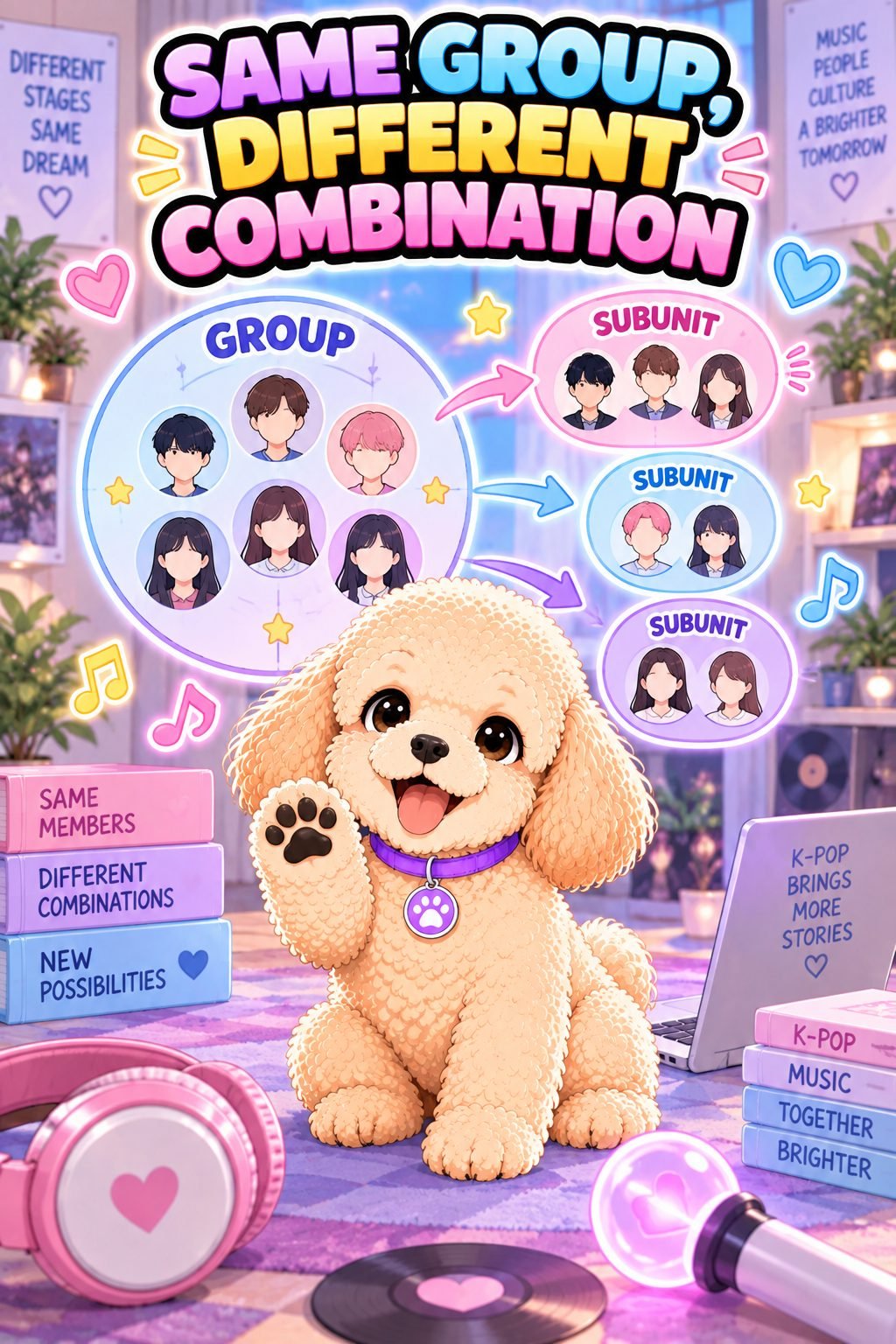
Nana: Keeps the lesson simple: same group, different combination.
Practical Tips for K-Pop Beginners
- Think of a subunit as a smaller member combination connected to a larger group.
- Do not assume subunit members have left the original group.
- Remember that not every K-Pop group has subunits.
- A group can have more than one subunit.
- The same member can potentially participate in multiple units.
- Subunits can explore different music or concepts.
- A subunit can release its own music or physical albums.
- Subunit debut does not erase the members’ previous full-group debut.
- Do not confuse subunit activity with solo activity.
- Do not assume every special stage is an official subunit.
- Do not treat subunit participation as a member ranking.
- Remember that unit roles can differ from full-group responsibilities.
- Do not assume every subunit is permanent.
- Check official artist information when the exact unit lineup or status matters.
FAQ
What is a K-Pop subunit?
A K-Pop subunit is generally a smaller combination of members from an existing group who carry out activities together as a unit.
Does joining a subunit mean leaving the group?
No. Subunit members generally remain connected to the full group and can participate in later full-group activities.
Why do K-Pop groups create subunits?
Subunits can explore different music, concepts, member combinations, performance styles, or other creative ideas.
Can a K-Pop group have several subunits?
Yes. Some groups have multiple units with different member combinations and concepts, while other groups have none.
Can one member be in more than one subunit?
Yes, depending on the group’s structure and projects.
What is a subunit debut?
A subunit debut is the beginning of official activities for a newly introduced unit. The individual members may already have debuted previously as part of the full group.
Does a subunit release its own albums?
It can. Some units release singles, EPs, physical albums, or other music under the unit’s own identity.
Can a subunit appear on music shows?
Yes. Some subunits promote releases on Korean music shows, although this is not required for every unit project.
Is a special concert unit always an official subunit?
No. Members can perform together temporarily for a special stage without forming an established or officially named subunit.
What is the difference between a subunit and a solo artist?
A subunit involves multiple members from a larger group, while solo activity centers on one individual artist.
Does being selected for a subunit mean a member is more important?
No. Unit lineups can reflect music, concepts, chemistry, schedules, or other project-specific decisions and should not automatically be interpreted as rankings.
Can a subunit have a different concept from the full group?
Yes. Exploring a different concept or musical direction is one possible reason for creating a subunit.
Is every K-Pop subunit permanent?
No. Some units continue for years, while others may be connected to a particular project or period.
Final Takeaway
A K-Pop subunit allows selected members of a larger group to carry out activities together in a smaller combination.
The unit may have its own name, music, albums, performances, concept, and promotional schedule, but subunit activity does not automatically mean that the members have left the original group.
Subunits can coexist with full-group and solo activities, and they can be long-term projects or temporary depending on the artist.
The easiest idea to remember is simple: same group, different combination.
Continue Exploring K-Pop
If you want to understand how member responsibilities differ inside the full group, read K-Pop Group Roles.
For the beginning of official artist activities, What Is a K-Pop Debut? explains why an already debuted member can later have a separate subunit or solo debut.
When a unit releases new music after its own debut, What Is a K-Pop Comeback? explains how later promotional cycles work.
Continue With K-Pop Beginner Concepts
Next, K-Pop Fan Chants explains how organized cheering can become part of music-show and concert performances.
For the broader structure surrounding groups, members, training, releases, and activities, use the K-Pop Idol System.
If unfamiliar terms appear while following group and unit activities, use the K-Pop Glossary for Beginners.
References
Image Credits
K-Pop subunit family visual with Dad, Mom, K-Nana daughter, and Nana learning how selected fictional members can carry out activities as a smaller unit within a larger group — K-Nana Studio original visual.
K-Pop subunit beginner visual with Dad and Nana learning that unit members remain connected to their original group — K-Nana Studio original visual.
K-Pop subunit concept visual with Mom and Nana exploring how a fictional unit can show a different musical or visual side of a larger group — K-Nana Studio original visual.
K-Pop activity-format visual with K-Nana daughter and Nana explaining the difference between full-group, subunit, and solo activities using fictional artists — K-Nana Studio original visual.
Nana as the K-Nana Studio K-Pop mascot explaining that a subunit can be understood as the same larger group using a different member combination — K-Nana Studio original visual.
Disclaimer
This article is provided for general cultural and educational information about common K-Pop terminology and artist activities. Subunit structures, member lineups, names, releases, concepts, promotions, music-show appearances, concert stages, fandom arrangements, and activity periods vary by artist, group, entertainment company, and project and may change over time.
K-Nana Studio is not affiliated with or endorsed by any K-Pop artist, group, subunit, entertainment company, record label, broadcaster, fandom, concert organizer, retailer, or other entertainment-industry organization discussed in this guide.
Terms such as subunit, unit debut, special unit, solo debut, and related expressions can be used differently depending on the artist and context. When the exact official status, lineup, name, or activity schedule of a real K-Pop unit matters, check current information from the relevant artist or entertainment company.
Subunit participation should not be interpreted as an objective ranking of members or as proof that a member has left the original group unless this has been confirmed through relevant official information.
All K-Nana family and Nana illustrations used in this article are K-Nana Studio original editorial visuals. They are not intended to depict or reproduce any specific real K-Pop artist, group, subunit, entertainment company, official logo, album artwork, costume, stage, music video, promotional image, or other protected official design.